

Victorian terraced streets are among Britain’s most recognisable urban landscapes. From the elegant white stucco terraces of West London to the long rows of red-brick workers’ houses that spread across much of the capital during the nineteenth century, they define the character of countless neighbourhoods. Their architectural features are well known—bay windows, decorative brickwork, slate roofs and original fireplaces—but one of their most important surviving features remains almost entirely invisible.
Hidden beneath the front gardens, footpaths and roads serving many of these properties lies infrastructure that was installed during the same period as the houses themselves. While roofs have been replaced, kitchens modernised and electrical systems rewired, the underground pipe carrying drinking water from the public water main to the property has often remained undisturbed for well over a century. In many cases, that original pipe was made from lead.
Lead water pipes were once regarded as the engineering standard. They were durable, flexible, easy to install and ideally suited to the rapid expansion of Britain’s urban water networks during the Victorian era. It would not be until the latter half of the twentieth century, as scientific understanding of lead toxicity developed and drinking water regulations evolved, that their widespread use would finally come to an end. Although lead pipework was prohibited for new installations in 1970, millions of homes constructed before that date still retain some or all of their original water supply infrastructure beneath the ground.
For London, this legacy is particularly significant. London experienced urban expansion on an exceptional scale during the Victorian period, and retains an extensive stock of nineteenth- and early twentieth-century housing. More than a million London dwellings were standing before the First World War.[7] Entire districts were developed during the decades when lead service pipes represented normal engineering practice. Today, these same neighbourhoods contain some of the highest concentrations of older housing in the country, creating a strong geographical overlap between historic construction and the potential presence of legacy lead pipework.
Modern public health research increasingly recognises housing age as one of the strongest indicators of environmental lead exposure. In England, analysis of childhood lead exposure undertaken by the UK Health Security Agency found that among children referred to the national surveillance system, those living in older housing had higher blood lead concentrations than those living in newer properties. The same study also found that terraced housing was substantially over-represented among reported cases, suggesting that the characteristics of Britain’s older urban housing stock continue to influence patterns of lead exposure decades after lead plumbing ceased to be installed.[1]
This does not mean that every Victorian house contains lead pipes. Many properties have already had their incoming water supply replaced, while others have undergone comprehensive redevelopment over successive generations. Equally, newer properties can sometimes inherit older infrastructure through previous site development or shared supply arrangements. Housing age alone cannot confirm the presence of lead pipework. What it does provide is one of the most useful and evidence-based indicators of where legacy plumbing is most likely to survive and where further investigation may be justified.
Understanding that relationship is becoming increasingly important. Water companies across the United Kingdom continue to reduce lead exposure through corrosion control treatment and targeted pipe replacement programmes, yet they also acknowledge that treatment alone cannot permanently eliminate the risk. Thames Water, whose network serves London and much of the surrounding region, has identified the replacement of legacy lead communication pipes as a long-term public health priority while recognising that customer-owned supply pipes remain a major part of the challenge. Permanent risk reduction ultimately depends on removing lead pipework from the drinking-water route altogether.
This article examines why London’s Victorian, Edwardian and inter-war housing occupies such an important place within that discussion. It explores the historical reasons lead became Britain’s preferred plumbing material, explains how Victorian terraces were originally connected to the water network, reviews the latest scientific evidence linking housing characteristics with lead exposure, and considers why London’s exceptional concentration of nineteenth-century housing continues to shape the city’s hidden water infrastructure today.
Only by understanding how these homes were built—and how much of that infrastructure still survives beneath them—can homeowners, surveyors, public health professionals and water companies make informed decisions about identifying and replacing one of the last remaining legacies of Victorian engineering.
Table of Contents
The rise of lead plumbing in Victorian Britain
To modern readers, it can seem extraordinary that a metal now recognised as a significant public health hazard was once regarded as one of the finest materials available for carrying drinking water. Yet for much of the nineteenth century, lead was not viewed as an inferior compromise or a dangerous necessity—it was considered the professional standard. Across Britain, and particularly within rapidly expanding cities such as London, lead pipework became an integral part of the engineering revolution that transformed public water supplies and brought piped drinking water to millions of homes.
The reasons were largely practical. Lead possesses a unique combination of physical properties that made it exceptionally well suited to nineteenth-century plumbing. It is soft enough to be shaped by hand, yet durable enough to remain watertight for decades. Unlike rigid cast iron, lead could be bent around obstacles, threaded through narrow trenches and connected to buildings without requiring complex joints or fittings. Long, continuous lengths could be installed with relatively simple tools, allowing plumbers to work efficiently in the crowded streets and confined building plots typical of Victorian towns and cities.
These advantages became increasingly important as Britain’s urban population expanded at an unprecedented rate. Between 1801 and 1901, the population of the area now covered by Greater London grew from roughly one million people to more than six and a half million. Both figures are stated on that modern boundary; the smaller Victorian administrative county was considerably less populous. Entire districts of terraced housing were constructed within only a few decades, each requiring reliable access to an increasingly sophisticated public water network. Water companies and local authorities needed pipe materials that were dependable, economical and practical to install beneath busy streets while also accommodating the irregular layouts of individual properties. Lead fulfilled those requirements remarkably well.
It is important to understand that Victorian engineers were not acting irresponsibly by the standards of their own time. Although concerns regarding lead poisoning had existed for centuries—particularly among miners, smelters and other industrial workers—the relationship between low-level lead exposure from drinking water and long-term health outcomes was poorly understood. Much of the contemporary debate focused on whether certain water sources were more “plumbosolvent” than others; in other words, whether some waters dissolved more lead from pipes than others. Hard waters rich in dissolved minerals often developed protective internal deposits that reduced corrosion, while softer, more acidic waters could dissolve greater quantities of lead. These observations were recognised long before the underlying chemistry was fully understood, but they were generally interpreted as problems of water quality rather than reasons to abandon lead pipework altogether. Troesken’s history of lead water pipes traces the same pattern across British and American cities: where water was hard and lead release low, the material was judged safe; where it was soft and aggressive, the water was blamed rather than the pipe.[2]
For Victorian plumbers, architects and engineers, lead remained a proven material with centuries of successful use behind it. Roman engineers had used lead extensively in aqueducts and domestic plumbing, and its continued use throughout Europe reinforced confidence in its suitability.[3] As Britain’s municipal water infrastructure expanded throughout the nineteenth century, lead naturally became the preferred material for the final connection between the public water main and individual properties. In many developments, cast iron mains distributed water beneath the street, while smaller lead communication and supply pipes carried water from the main directly into each house.
The widespread adoption of lead was also supported by the building practices of the period. Victorian terraces were typically constructed as large, uniform developments rather than as isolated individual houses. Streets were laid out, sewers installed, water mains extended and hundreds of properties connected in rapid succession. Standardised construction methods encouraged standardised plumbing, and lead became embedded within the physical fabric of these new neighbourhoods. Once buried beneath roads, pavements and front gardens, these pipes were expected to remain in service for generations.
That expectation largely proved correct. Unlike visible elements of a building, underground water supply pipes are rarely replaced unless they fail or become the subject of major redevelopment. Kitchens are modernised, bathrooms refurbished, boilers upgraded and electrical wiring renewed several times during a property’s lifetime, but the incoming buried supply pipe often escapes attention entirely. As a result, many of the decisions made by Victorian engineers continue to influence the condition of Britain’s drinking water infrastructure today.
By the middle of the twentieth century, however, scientific understanding of lead toxicity had advanced considerably. Research increasingly demonstrated that lead exposure could occur at concentrations previously considered insignificant and that children were particularly vulnerable to its effects on neurological development. As evidence accumulated, plumbing regulations gradually evolved, culminating in the prohibition of lead pipework for new drinking water installations in 1970.[5] Existing lead pipes, however, were not automatically removed. Instead, they remained underground wherever replacement was considered unnecessary or economically impractical, leaving a substantial legacy beneath millions of properties built before the ban.
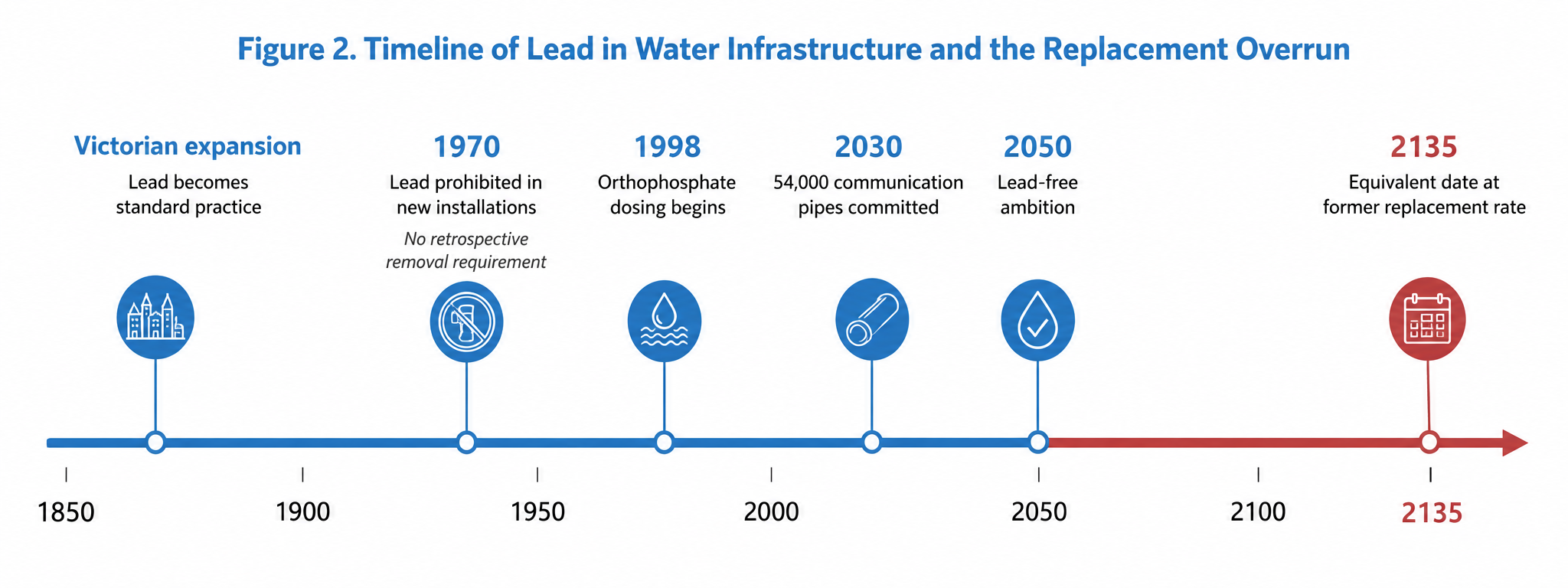
Lead in the water network, from Victorian standard practice to the 2050 ambition.
This historical context is essential to understanding why housing built before 1970 remains such an important focus for modern lead risk assessment. The issue is not simply that these houses are old. It is that they were constructed during the precise period when lead represented the accepted engineering solution for domestic water supplies, and much of that hidden infrastructure has survived long after the material itself fell out of favour.
Why Victorian terraced housing is different
Not all older homes present the same likelihood of retaining legacy lead water pipes. A detached Georgian farmhouse, an Edwardian suburban villa and a Victorian urban terrace may all have been built before the prohibition of lead plumbing, yet the way they were planned, serviced and subsequently altered over the past century has been very different. It is these differences—not simply the age of the buildings themselves—that make Victorian terraced housing one of the most important housing types when considering the potential presence of legacy lead pipework.
During the nineteenth century, Britain’s rapidly expanding industrial towns and cities faced an unprecedented demand for housing. Thousands of workers needed accommodation within walking distance of factories, docks and commercial centres, and developers responded by constructing long, uniform rows of terraced houses. Streets that had previously been fields were transformed into dense residential neighbourhoods within remarkably short periods of time. Entire terraces were often built by a single developer, using the same architectural plans, the same building materials and, critically, the same underground utility infrastructure.
Unlike many modern housing developments, where utilities are designed around individual plots and future maintenance is considered from the outset, Victorian services were installed as part of a single coordinated construction programme. Once the public water main had been laid beneath the street, individual properties were connected in sequence using the accepted plumbing methods of the day. Because lead was regarded as the preferred material for domestic water supplies, it became the standard choice for the communication pipes linking the public main to the property boundary and for the customer-side supply pipes carrying water into the house.
This created a degree of uniformity that still influences London’s underground infrastructure today. If one house within a Victorian terrace originally received a lead supply pipe, there is a strong possibility that neighbouring houses were connected using the same materials and construction methods. While individual properties may subsequently have undergone renovation or pipe replacement, the original pattern of infrastructure often survives across entire streets, making housing age and development history useful indicators when assessing the likelihood of legacy lead pipework.
The physical layout of Victorian terraces also encouraged the long-term survival of buried water pipes. Unlike internal plumbing, which is exposed whenever kitchens, bathrooms or heating systems are modernised, the incoming supply pipe lies beneath areas that are rarely disturbed. It typically runs under the public footway, through a narrow front garden or path and into the building below ground level. Unless there is a leak, a major extension or a complete replacement of the incoming water service, there is little reason for homeowners to excavate and renew this section of pipework.
This distinction is important because many homeowners understandably assume that previous renovation work has modernised the entire plumbing system. A house may contain new copper or plastic pipework throughout the kitchen and bathroom, a recently installed boiler and modern sanitary fittings, yet still receive its drinking water through an original buried lead supply pipe installed more than a century earlier. The visible plumbing and the underground infrastructure often tell two very different stories.
Victorian terraces are also associated with another characteristic that remains highly relevant today: shared water supplies. During the nineteenth and early twentieth centuries it was common for two or more neighbouring properties to share part of their incoming water supply before the pipe divided to serve each individual house. In some cases this arrangement reflected contemporary construction practices; in others it evolved as properties were subdivided, extended or converted into multiple dwellings during the twentieth century. Although many shared supplies have since been separated, a significant number remain in service across older urban neighbourhoods, particularly within London.

One pipe, several houses. Shared supplies commonly run along the rear of a terrace rather than connecting each property separately to the street.
Shared supplies introduce additional complexity when considering lead pipe replacement. Replacing the supply pipe serving one property may not remove all lead from the drinking-water route if neighbouring properties continue to share older sections of pipework. Similarly, identifying ownership and responsibility becomes more complicated where multiple households depend upon the same buried infrastructure. Modern replacement programmes therefore often require careful investigation to establish precisely how water reaches each property before any work can begin.
The pattern of redevelopment seen across Victorian housing has also contributed to the survival of legacy infrastructure. Unlike many twentieth-century housing estates, which were comprehensively rebuilt or redeveloped, large areas of Victorian London have been renewed gradually over many decades. Individual houses have been extended, converted into flats, restored to single-family occupation and refurbished countless times, but complete reconstruction of entire streets has been comparatively rare. As a result, underground services originally installed during the nineteenth century have frequently remained in place beneath successive generations of improvements above ground.
This incremental approach to renovation means that the age of the building often remains closely linked to the age of its buried infrastructure. While every property has its own history, Victorian terraces are more likely than many other housing types to retain original service routes, original connection points and, where replacement has never taken place, original pipe materials. That relationship between housing age and surviving infrastructure helps explain why modern public health researchers continue to use housing characteristics as practical indicators of potential lead exposure risk.
It is important, however, not to confuse probability with certainty. A beautifully preserved Victorian terrace may have had every section of lead pipe removed decades ago, while a less obviously historic property could still contain legacy pipework because parts of an earlier supply network were retained during redevelopment. The presence of Victorian architecture does not prove that lead pipes remain, just as the absence of visible period features does not guarantee they have been removed. Confirmation always requires inspection, testing or excavation where appropriate.
Nevertheless, when viewed across thousands of properties rather than individual houses, the pattern becomes clear. Victorian terraced housing represents the period of Britain’s urban expansion during which lead plumbing was at its most widespread, its streets were constructed using highly standardised infrastructure, and much of that underground network has survived successive generations of renovation. It is this combination of historical timing, engineering practice and long-term urban continuity that places Victorian terraced housing at the centre of today’s discussion about legacy lead water pipes.
London's Victorian housing legacy
London is a city defined to an unusual degree by the nineteenth century. While many European capitals rebuilt extensively after war or underwent comprehensive twentieth-century redevelopment, much of London’s Victorian housing stock has survived. From the grand terraces of Kensington and Westminster to the long rows of workers’ houses stretching across South, East and North London, the capital retains an exceptional stock of nineteenth-century residential streets. More than a million London dwellings were standing before the First World War, and in Kensington and Chelsea two houses in every three predate 1919.
This architectural legacy is often celebrated for its character, craftsmanship and historic value. Yet beneath these streets lies another legacy that receives far less attention: the underground infrastructure installed when these neighbourhoods were first built. Water pipes, drains, gas mains and other buried services were constructed to support a rapidly expanding city, and while many components of those networks have been renewed over successive generations, others remain remarkably unchanged.
For drinking water supplies, this period coincided almost exactly with the widespread use of lead pipework. As London’s water companies expanded their distribution systems throughout the nineteenth and early twentieth centuries, lead became the preferred material for connecting individual properties to the public water main. Every new terrace required hundreds of metres of underground pipework, and because developments were typically constructed as complete streets rather than isolated houses, the same engineering standards were applied across entire neighbourhoods.
The significance of this historical overlap becomes clearer when London’s housing stock is examined today. Unlike many towns where older housing has been progressively replaced by lower-density suburban development, London continues to contain exceptionally large concentrations of homes built before the prohibition of lead plumbing. Across many boroughs, Victorian and Edwardian terraces remain the dominant form of residential development, meaning that substantial numbers of properties were originally connected to the water network during the period when lead pipes represented standard plumbing practice.
Where legacy lead pipework is most likely to survive
Housing age is the strongest indicator available of where lead service pipes remain, because lead was standard practice for domestic connections until it was prohibited for new drinking-water installations in 1970. Buried supply pipes are rarely renewed unless they leak or a property is redeveloped. So the age profile of a borough’s housing stock estimates how much original pipework is still in the ground beneath it.
The table below ranks all 33 London local authorities on that basis, using Valuation Office Agency dwelling-age data.[7]
Two things it does not do. It does not identify individual properties—a Victorian terrace whose supply was renewed in 1985 carries no more risk than a new build, and a 1990s house on a redeveloped site can inherit older pipework. And it does not measure lead itself. It estimates where investigation is most likely to be worthwhile.
| Rank | Borough | Lead-era index | Pre-1919 | Pre-1970 | Terraced | Water supplier |
|---|---|---|---|---|---|---|
| 1 | Kensington & Chelsea | 76.7 | 65.9% | 82.2% | 12.8% | Thames |
| 2 | Hammersmith & Fulham | 68.6 | 56.3% | 73.2% | 18.8% | Thames |
| 3 | Haringey | 68.4 | 54.4% | 74.9% | 25.6% | Thames / Affinity |
| 4 | Waltham Forest | 65.8 | 45.7% | 75.5% | 34.7% | Thames |
| 5 | Westminster | 64.4 | 49.2% | 72.4% | 7.2% | Thames |
| 6 | Camden | 63.9 | 49.1% | 72.3% | 8.1% | Thames |
| 7 | Richmond upon Thames | 63.1 | 38.2% | 76.4% | 26.6% | Thames |
| 8 | Redbridge | 59.5 | 27.0% | 76.3% | 32.3% | Thames / Essex & Suffolk |
| 9 | Lambeth | 59.2 | 40.4% | 69.5% | 15.0% | Thames |
| 10 | Merton | 59.0 | 26.6% | 73.2% | 35.7% | Thames / SES |
| 11 | Wandsworth | 58.8 | 44.3% | 66.9% | 22.2% | Thames |
| 12 | Lewisham | 57.6 | 35.9% | 68.4% | 26.2% | Thames |
| 13 | Islington | 57.1 | 44.6% | 63.7% | 12.7% | Thames |
| 14 | Ealing | 57.0 | 28.5% | 69.4% | 23.4% | Thames / Affinity |
| 15 | Enfield | 56.7 | 23.4% | 73.3% | 28.9% | Thames |
| 16 | Brent | 56.3 | 28.1% | 66.4% | 14.9% | Thames / Affinity |
| 17 | Croydon | 55.3 | 28.7% | 69.9% | 23.3% | Thames / SES |
| 18 | Kingston upon Thames | 54.4 | 21.2% | 71.8% | 17.2% | Thames |
| 19 | Harrow | 53.9 | 10.3% | 73.9% | 16.9% | Affinity |
| 20 | Hackney | 52.6 | 35.5% | 63.1% | 13.9% | Thames |
| 21 | Barnet | 52.3 | 20.2% | 66.5% | 14.9% | Affinity / Thames |
| 22 | Newham | 51.1 | 38.0% | 55.8% | 31.3% | Thames |
| 23 | Bromley | 50.5 | 17.1% | 70.7% | 20.6% | Thames |
| 24 | Bexley | 50.5 | 10.9% | 71.9% | 23.6% | Thames |
| 25 | Sutton | 50.0 | 13.2% | 66.0% | 24.5% | SES |
| 26 | Barking & Dagenham | 49.2 | 4.1% | 71.5% | 41.6% | Essex & Suffolk |
| 27 | Hounslow | 46.9 | 16.6% | 61.0% | 20.5% | Thames / Affinity |
| 28 | Greenwich | 46.2 | 22.6% | 58.0% | 26.7% | Thames |
| 29 | Havering | 45.8 | 5.0% | 73.6% | 24.3% | Essex & Suffolk |
| 30 | Southwark | 43.5 | 26.0% | 52.1% | 14.3% | Thames |
| 31 | Hillingdon | 43.1 | 4.5% | 64.4% | 19.9% | Affinity |
| 32 | City of London | 38.9 | 22.0% | 50.9% | 1.6% | Thames |
| 33 | Tower Hamlets | 28.3 | 12.1% | 32.8% | 8.8% | Thames |
| England | 23.0% |
Kensington and Chelsea leads on housing age: 65.9% of its dwellings predate 1919 and 82.2% predate the 1970 prohibition. Hammersmith and Fulham, Haringey, Waltham Forest, Westminster and Camden follow, each with roughly half their stock built before the First World War. It does not lead on terraced share, and that difference is dealt with below.
More useful is where the two age measures disagree. Havering has 73.6% of its housing built before 1970 but only 5.0% built before 1919—it ranks ninth on one measure and thirty-first on the other. Barking and Dagenham shows the same pattern at 71.5% and 4.1%, as do Harrow, Bexley and Hillingdon. These are boroughs of interwar suburban expansion: Becontree, Metroland, the 1930s semi. They were built when lead was still standard, so lead-era prevalence is high, but they contain almost no Victorian housing.
The reverse holds in inner east London. Islington, Hackney, Southwark and Tower Hamlets all rank low on pre-1970 share despite substantial surviving Victorian terraces, because postwar estate building and recent high-density development diluted the proportion.
This matters for how a replacement programme is targeted. A pre-1970 cut points towards outer suburbia. A pre-1919 cut points towards inner London terraces. Both identify housing likely to have been connected using lead, and the difference between them is the difference between a 1930s semi with an original supply pipe and a Victorian terrace with the same.
Terraced share cuts differently again. Kensington and Chelsea sits twenty-ninth on it at 12.8%; its older housing is stucco villas, mansion blocks and conversions rather than workers’ terraces. The most terraced boroughs are Barking and Dagenham at 41.6%, Merton at 35.7% and Waltham Forest at 34.7%, against 23.0% for England as a whole.[8] Three boroughs rank high on housing age and terraced form together — Waltham Forest, Haringey and Redbridge — and those are where the two indicators reinforce one another.

Figure 1. Housing age is the strongest available indicator of where lead service pipes remain, because lead was standard practice for domestic connections until the 1970 prohibition and buried supply pipes are rarely renewed unless they leak or a property is redeveloped. The chart ranks all 33 London local authorities on that basis. It does not identify individual properties, and it does not measure lead. It estimates where investigation is most likely to be worthwhile.
Supply is not uniform across the capital
Thames Water supplies most of London but not all of it. Harrow and Hillingdon are served entirely by Affinity Water, Sutton almost entirely by SES Water, and Barking and Dagenham and Havering entirely by Essex and Suffolk Water. Barnet is majority Affinity.[9] Several boroughs are genuinely split: Brent divides roughly evenly between Thames and Affinity, Ealing around 61/39, Redbridge 69/31 between Thames and Essex and Suffolk, Croydon 83/17 with SES, Merton 88/12.
Wastewater is a separate matter, and a common source of confusion. Thames Water is the sewerage undertaker for effectively the whole capital regardless of who supplies the drinking water. A Sutton household has SES Water for supply and Thames Water for drainage. Anyone checking who is responsible for a lead communication pipe needs the water supply answer, not the wastewater one.
How the index is calculated
The index weights each dwelling-age band by the likelihood that a property of that period was originally connected using lead, and expresses the result as a percentage of known-age stock:
- Pre-1919 — weight 1.0
- 1919 to 1939 — weight 0.7
- 1940 to 1969 — weight 0.4
- 1970 onward — weight 0.1
Those weights are a professional estimate, not a measured prevalence. No dataset records what proportion of dwellings of each period were actually connected using lead, so the weighting reflects the documented history of lead as standard practice up to the 1970 prohibition rather than an observed rate. Every other input to this method is drawn from a published source. This step is judgement, and it should be read as such.
The practical consequence is that the ranking is more robust than the scores. The order in which boroughs appear is stable across any reasonable choice of weights, because it is driven by the underlying age profile rather than by the weighting applied to it. The scores themselves are index values rather than measurements, and a gap of a point or two between adjacent boroughs should not be read as a real difference in risk.
Source: Valuation Office Agency, Council Tax stock of properties, Table CTSOP 4.0 (Time Series), reference date 31 March 2024, published 11 July 2024.[7]
Three points on the method. CTSOP publishes no band covering 1940 to 1944, so the third weight applies to 1945–1969 in practice. The published 1965–1972 band straddles the prohibition date and is apportioned five-eighths to the pre-1970 side. Dwellings of unknown construction date are excluded from the denominator; this is under 1.5% of stock in most boroughs, rising to 4.6% in Southwark, 3.3% in Lewisham and 3.2% in Islington.
Supplier boundaries are from Ofwat’s digitised appointment areas, compiled with Ordnance Survey and published by the House of Commons Library.[9] Percentages are estimated from property coordinates by parliamentary constituency and apportioned to boroughs; because 27 of London’s 75 constituencies cross a borough boundary, they are approximations. Ealing and Hounslow are the least certain. Ofwat’s digital boundaries are not the legal record—the appointments themselves are.
Terraced share is from the 2021 Census, Office for National Statistics table TS044. It counts households rather than dwellings, so it is not directly comparable with the Valuation Office Agency columns, and it includes end-terrace as well as mid-terrace.[8] The England figure is 23.0%.
Housing age and water company practice
The relationship between housing age and potential lead pipework also aligns closely with the operational experience of water companies. Thames Water advises that properties built after 1970 are unlikely to have lead supply pipes because lead was no longer permitted for new drinking water installations. Older properties, however, may still contain lead communication pipes, private supply pipes or internal plumbing components that remain in contact with drinking water, particularly where no comprehensive replacement has taken place.
London’s housing history also creates another important characteristic that distinguishes it from many other parts of the country: continuity. Entire Victorian neighbourhoods remain substantially intact. Streets that were constructed within only a few years during the late nineteenth century often retain the same property boundaries, front gardens and underground service corridors today. Although buildings have been modernised above ground, the routes used by incoming water supplies have changed very little. This continuity means that infrastructure installed during the original construction phase has often remained in place simply because there has been little reason to disturb it.
The gradual nature of London’s redevelopment reinforces this pattern. Unlike post-war estates that were frequently demolished and rebuilt on a large scale, Victorian terraces have more commonly been refurbished, extended or converted one property at a time. Internal plumbing may have been renewed repeatedly, but the buried pipe connecting the property to the street frequently escaped attention. Unless leakage occurred or major excavation became necessary, replacement of the incoming water service was often deferred indefinitely.
This helps explain why housing age continues to be one of the most useful indicators when assessing the likelihood of legacy lead infrastructure. It is not simply that older houses were originally built with lead pipes. It is that the physical and historical development of London has allowed many of those original underground service routes to survive while almost every visible part of the building has evolved around them.
Understanding this distinction is essential. London’s Victorian housing stock should not be viewed as a public health problem in itself. Millions of these homes have already undergone partial or complete replacement of their incoming water supplies, while many others have benefited from broader infrastructure improvements over time. Equally, some newer properties may inherit older supply arrangements through redevelopment, conversion or shared service connections. Building age is therefore an indicator of probability rather than confirmation of pipe material.
Nevertheless, when considered at borough level, neighbourhood level or street level, the relationship between historic housing and legacy water infrastructure becomes increasingly valuable. It allows water companies, local authorities, surveyors and homeowners to prioritise inspections, target replacement programmes and better understand where the hidden legacy of Victorian engineering is most likely to remain. That principle underpins much of today’s public health approach to lead risk management—and it forms the basis for the scientific evidence examined in the following sections.
How lead water pipes contaminate drinking water
For much of the twentieth century, the assumption that lead pipes presented little ongoing risk rested on a simple observation: many households had used them for decades without obvious signs of illness. Unlike a burst pipe or contaminated water supply, lead contamination is invisible. Drinking water remains clear, odourless and usually tastes no different, even when it contains elevated concentrations of dissolved lead. The danger lies not in the appearance of the water, but in the chemical interaction between the water itself and the pipe through which it travels.
Lead does not simply dissolve continuously into drinking water at a constant rate. Instead, the amount released depends upon a complex interaction between pipe material, water chemistry, temperature, flow conditions and the length of time that water remains in contact with the internal surface of the pipe. Understanding these processes is essential because they explain why two neighbouring properties connected to apparently similar lead pipes may produce very different lead concentrations at the kitchen tap.
When water enters a lead pipe, small quantities of the metal can dissolve into the water or be released as microscopic particles from the pipe’s internal surface. The rate at which this occurs depends largely upon the corrosiveness of the water. Soft, slightly acidic water generally dissolves lead more readily than hard water rich in dissolved calcium and carbonate minerals, which tend to form protective deposits inside the pipe. This relationship between water chemistry and lead release has been recognised for well over a century and forms the basis of modern corrosion-control strategies used by water companies.
Contact time is equally important. Water that flows continuously through a pipe has relatively little opportunity to absorb lead. By contrast, water that remains stationary inside a lead pipe for several hours—overnight, during the working day or while a property is unoccupied—has far longer to interact with the pipe’s internal surface. As a result, the first water drawn from the tap after a prolonged period of stagnation often contains the highest lead concentrations. Once fresh water from the water main begins to flow through the pipe, concentrations usually decline.
This behaviour explains why lead contamination is rarely constant throughout the day. Samples collected at different times can produce markedly different results depending on recent water usage. It also explains why standard water quality testing follows carefully controlled sampling protocols designed to reflect realistic household exposure rather than simply analysing randomly flowing water.
Pipe condition introduces another layer of complexity. Many lead pipes have been in service for more than one hundred years. Over time, minerals naturally present in drinking water react with the internal pipe surface to form thin protective scales that can significantly reduce the amount of lead entering the water. These mineral deposits are one reason why many older lead pipes release considerably less lead than might otherwise be expected.
However, these protective layers are not permanent. Changes in water chemistry, physical disturbance during nearby excavation, pressure fluctuations or alterations to the plumbing system can damage or destabilise them, allowing increased quantities of lead to enter the water. Even relatively small changes to the drinking water environment may temporarily increase lead release until a new protective layer develops.
For this reason, modern water companies invest heavily in corrosion control rather than relying solely on pipe replacement. Across much of England, orthophosphate is added to treated drinking water before it enters the distribution network. Thames Water has dosed orthophosphoric acid since 1998 and now has dosing equipment at more than 92% of its treatment works[6]—an indication in itself of how widely lead pipework is distributed across its area. Rather than removing lead pipes, orthophosphate works by encouraging the formation of highly insoluble lead-phosphate minerals on the internal surface of the pipe. These deposits act as a barrier between the lead metal and the drinking water, reducing corrosion and limiting the amount of lead that can dissolve into the water supply.

How orthophosphate dosing forms a protective lead-phosphate layer inside the pipe.
This approach has been highly successful in reducing average lead concentrations across the public water network and remains one of the most important public health interventions introduced since lead plumbing began to be phased out. Nevertheless, corrosion control has an important limitation: it treats the symptom rather than the underlying cause. The lead pipe itself remains in place. Should the protective layer become damaged or water chemistry change, lead can still be released. As Thames Water acknowledges in its long-term water quality strategy, corrosion control cannot permanently eliminate the public health risk while lead pipework remains in contact with drinking water.[6] The company’s long-term objective is therefore the removal of lead communication pipes from the network alongside solutions for customer-owned supply pipes, recognising that permanent risk reduction ultimately requires removal of the source itself.
Another important consideration is that lead contamination is rarely the result of a single section of pipe. Drinking water travels through an entire pathway before reaching the kitchen tap. Depending on the age and history of the property, lead may be present within the communication pipe owned by the water company, the private supply pipe serving the property, internal lead pipework, lead-based solder used in historic plumbing repairs or even older brass fittings containing measurable amounts of lead. Removing one component of that pathway may substantially reduce exposure, but complete elimination often requires every remaining source of lead to be identified and addressed.
This helps explain why older housing continues to occupy such an important place in modern public health research. The question is not simply whether a lead pipe exists, but whether the combination of historic plumbing materials, water chemistry and ageing infrastructure creates opportunities for lead to enter drinking water. Understanding that mechanism provides the scientific foundation for the epidemiological evidence examined next.
Does living in older housing increase the risk of lead exposure?
The strongest modern evidence linking housing characteristics to lead exposure in England comes from the UK Health Security Agency’s analysis of the national childhood lead surveillance system. Published in 2022 by Crabbe and colleagues, the study examined children referred for public health management after elevated blood lead concentrations had been detected. It found an association between housing age and the levels of lead measured in those children, and that terraced housing was over-represented among them.[1]
Among the referred children, those living in older properties had higher blood lead concentrations than those living in newer homes. Terraced housing was substantially over-represented among the referred cases: 47% of the children lived in terraced homes, against 28% of the English housing stock — an observed-to-expected ratio of 1.68.[1] They were correspondingly less likely to live in flats or detached houses. The authors concluded that housing age and housing type can act as practical proxies for the likelihood of lead exposure, reflecting the greater probability that older dwellings still contain lead water pipes, lead-based paint, or other historic sources of the metal.
The study does not claim that every older or terraced house is hazardous, nor does it identify individual properties. It is based on children already referred into the surveillance system rather than a random population sample. What it does show is that, among those children who come to medical attention because of elevated blood lead, the characteristics of the housing they occupy differ markedly from the national picture. In other words, the same features that defined Britain’s urban expansion in the nineteenth and early twentieth centuries continue to shape patterns of exposure more than fifty years after lead plumbing was prohibited for new installations.
These findings sit alongside the operational experience of water companies and the engineering history of the water network. They do not replace the need for property-specific investigation, but they reinforce why housing age and typology are used as screening indicators when prioritising lead risk management.
One finding runs against expectation and is worth stating plainly. Housing built before 1900 was not over-represented among the referred children — it was under-represented, accounting for 15% of cases against 21% of the English housing stock.[1] The age band that carried the signal was 1900 to 1929, which the authors themselves describe as unexpected.
This matters less than it first appears, because blood lead in young children is dominated by ingestion, and in high-income countries the commonest route is flakes and dust from deteriorating lead paint rather than water. A surveillance sample of children with clinically raised readings therefore reflects where children encounter old paint and contaminated dust, which is a different question from where lead pipes remain buried. It is also consistent with the oldest housing having seen the most refurbishment.
Of the hazards that cluster in older housing, the buried supply pipe is the one that can be permanently removed. Paint can be sealed but remains beneath later coats. Household dust returns. Contaminated soil stays where it is. A lead service pipe, once replaced, is gone.
Two limitations bear on how much weight the study can carry. The surveillance system is passive and captures around five children per million — roughly 0.1% of the children in England estimated to have raised blood lead — so cases reaching it are likely to be the more severe. And the study found no association between housing age and blood lead when using Valuation Office Agency data, which describes small areas rather than individual properties; only the property-level Ordnance Survey dataset produced a signal.[1] The authors attribute this to brownfield development and post-war infill mixing housing ages within small areas, particularly in cities. That is a caution against diagnosing individual properties from area statistics, not an argument against using area statistics to decide where to look.
The hidden pipe beneath every Victorian home
The pipe that most often remains invisible is the customer supply pipe—the section that runs from the boundary, usually beneath the front garden or path, and into the building. In a typical Victorian terrace this length is short, rarely more than a few metres, yet it is the section most likely to have escaped replacement.
Because it lies outside the building envelope it is not renewed when kitchens or bathrooms are modernised. Because it is privately owned it is not automatically included when the water company replaces its own communication pipe. Because many terraces were originally laid out with shared supplies, even a complete renewal on one property can leave a neighbouring shared section in place.
The result is a hidden discontinuity: modern copper or plastic pipework inside the house, a modern communication pipe under the street, and between them an original lead supply pipe that has been in continuous service for more than a century.
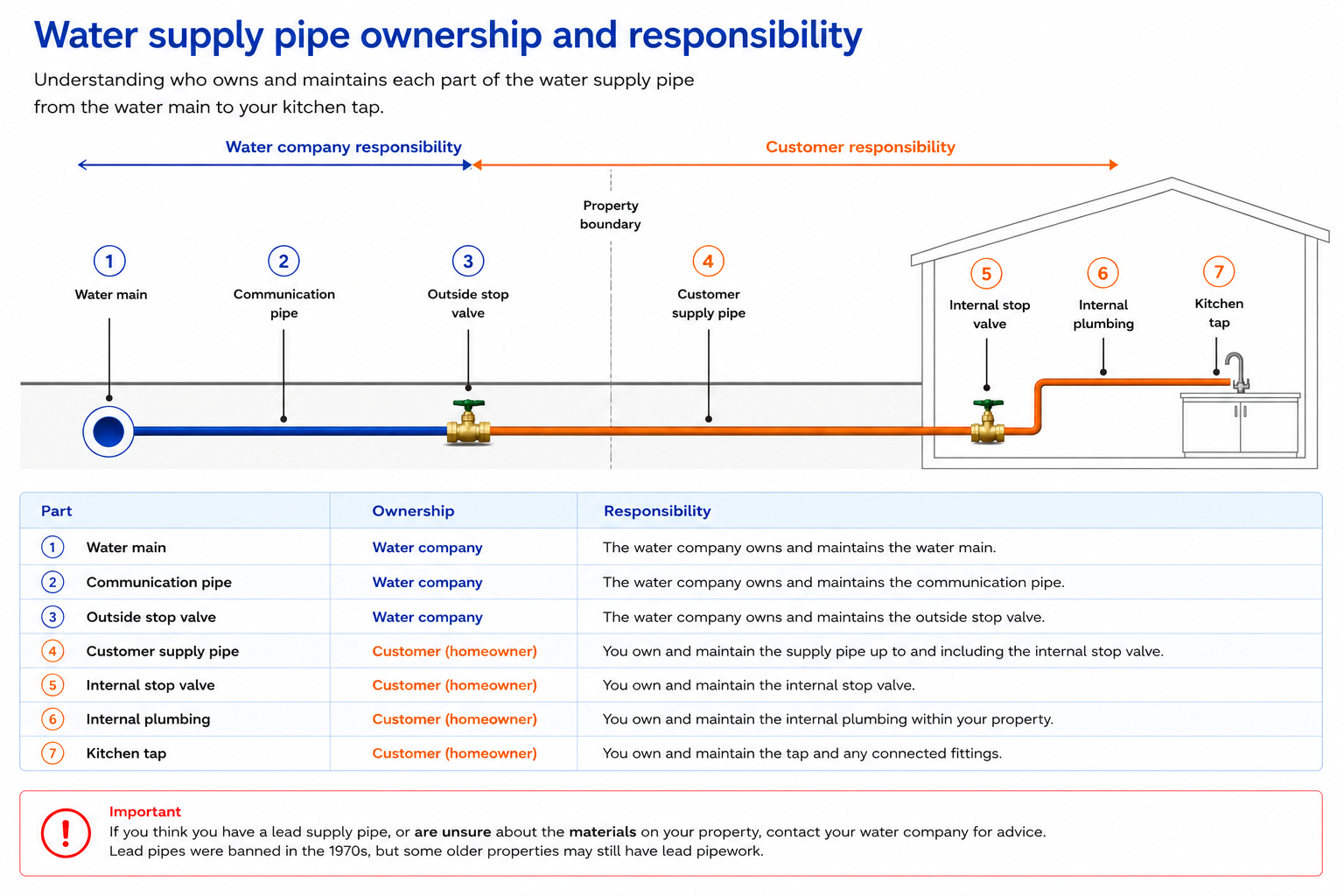
Who owns which section. Responsibility changes at the property boundary.
Water travels through that lead section every time a tap is opened. The only reliable way to establish whether it is still present is to combine the property’s construction date and renovation history with visual inspection of the entry point and, where necessary, professional tracing or limited excavation.
This short, buried length is among the most common remaining sources of lead in the drinking-water pathway of older housing generally. Identifying it—and replacing it when it is found—is the practical step that converts the statistical risk shown by housing-age studies into a permanent reduction of exposure at the individual property.
What homeowners can actually rely on
Water companies continue to operate lead replacement programmes designed to reduce long-term public health risk.
In practice, what a homeowner can rely on is narrower than is often assumed. There is no general scheme through which a private supply pipe can be replaced at the water company’s expense, and no application route for having a communication pipe replaced on request. Thames Water’s proactive programme targets areas the company selects, and its investment plan for 2025–2030 allocates no funding to customer supply pipe replacement as a programme of works.[6]
Two circumstances do carry a legal entitlement. Where a statutory sample at the tap fails the lead standard, the water company must replace its lead communication pipe. And where a homeowner has replaced their own supply pipe and a risk of lead in the drinking water remains, the same obligation applies—so a homeowner who renews their private section can require the company to renew the public one. Both obligations sit in the Water Supply (Water Quality) Regulations 2016.[11]
This is why sequencing matters. Replacing the private supply pipe first, then notifying the water company, converts an unfunded aspiration into an entitlement.
Why replacing only one pipe isn't enough
At first glance, replacing a lead water pipe appears to be a straightforward engineering problem. Remove the old pipe, install a new one and the issue is resolved. In practice, however, legacy lead plumbing rarely exists as a single isolated component. Instead, it forms part of an interconnected system that may include water company assets, privately owned supply pipes and internal plumbing installed over many decades. Unless the entire drinking-water pathway is considered, lead can remain in contact with drinking water even after substantial replacement work has been completed.
This distinction lies at the heart of modern lead management.
Historically, responsibility for the drinking water network has always been divided. Water companies are responsible for supplying wholesome drinking water to the property boundary, while homeowners are generally responsible for the pipework that carries water from the boundary into the building itself. In engineering terms, these are two separate assets with different owners, different maintenance responsibilities and, frequently, different replacement histories.
As a result, a property may receive water through a modern plastic communication pipe installed by the water company while still relying on an original lead supply pipe beneath the front garden. Equally, a homeowner may invest in replacing their own private supply pipe while an older lead communication pipe continues to connect the property to the public water main. In both situations, the amount of lead entering the drinking water may be significantly reduced, but the source has not been completely eliminated.
This challenge becomes even more complicated in older Victorian streets where shared supply arrangements remain. A homeowner may replace every section of pipe serving their own property, yet still receive water through a shared section of older pipe supplying neighbouring houses. Determining precisely where responsibility begins and ends therefore requires careful investigation before replacement work is planned.
These practical realities explain why modern water companies increasingly describe lead management as a whole-system problem rather than simply a pipe replacement programme.
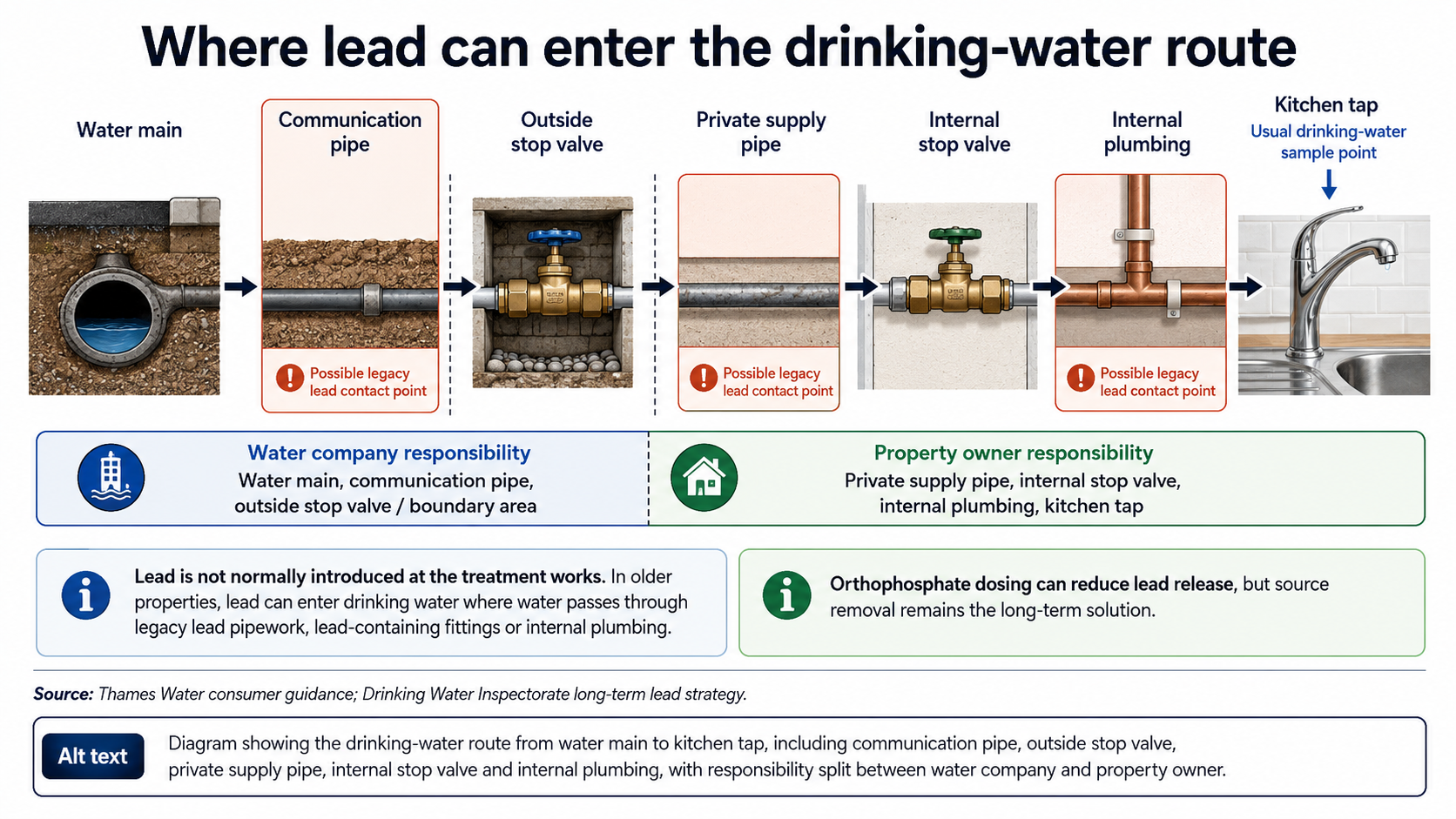
Every point on the route where drinking water can still meet lead.
Thames Water’s long-term water quality strategy makes this position explicit. The company states that lead detected at customers’ taps originates from lead pipes rather than the water treatment works, and that the long-term public health objective is to remove lead pipework from contact with drinking water. While corrosion control through orthophosphate dosing has substantially reduced lead concentrations over recent decades, Thames Water acknowledges that chemical treatment cannot permanently eliminate the underlying risk because the lead pipes themselves remain in the network.
To address this, Thames Water has committed to a long-term programme of replacing lead communication pipes across its network. The strategy estimated that around 1.15 million lead communication pipe connections remained within its operational area as of March 2025[6] and proposes a phased programme extending over multiple investment periods, targeting those customers considered to be at greatest public health risk first. The figure is a modelled estimate rather than a survey count. The scale of the task is such that, at recent replacement rates, the company calculates the work would not be complete until 2135—more than eighty years beyond its own target of removing all lead communication pipes by 2050.[6]
However, the strategy also recognises an equally important limitation.
Replacing the communication pipe alone solves only part of the problem.
Beyond the property boundary, the customer supply pipe remains privately owned. If this section is still constructed from lead, drinking water continues to pass through lead before reaching the kitchen tap. Thames Water therefore describes customer-owned supply pipes as one of the major unresolved challenges in achieving a genuinely lead-free drinking water system and has proposed customer trials aimed at encouraging and supporting homeowners to replace these private sections alongside water company works. The asymmetry in funding is stark. For the 2025–2030 period the company has costed a programme of 54,000 communication pipe replacements alongside a customer trial, but has allocated no expenditure to external or internal customer supply pipe replacement as a programme of works.[6] The trial is intended to establish how homeowners might be supported to replace their own pipework, with the findings feeding into planning for the following investment period.
This reflects a broader shift in thinking across the water industry. Rather than viewing lead replacement as a series of isolated engineering projects, utilities increasingly regard it as an integrated public health programme requiring cooperation between water companies, homeowners, regulators and approved contractors.
For homeowners, this has an important practical implication.
Replacing only the visible plumbing inside the house is unlikely to address the greatest remaining risk if the incoming buried supply pipe is still lead. Likewise, replacing only the customer supply pipe may still leave a lead communication pipe beneath the pavement. Even where both of these have been renewed, isolated sections of historic internal plumbing or older fittings may still warrant investigation.
The most effective approach is therefore to consider the entire drinking-water pathway from the public water main to the kitchen tap. Only by understanding every component of that route can surveyors and engineers determine whether lead remains in contact with drinking water and whether further replacement is required.
For older housing, where infrastructure has often evolved incrementally over more than a century, this whole-system approach is particularly important. Every property tells a different story. Some may have undergone complete renewal decades ago. Others may have experienced partial replacement during extensions, repairs or utility works, leaving a mixture of modern and historic materials within the same supply route. Without investigation, assumptions based solely on the appearance of visible plumbing can be misleading.
This is precisely why modern lead replacement programmes begin with identification before excavation. Understanding the route taken by the incoming supply, establishing ownership of each section and confirming the pipe materials involved are now recognised as essential steps before any replacement strategy is developed.
Ultimately, the goal is not simply to replace a pipe. It is to remove every remaining opportunity for drinking water to come into contact with lead. That objective underpins the long-term strategies of water companies, informs public health guidance and explains why complete, end-to-end replacement of legacy lead infrastructure remains the only permanent solution to one of the last surviving engineering legacies of Victorian Britain.
Does living in an older London home mean you have lead pipes?
After reading about London’s Victorian housing stock, the history of lead plumbing and the scientific evidence linking older housing with increased lead exposure, it would be easy to reach a simple conclusion: if a property is Victorian, it probably still has lead pipes.
The reality is more complicated.
Housing age is one of the strongest indicators available when assessing the likelihood of legacy lead pipework, but it is not confirmation that lead remains beneath any individual property. More than fifty years have passed since lead was prohibited for new drinking water installations, and during that time millions of older homes have undergone varying degrees of renovation, redevelopment and infrastructure renewal. Every property has its own history.
Some Victorian houses retain their original incoming water supply almost unchanged since the nineteenth century. Others have had only the internal plumbing modernised, leaving the buried supply pipe untouched beneath the front garden. Some have benefited from complete replacement of both the water company’s communication pipe and the privately owned supply pipe. Others have been rebuilt entirely, with little or none of the original infrastructure surviving.
This variation explains why public health researchers, water companies and surveyors all treat housing age as a risk indicator rather than a diagnosis. The age of a property tells us when it was built and therefore what materials were likely to have been used during its construction. It cannot tell us what has happened during the following hundred or more years.
For this reason, modern lead replacement programmes begin with investigation rather than excavation.
Water companies routinely use historic housing data, previous sampling results and network records to identify neighbourhoods where lead pipes are more likely to exist. These datasets help prioritise resources, but they do not replace physical inspection. Confirmation ultimately depends upon establishing the route of the incoming water supply and identifying the materials actually present.
This distinction is reflected throughout modern public health guidance. The UK Health Security Agency’s own analysis of childhood lead exposure treats housing age as a proxy for possible exposure, on the basis that older homes are more likely to contain lead water pipes, lead-based paint and other historic sources of lead. The emphasis is consistently placed on likelihood, not certainty.
The same principle underpins the borough-level housing analysis presented earlier in this article. Boroughs rank higher in the model where a greater share of their housing was built during the period when lead plumbing was standard practice. The model was never intended to identify individual houses with lead pipes, nor should it be interpreted in that way. It is a planning tool that helps identify where further investigation is most likely to be worthwhile.
There are several reasons why a Victorian property may no longer contain lead pipework.
The most obvious is previous replacement. During major renovations, extensions or redevelopment projects, owners sometimes replace the incoming supply pipe as part of wider plumbing works. In other cases, replacement occurs because of leakage, low water pressure or participation in a water company lead replacement scheme. Over time, these individual projects gradually reduce the number of remaining lead pipes within older neighbourhoods.
Infrastructure renewal by water companies also plays an important role. Where lead communication pipes have been identified through planned replacement programmes or following elevated lead results at customer taps, these sections may already have been replaced with modern polyethylene pipework. However, because the customer supply pipe remains privately owned, replacement on one side of the property boundary does not necessarily mean the other side has also been renewed.
Conversely, there are circumstances in which newer-looking properties may still contain older infrastructure.
Buildings that have been converted from earlier premises, constructed on previously developed land or connected to retained service routes can occasionally inherit elements of an older water supply system. While considerably less common than in Victorian housing, this illustrates why appearance alone is never a reliable guide to what lies beneath the ground.
For homeowners, the point is that assumptions work in both directions.
Assuming a Victorian property must contain lead pipes can lead to unnecessary concern. Assuming that modern internal plumbing proves lead has already been removed can create a false sense of security. Neither assumption is supported by the available evidence.
Instead, the most sensible approach is one based on investigation. The combination of property age, renovation history, visible plumbing materials, water supply arrangements and, where appropriate, professional inspection provides a far more reliable assessment than any single factor considered in isolation.
This balanced approach reflects the way engineers and public health professionals now assess legacy lead infrastructure. Housing age identifies where attention should be focused. Investigation establishes what is actually present. Only then can informed decisions be made about whether replacement is necessary and, if so, which sections of the drinking-water system require attention.
How to check whether your property has lead pipes
For most homeowners, the question is not whether lead pipes were once common—they clearly were—but whether they remain beneath their own property today. Unfortunately, there is no single indicator that can answer that question with certainty. The age of the building, the appearance of internal plumbing and even previous renovation work provide useful clues, but none of them can confirm the material of the entire drinking water supply.
The only reliable approach is to combine historical evidence, visual inspection and, where necessary, professional investigation. Fortunately, many potential lead pipes can be identified without excavation, allowing homeowners to build a much clearer picture before deciding whether replacement is required.
Start with the age of the property
The first question is simply when was the property built?
Properties constructed after the 1970 prohibition on lead pipework for new drinking water installations are unlikely to have originally been supplied using lead. Older buildings, particularly those dating from the Victorian, Edwardian and inter-war periods, are considerably more likely to have been connected using lead communication pipes, customer supply pipes or internal plumbing.
However, age should always be treated as a starting point rather than a conclusion. A Victorian house may have undergone complete renewal of its incoming water supply decades ago, while a later property may occasionally inherit older infrastructure through redevelopment or retained service connections. Building age establishes probability, not proof.
Examine the visible pipework
The easiest inspection begins inside the property, usually close to where the water supply first enters the building. In many houses this is near the internal stop tap, often beneath the kitchen sink, inside a utility room, under the stairs or within a cellar or basement.
If an exposed section of the incoming pipe is visible, its material may provide valuable evidence. Lead pipes have several distinctive characteristics:
- They are dull grey rather than bright copper or silver.
- They are relatively soft and can often be marked carefully with a coin.
- Unlike copper, they do not develop the familiar green oxidation associated with older copper plumbing.
- They were traditionally joined using wiped lead joints rather than modern compression fittings.
Older lead pipework also typically has a slightly larger outside diameter than modern copper pipes serving the same purpose and often appears less perfectly straight because of the material’s flexibility.
However, visible inspection has obvious limitations. In many modernised homes only a very short section of the incoming supply remains exposed, while the remainder disappears beneath floors or walls. It is entirely possible for a short section of visible copper to have been connected to an older buried lead supply pipe during previous plumbing work.
Don't assume new internal plumbing means the supply has been replaced
This is perhaps the most common misconception encountered during lead pipe surveys.
Many Victorian properties have undergone extensive internal refurbishment over the past fifty years. Bathrooms have been modernised, kitchens remodelled, boilers replaced and visible plumbing renewed in copper or plastic. These improvements often create the impression that the entire water supply has already been upgraded.
Unfortunately, this is not always the case. Replacing internal plumbing is generally far less disruptive than replacing the buried incoming supply. A plumber installing a new kitchen rarely has any reason to excavate the front garden or replace the pipe running beneath the pavement. As a result, it is entirely possible for drinking water to travel through an original lead supply pipe before entering a completely modern internal plumbing system.
This is why the incoming buried supply requires separate consideration from the visible plumbing inside the home.
Consider the property's renovation history
The history of the property can often provide useful clues. Questions worth asking include:
- Has the incoming water supply ever been replaced?
- Was the property extensively renovated or rebuilt?
- Have major extensions been constructed?
- Has the front garden been excavated for previous utility works?
- Was the property ever divided into flats or later converted back into a single dwelling?
Older documentation, building records or previous survey reports may occasionally record replacement of the incoming water supply. However, unless there is clear evidence that the complete supply route has been renewed, assumptions should be avoided.
Shared supplies require additional investigation
Victorian terraced housing introduces another complication that is often overlooked. Many older terraces were originally constructed with shared water supplies, where two or more neighbouring properties receive water through a common section of pipe before separate branches enter each house.
Even where one homeowner has replaced part of their own supply, sections of older shared pipework may still remain. This means that identifying the exact route taken by the incoming water supply becomes just as important as identifying the pipe material itself.
Professional surveys frequently include flow testing, stop valve isolation and tracer investigations to establish whether neighbouring properties continue to share part of the incoming supply. Understanding these arrangements is particularly important before replacement work begins, as they may influence both engineering design and discussions with adjoining property owners.
Water testing can help—but has limitations
Many homeowners assume that a laboratory water test will definitively determine whether lead pipes are present. In reality, water testing provides information about lead in the water, not necessarily lead in the pipework.
Lead concentrations vary considerably depending upon:
- how long water has remained stagnant,
- recent household water use,
- water chemistry,
- temperature,
- and the condition of any protective mineral deposits inside the pipe.
A low lead result does not prove that lead pipes are absent. Equally, an elevated result does not automatically identify where the lead originates within the supply route.
This is why sampling protocols matter. A test taken after water has stood in the pipe overnight tells you something quite different from one taken after the tap has been running, and a properly conducted test specifies which. Used correctly, a laboratory analysis is the only way to establish what is actually reaching the tap, and an accredited result carries evidential weight that visual inspection cannot.
Water sampling should therefore be viewed as one component of a broader investigation rather than a substitute for physical inspection. Where lead is detected above the regulatory standard, the water company is required to replace its own communication pipe[11]—so a test result is also the route to having part of the supply renewed at no cost to the homeowner.
Professional surveys provide the clearest picture
Where uncertainty remains, a professional survey offers the most reliable method of establishing whether lead pipework is present. Depending on the property, this may include:
- inspection of the incoming water supply,
- identification of visible pipe materials,
- tracing the route of the communication and supply pipes,
- investigation of shared supply arrangements,
- review of previous replacement work,
- assessment of stop valve locations,
- targeted water sampling where appropriate,
- and, if necessary, small exploratory excavations to confirm buried pipe materials.
Modern surveys aim to minimise unnecessary excavation by combining historical information with engineering knowledge of how Victorian water services were typically installed. In many cases, experienced surveyors can establish the likely configuration of the supply system long before any replacement work begins.
When excavation becomes necessary
Occasionally, visual inspection alone cannot determine the material of the buried supply. This is particularly common where:
- the incoming pipe disappears beneath solid floors,
- previous alterations have obscured the original route,
- several generations of plumbing modifications have been carried out,
- or shared supply arrangements complicate interpretation.
In these situations, limited excavation near the property boundary or external stop valve may be required to confirm the pipe material before replacement decisions are made.
Although excavation is often viewed as the final stage of investigation, it usually represents only a small part of the overall survey process. By the time excavation is undertaken, much of the engineering assessment has already been completed using the property’s history, visible pipework and knowledge of historic water supply layouts.
A structured approach is better than guesswork
Identifying lead pipework should never rely on a single observation. No individual factor—whether property age, pipe colour, renovation history or water test results—provides the complete answer. Instead, engineers build a picture by combining multiple pieces of evidence.
For any property built before 1970, that process usually begins with the age and history of the property, continues through careful inspection of the visible plumbing and incoming supply, considers the possibility of shared water services and, where appropriate, uses professional investigation to confirm the findings.
This systematic approach reflects the way water companies, surveyors and public health professionals now assess legacy lead infrastructure. Rather than assuming every older house contains lead pipes—or assuming every modernised house is free from them—it focuses on gathering evidence, understanding the complete drinking water pathway and making informed decisions based on the property itself.
Why early identification matters
For many homeowners, discovering that a property may contain lead water pipes can be unsettling. Yet identifying potential lead pipework should not be viewed as a cause for alarm. Instead, it should be seen as an opportunity to make informed decisions based on evidence rather than assumption.
One of the most important developments in modern public health has been the shift away from reacting to lead exposure after it has occurred and towards preventing exposure before it happens. Rather than waiting until elevated blood lead concentrations are identified, public health authorities increasingly advocate locating and removing potential sources of lead before they present a risk. This principle, known as primary prevention, underpins modern guidance from the World Health Organization, the UK Health Security Agency and drinking water regulators in the United Kingdom.
For homeowners, this means understanding the condition of the incoming water supply before problems arise.
Protecting those most vulnerable
Although lead exposure is undesirable at any age, not everyone is affected in the same way.
The greatest concern is for unborn babies, infants and young children. During early development, the brain and nervous system are particularly sensitive to lead, and research over many decades has demonstrated that even relatively low levels of exposure can affect neurological development. Because children absorb a greater proportion of ingested lead than adults and their brains are still developing, reducing unnecessary exposure during childhood remains a major public health priority.[4]
Pregnant women also represent an important group for prevention. Lead stored within the body can be mobilised during pregnancy, while reducing exposure to drinking water provides one practical way of minimising overall lead intake during this critical period.[4]
This does not mean that every older property presents a significant health risk, nor that families living in Victorian housing should become anxious. Rather, it reinforces the value of understanding whether legacy lead plumbing is present so that informed decisions can be made where appropriate.
Renovation is the best opportunity for replacement
One of the most practical times to investigate an incoming water supply is during planned building work.
Extensions, kitchen refurbishments, landscaping projects and driveway replacement frequently involve excavation or alterations close to the existing water supply. Incorporating supply pipe replacement into these projects is often considerably simpler than returning to excavate the same areas several years later.
Replacing a buried water supply while access is already available can reduce disruption, minimise reinstatement work and allow the entire plumbing system to be upgraded as part of a single coordinated project. For owners of Victorian, Edwardian and inter-war property, this integrated approach often represents the most practical opportunity to remove any remaining legacy infrastructure.
Buying or selling an older property
Property transactions provide another valuable opportunity to consider the condition of the incoming water supply.
Surveyors routinely comment on many aspects of a building’s construction, but buried services often receive relatively little attention because they are largely inaccessible during standard inspections. Where a property dates from the Victorian, Edwardian or inter-war period, understanding the material of the incoming supply can provide useful information for prospective purchasers, particularly if other renovation work is already planned.
For sellers, evidence that lead pipework has already been replaced can also provide reassurance to buyers who are increasingly aware of drinking water quality and older infrastructure.
Avoiding partial solutions
The clearest benefit of early identification is that it allows replacement to be planned properly.
Without understanding the complete route taken by the incoming water supply, there is a risk that only part of the system will be renewed. While partial replacement may reduce lead exposure, it may also leave older sections of lead pipework in service or create situations where future excavation becomes necessary to complete the work.
A structured survey undertaken before replacement begins helps identify:
- the material of the communication pipe,
- the material of the customer supply pipe,
- the presence of any shared supply arrangements,
- the location of stop valves,
- and the most appropriate replacement strategy.
This approach avoids unnecessary assumptions and enables replacement works to be designed around the actual configuration of the property rather than its apparent age alone.
Preserving London's historic housing while modernising its infrastructure
Victorian, Edwardian and inter-war housing forms an important part of London’s architectural heritage. Millions of people continue to choose these properties because of their character, craftsmanship and enduring appeal. Replacing legacy water infrastructure does not diminish that heritage; rather, it allows historic buildings to continue serving modern households safely while preserving the qualities that make them so desirable.
Throughout London’s history, these houses have adapted continuously to changing standards, and replacing ageing water supply pipes is simply another stage in that process.
The brickwork, craftsmanship and architectural character that define Victorian London can remain untouched while the hidden infrastructure beneath them is renewed for future generations.
Looking beyond the individual property
The importance of early identification extends beyond individual homeowners.
Every lead pipe that is identified and replaced contributes to a gradual reduction in the amount of legacy lead infrastructure remaining within the wider drinking water network. Over time, this benefits entire communities by supporting broader public health objectives and reducing reliance on corrosion-control measures alone.
This long-term perspective is reflected in the strategies adopted by water companies and regulators. The objective is not merely to respond to isolated cases of elevated lead but to progressively remove lead from the drinking water system altogether. Achieving that goal will take many years, particularly in cities such as London with extensive nineteenth-century housing stock, but it begins with understanding where legacy pipework remains and taking opportunities to replace it whenever practical.
Ultimately, early identification is about replacing uncertainty with knowledge. Rather than relying on assumptions based on the age of a property or the appearance of visible plumbing, homeowners can make decisions based on evidence. That evidence-based approach—combining historical understanding, engineering investigation and modern public health guidance—offers the most effective way of managing one of the last remaining legacies of Victorian Britain’s water infrastructure.
Conclusion
For more than a century, Victorian, Edwardian and inter-war housing has shaped the appearance and character of Britain’s towns and cities. Behind the brick façades, decorative bay windows and tree-lined streets lies an engineering legacy that is far less visible but no less significant. The same period that transformed urban housing also transformed Britain’s drinking water infrastructure, and lead became the material of choice for connecting millions of homes to the public water supply.
Today, that legacy still exists beneath many older properties.
This does not mean that every Victorian terrace contains lead pipes, nor does it mean that every older home presents a significant risk. More than fifty years have passed since lead pipework was prohibited for new installations, and countless properties have benefited from partial or complete replacement of their water supplies. Every building has its own history, and the presence of lead pipework can only be confirmed through inspection, testing or professional investigation.
What modern research demonstrates, however, is that housing age remains one of the strongest indicators of potential exposure. The UK Health Security Agency’s analysis of childhood lead exposure found that among children referred for public health management, those living in older housing had higher blood lead concentrations than those living in newer properties, while terraced housing was significantly over-represented among reported cases. These findings do not identify individual hazardous properties, but they provide compelling evidence that the characteristics of Britain’s historic housing stock continue to influence patterns of environmental lead exposure today.
Nowhere is this more relevant than London.
The capital contains an exceptional surviving concentration of Victorian and Edwardian housing—more than a million dwellings standing before the First World War. Entire neighbourhoods were constructed during the decades when lead represented standard plumbing practice, and although the city above ground has evolved continuously, much of the buried infrastructure has remained remarkably stable. This combination of historic housing, long-lived underground services and dense urban development makes London central to the long-term management of legacy lead pipework. Housing-age analysis, such as the borough-level probability model set out in this article, provides a valuable way of prioritising investigation and replacement programmes while recognising that every property must ultimately be assessed on its own merits.
The challenge is also greater than replacing a single pipe.
Drinking water passes through an entire system before it reaches the kitchen tap, including the communication pipe, customer supply pipe and internal plumbing. Modern corrosion control has dramatically reduced lead concentrations in many areas, but as water companies themselves acknowledge, treatment cannot permanently remove the underlying hazard while lead pipework remains in contact with drinking water. Long-term risk reduction ultimately depends upon replacing legacy infrastructure throughout the complete drinking-water pathway. Thames Water estimated that around 1.15 million lead communication pipes remained in its network as of March 2025, and intends to have removed them all by 2050. Customer-owned supply pipes are not part of that commitment.
Perhaps the most important message is that this is not a reason for fear—it is a reason for understanding.
Older housing should not be viewed as defective or unsafe simply because of its age. These homes remain among Britain’s most desirable and enduring residential buildings, and many have already benefited from extensive modernisation. Understanding the hidden infrastructure beneath them simply allows homeowners, surveyors and engineers to make informed decisions based on evidence rather than assumption.
The story of Britain’s Victorian terraces is, in many ways, a story of continuous adaptation. Coal fires gave way to central heating, gas lighting to electricity, outside toilets to modern bathrooms, and original drainage systems to contemporary sewerage networks. Replacing ageing lead water pipes represents the next stage in that evolution—preserving the architectural heritage above ground while renewing the infrastructure beneath it for generations to come.
Housing age is a reason to look. It is not a diagnosis. Two houses of the same decade can have different pipework, and the same house may have been partly modernised. The question that settles a property is whether lead is still in contact with the drinking-water route, on either side of the boundary.
About this article
London & Surrey Water Services Ltd is a Chartered Institute of Plumbing and Heating Engineering and WaterSafe registered contractor, specialising in lead pipe replacement.[10] We have a commercial interest in lead pipe replacement work.
This article is written to be accurate first. Health and exposure claims are drawn from primary sources — peer-reviewed research, World Health Organization guidance, and water companies’ own published strategies — and are cited so readers can check them. Where the evidence is limited or contested, we say so.
Nothing here is a substitute for inspection of your own property. If you are concerned about lead in your drinking water, your water company is required to investigate and can arrange a sample at your tap.
Sources
- Crabbe H, Verlander NQ, Iqbal N, Close R, White G, Leonardi GS, Busby A. As Safe as Houses; the Risk of Childhood Lead Exposure from Housing in England and Implications for Public Health. BMC Public Health. 2022;22:2052. doi:10.1186/s12889-022-14350-y
- Troesken W. The Great Lead Water Pipe Disaster. Cambridge, MA: MIT Press; 2006.
- Rabin R. The Lead Industry and Lead Water Pipes: A Modest Campaign. American Journal of Public Health. 2008;98(9):1584–1592.
- World Health Organization. WHO Guideline for Clinical Management of Exposure to Lead. Geneva: World Health Organization; 2021.
- Drinking Water Inspectorate. Lead in Drinking Water. London: Drinking Water Inspectorate. [accessed 27 July 2026]
- Thames Water. TMS22 Enhancement Case: Long Term Water Quality Strategy — Lead. PR24 submission. Reading: Thames Water; 2023.
- Valuation Office Agency. Council Tax: Stock of Properties. Table CTSOP 4.0. London: Valuation Office Agency; 2024.
- Office for National Statistics. Census 2021: Accommodation Type. Table TS044. Newport: Office for National Statistics; 2023.
- House of Commons Library. Constituency Data: Water Companies. London: House of Commons Library; 2024. [accessed 27 July 2026]
- WaterSafe. Approved Contractors Scheme. Swindon: WaterSafe. [accessed 27 July 2026]
- The Water Supply (Water Quality) Regulations 2016. SI 2016/614, as amended.
Disclosure
This article is published by London & Surrey Water Services Ltd, a CIPHE member and WaterSafe registered contractor whose business includes lead pipe replacement. The company therefore has a commercial interest in the subject matter. The article is restricted to findings and positions reported in the sources cited, and no claim is made here that is not traceable to those sources. It is not medical advice. Readers concerned about lead exposure should speak to their GP, and readers concerned about lead in their own water supply should contact their water supplier or seek independent laboratory testing.