
This is a companion to How Many UK Children Have Elevated Levels of Lead in Their Blood?, which sets out the three numbers in circulation and what each one means. This page holds the working behind them: how cases are detected and reported, what the 2018 screening review concluded and where it now stands, what population biomonitoring in comparable countries shows, and what the ECLIPS study in Leeds may and may not establish.
The 5 µg/dL Intervention Concentration
In England, the concentration used to trigger public-health action following childhood lead exposure was historically 10 µg/dL (0.48 µmol/L). In 2021, Public Health England reviewed whether that concentration remained appropriate in light of evidence that adverse effects occur at substantially lower blood lead concentrations. The review concluded that it did not. From 5 July 2021, the public-health intervention concentration for children under 16 years of age, and for pregnant women, was reduced to 5 µg/dL (0.24 µmol/L). The concentration triggering local public-health action for other adults remained at 10 µg/dL [1].
The distinction between an intervention concentration and a threshold for toxicity is important. The reduction to 5 µg/dL did not establish a new boundary below which lead exposure is considered harmless. PHE’s review treated lead as a non-threshold contaminant and concluded that the available evidence did not identify a blood lead concentration below which adverse effects could be excluded. The 5 µg/dL concentration was instead selected as an operational level at which an individual child’s result should trigger public-health investigation and action.
The evidence considered by PHE was particularly concerned with neurodevelopment. Its review found strong evidence for adverse cognitive effects at blood lead concentrations below 5 µg/dL, together with evidence of externalising behaviours and delayed sexual maturation or puberty onset at concentrations below 10 µg/dL. Importantly, the relationship between blood lead and cognitive outcomes was not interpreted as a simple linear relationship in which progressively lower exposures produced proportionately negligible effects. PHE described evidence of a supra-linear dose-response relationship, with proportionally greater harm incurred by initial lower-level exposures than by subsequent higher exposures.
This matters because the former 10 µg/dL concentration had increasingly become difficult to interpret as a meaningful boundary for public-health intervention. A child with a blood lead concentration of 9 µg/dL was not thereby protected from effects that might occur at 10 µg/dL or above. Nor did reducing the intervention concentration to 5 µg/dL imply that a child at 4 µg/dL was free from lead-related risk. PHE stated this directly: a blood lead concentration of less than 5 µg/dL is still associated with adverse health effects.
PHE therefore had to address a different question: not “At what blood lead concentration does harm begin?”, but “At what concentration should an individual result trigger public-health action?”
That distinction is reflected in the terminology adopted elsewhere. PHE’s review notes that Germany lowered its action level in 2010 and that the United States Centers for Disease Control and Prevention followed in 2012, and that both adopted a new term — the reference value — because no lower threshold for the adverse effects of lead exposure had been demonstrated. Recognising that any exposure to lead may be harmful, reference values were instead set to identify unusually high exposure within a population, which may be more likely to arise from a specific source. PHE records that France, Australia and Wales took a similar approach.
England’s 5 µg/dL is a value of that kind. UKHSA describes it as a concentration at which a child’s blood lead result is unlikely to represent background exposure and where investigation should be undertaken to identify and reduce continuing sources. Public-health management may include a detailed exposure history, environmental investigation, identification of potential sources and action to prevent further exposure.
Reference values, surveillance definitions and clinical intervention concentrations are not interchangeable. A population reference value may identify children whose blood lead concentrations are high relative to their peers; an intervention concentration determines when a public-health response is initiated. Neither necessarily represents a toxicological threshold.
There is one further point about what the 5 µg/dL figure was calculated from, and it bears directly on the argument of this article. PHE had no contemporary English measurement to work from. Because there had been no representative survey of children’s blood lead in England since the 1990s, the working group searched for surveys in other high-income countries and used the trends observed there to infer how concentrations were likely to have changed in the UK and where the population range might now lie. The judgement that a 5 µg/dL threshold would identify children in approximately the top 2% of the population range therefore rests on inference from French, German, American, Australian and Swedish data rather than on a measurement of English children.
The practical consequence of the 2021 decision was substantial. Before 5 July, a child generally needed a confirmed blood lead concentration of at least 10 µg/dL to meet the LEICSS case definition. After the change, children between 5 and <10 µg/dL entered the surveillance and public-health management system as confirmed cases.
The significance of that newly included concentration range became apparent as soon as a complete year of surveillance data became available. In 2022, 119 of the 191 children reported to LEICSS — 62% of all cases — had blood lead concentrations between 5 and <10 µg/dL. Only 72 children were at or above the former 10 µg/dL intervention concentration.
The majority of children identified through LEICSS that year would therefore have fallen below the previous intervention concentration.
That does not mean that lowering the concentration created a new population of lead-exposed children. Those blood lead concentrations existed irrespective of the surveillance definition. What changed was the point at which England formally recognised an individual result as requiring public-health investigation.
The distinction becomes particularly important when interpreting the sharp increase in LEICSS cases after 2021. Part of that increase is an inevitable consequence of including children between 5 and <10 µg/dL. But, as the subsequent surveillance data show, the threshold change does not explain the whole increase. To understand what happened after 2021, it is first necessary to examine how LEICSS identifies and counts childhood lead exposure.
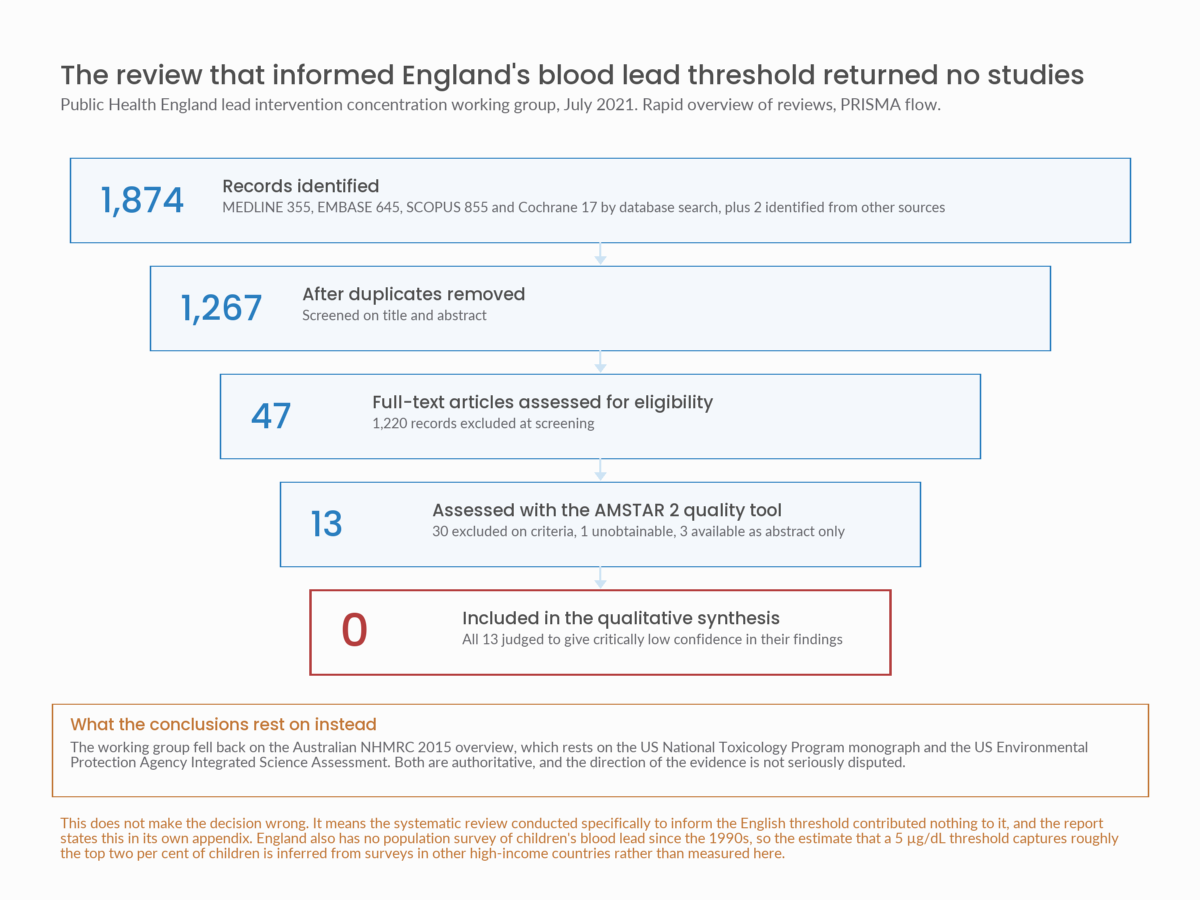
Figure 1. The rapid overview of reviews conducted to inform the English threshold identified 1,874 records and included none of them. All thirteen studies reaching quality assessment were judged to give critically low confidence. The working group fell back on the Australian NHMRC 2015 overview, which rests on the US National Toxicology Program monograph and the US Environmental Protection Agency Integrated Science Assessment. This does not make the decision wrong; it means the review conducted for the purpose contributed nothing to it, as the report states in its own appendix.
The Effect of Lowering the Intervention Concentration
The reduction of England’s public-health intervention concentration from 10 µg/dL to 5 µg/dL on 5 July 2021 created a clear break in the LEICSS surveillance series. Before the change, children with blood lead concentrations between 5 and <10 µg/dL did not meet the surveillance case definition. Afterwards, they did. The increase in reported cases was therefore expected to some degree simply because the population eligible for inclusion had expanded.
The difference between the two periods is substantial. During the six complete years from 2015 to 2020, when the LEICSS definition was ≥10 µg/dL, England recorded 231 cases, equivalent to an average of 38.5 cases per year. The transition year of 2021 recorded 121 cases. In the first three complete years operating at ≥5 µg/dL, LEICSS recorded 191 cases in 2022, 226 in 2023 and 247 in 2024: 664 cases in total, or an average of 221.3 per year. The annual average of detected cases was therefore approximately 5.75 times higher than during 2015–20.
That comparison does not mean that the prevalence of childhood lead exposure increased nearly sixfold. The surveillance definition itself changed. The more informative question is therefore not simply how many additional cases appeared, but where their blood lead concentrations lay in relation to the old 10 µg/dL intervention concentration.
The first complete year after the change provides the clearest answer. Of the 191 confirmed LEICSS cases in 2022, 119 children had blood lead concentrations between 5 and <10 µg/dL, while 72 were at or above 10 µg/dL. Among confirmed cases, the newly included concentration band therefore accounted for 62.3% of the total. UKHSA described this directly as a result of the case definition change, noting that the 5 to 10 µg/dL group was almost double the number of cases at or above 10 µg/dL.[6]
The same pattern continued in subsequent years. In 2023, 138 of 226 cases were between 5 and <10 µg/dL, compared with 88 at ≥10 µg/dL. In 2024, 159 of 247 cases were between 5 and <10 µg/dL, while 88 remained at or above 10 µg/dL. Expressed as a proportion of confirmed cases, the 5–<10 µg/dL group represented 61.1% in 2023 and 64.4% in 2024.
Across the three complete years from 2022 to 2024, the distribution was therefore:
| Blood lead concentration | Confirmed LEICSS cases | Share of cases |
|---|---|---|
| 5–<10 µg/dL | 416 | 62.7% |
| ≥10 µg/dL | 248 | 37.3% |
| Total | 664 | 100% |
This is perhaps the clearest measure of what lowering the intervention concentration changed. 416 children identified during 2022–24 had blood lead concentrations that met the current LEICSS definition but would have fallen below the former ≥10 µg/dL case definition.
The phrase “would have fallen below” requires some care. It does not necessarily mean that every one of those children would never have come to the attention of health services under the previous system. A clinician could still have tested a child, identified lead exposure or sought specialist advice below the formal intervention concentration. What can be said directly is that these children would not have met the former LEICSS surveillance case definition on the basis of their blood lead concentration.
The effect is also visible during the transition year itself. The 2021 data record 31 cases before 5 July and 90 after the new definition came into force. The two periods are not identical in length and cannot be treated as a controlled before-and-after experiment, but the increase is consistent with the expected effect of broadening the qualifying concentration range.
There is a further complication in interpreting the published percentages. Recent UKHSA blood-lead tables include reports below 5 µg/dL that did not satisfy the LEICSS case definition. In 2022, the published distribution included 21 such reports; there were 35 in 2023 and 28 in 2024. If those reports are retained in the denominator, the published proportion in the 5–<10 µg/dL band appears lower. For the narrower question being asked here — what proportion of confirmed LEICSS cases lay between the new and old intervention concentrations? — the appropriate denominators are the confirmed case totals of 191, 226 and 247. This gives 62.3%, 61.1% and 64.4% respectively.
The post-2021 increase therefore has an obvious definitional component. Lowering the intervention concentration brought a large group of children between 5 and <10 µg/dL within formal surveillance, and those children have consistently accounted for around three-fifths of confirmed cases.
But the distribution also reveals something the threshold change alone cannot explain. The number of children detected at ≥10 µg/dL — who would have qualified under either definition — was 72 in 2022 and 88 in both 2023 and 2024. Those figures are themselves substantially higher than the 33–49 total annual cases recorded during the years when ≥10 µg/dL was the case definition.
In other words, England has not simply added a new 5–<10 µg/dL group to an otherwise unchanged surveillance system. It is also finding more children at concentrations that would have met the old definition.
That is critical to understanding the rise in LEICSS cases. Lowering the intervention concentration made previously excluded children formally visible to surveillance, but it does not account for all of the increase. Changes in clinical awareness, testing and case ascertainment also appear to be important.
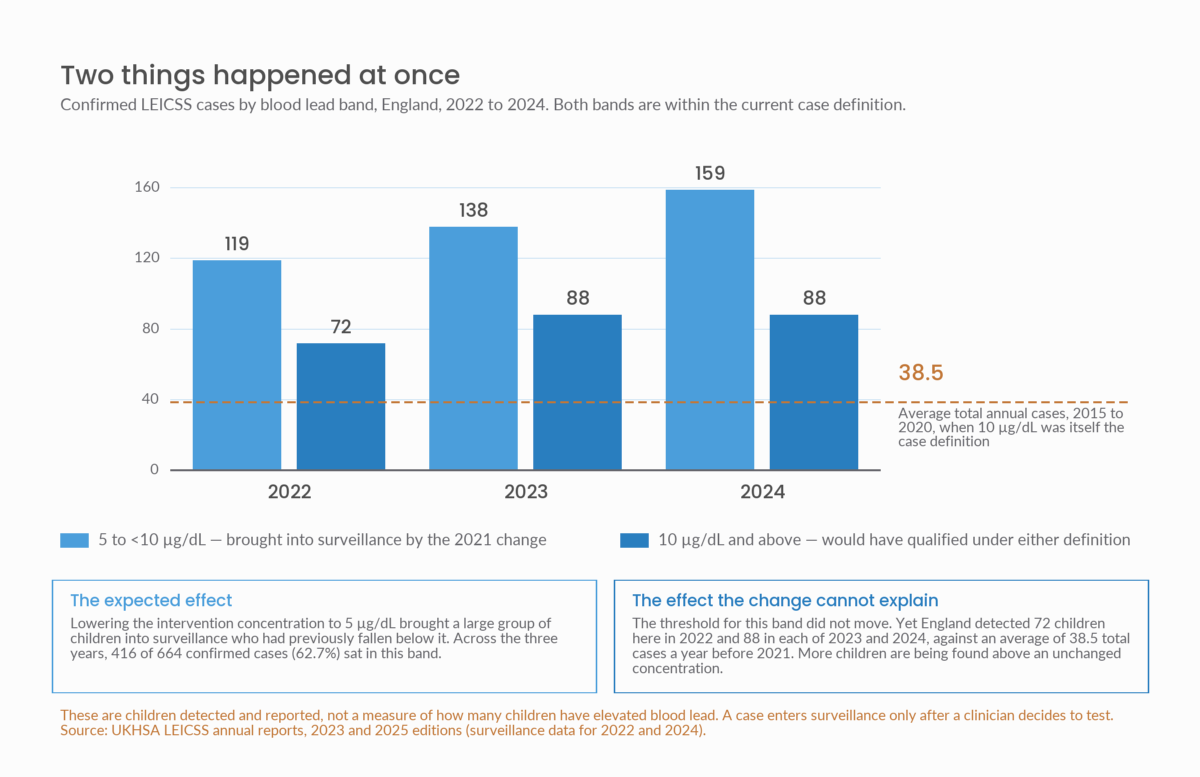
Figure 3. The lighter bars are children brought into surveillance by the 2021 change. The darker bars are children at or above 10 µg/dL, where the threshold did not move — and in every year since 2022 that group alone exceeds the total annual caseload of the entire system before 2021. That is the part the definition change cannot explain.
Testing and Case Detection
The increase in LEICSS cases after 2021 cannot be explained solely by the reduction in the intervention concentration. If the change from 10 to 5 µg/dL were the only important factor, the principal effect would be the addition of children in the newly included 5–<10 µg/dL range, while the number detected at ≥10 µg/dL might be expected to remain broadly comparable with the earlier period. That is not what the surveillance data show.
Between 2015 and 2020, when ≥10 µg/dL was itself the LEICSS case definition, England recorded between 33 and 49 cases per year, with an annual average of 38.5. These totals effectively represent children meeting the old ≥10 µg/dL definition. By contrast, after the intervention concentration was lowered, LEICSS identified 72 children at ≥10 µg/dL in 2022, 88 in 2023 and 88 in 2024.
The number of children being identified above the old intervention concentration has therefore approximately doubled relative to the pre-2021 annual average.
This does not demonstrate that severe or higher-level childhood lead exposure itself doubled. It demonstrates that more children with blood lead concentrations ≥10 µg/dL are now being detected by the surveillance system.
That distinction is central to interpreting LEICSS.
A surveillance case can only exist after a child has been tested. Blood lead testing in England is not performed routinely across the child population. It generally follows clinical suspicion, recognised risk factors or an environmental investigation. Consequently, the number of cases reported by LEICSS is partly a function of the underlying occurrence of elevated blood lead and partly a function of the probability that an exposed child will be recognised and tested.
The surveillance pathway therefore contains an important ascertainment effect:
more clinical recognition → more blood lead tests → more opportunities to detect elevated BLCs → more LEICSS cases
The experience in Leeds provides unusually useful evidence of this effect.
The Leeds experience
The Leeds Supra-regional Assay Service laboratory introduced an alert on its electronic test-request system prompting clinicians to consider blood lead testing in children with suspected pica and iron deficiency. The intervention followed the death of a lead-exposed child and was accompanied by clinician education [1].
The subsequent change was substantial. UKHSA reports that the introduction of the alert increased blood lead test requests by approximately 90% in 2017, accompanied by increased identification of children with elevated blood lead concentrations. Crabbe and colleagues report the same 90% increase in test requests during the twelve months following its introduction, and note that this may partly explain the higher case incidence observed in Yorkshire and the Humber.
The environmental lead burden of Leeds did not need to change for the number of identified children to rise. What changed was the probability that clinicians would consider lead exposure and request a blood test.
That experience is particularly relevant because Yorkshire and the Humber now has by far the highest LEICSS case-detection rate in England. In 2024, the national rate was 23 detected cases per million children aged 0–15, while Yorkshire and the Humber recorded approximately 93–94 cases per million — around four times the English rate, and 39% of all reported English cases. At the other extreme, the East of England recorded 7 cases per million.
At first sight, such a geographical difference might suggest that childhood lead exposure is four times as common in Yorkshire and the Humber. LEICSS cannot support that conclusion.
UKHSA specifically cautions against interpreting regional case-detection rates as regional prevalence, stating that the substantial differences observed across regions are likely due to bias in case ascertainment rather than a reflection of incidence or prevalence rates. The experience in Leeds provides a concrete example of how substantially changing clinical practice can alter the number of cases that surveillance subsequently sees.
This does not mean that the Yorkshire and the Humber excess is entirely an artefact of testing. Environmental exposures may also differ geographically. The available surveillance data cannot separate those effects sufficiently to determine how much of the regional variation represents underlying prevalence and how much represents differences in detection.
Screening for Lead Exposure in the UK
The limitations of passive surveillance raise an obvious question: if elevated blood lead may be clinically silent and detection depends upon a clinician deciding to request a test, why are children in the UK not routinely screened for lead exposure?
Population screening for childhood lead exposure is not currently recommended by the UK National Screening Committee. The most recent completed review was published in 2018 and concluded that the evidence did not support introducing a national screening programme.[2] The decision applied across the UK screening policy framework rather than representing a LEICSS decision: LEICSS is an English surveillance system for cases that have already been detected, whereas the UK NSC considers whether apparently healthy populations should systematically be offered screening.
The distinction matters. A surveillance system asks what can be learned from cases that reach health services. A screening programme deliberately seeks to identify a condition in people who have not necessarily presented with symptoms. Introducing childhood lead screening would therefore represent a fundamentally different approach to case finding.
The 2018 review
The 2018 UK NSC review considered whether asymptomatic children aged 1–5 years should be screened for elevated blood lead concentrations. Its conclusion was not based on a claim that childhood lead exposure was harmless or had disappeared from the UK. Rather, the committee identified weaknesses at several points in the pathway required for a population screening programme.
One problem was basic epidemiology. The review found no new UK prevalence studies and insufficient contemporary evidence on the prevalence and distribution of elevated blood lead concentrations among UK children. Much of the UK evidence was old, geographically restricted or derived from selected populations rather than representative national sampling. As discussed earlier, this remains a significant limitation: the last representative childhood blood-lead population data for England date from the 1990s.
This creates an unusual difficulty for screening policy. To assess the likely benefits, harms, workload and cost-effectiveness of a screening programme, it is useful to know how common the condition being sought actually is. Yet the absence of representative biomonitoring means that the contemporary UK prevalence of elevated childhood blood lead is itself uncertain.
The UK NSC also considered the suitability of the screening test and pathway. Blood lead concentration can be measured directly, but the practical question for screening is not simply whether a laboratory can measure lead accurately. A population programme requires an acceptable method of obtaining samples from large numbers of otherwise healthy young children.
The review specifically identified contamination and sensitivity and specificity problems with capillary testing. Lead present on the skin can contaminate a finger-prick sample unless collection procedures are carefully controlled, and positive capillary results may therefore require confirmation using a venous sample. Venous sampling reduces that particular contamination problem but is more invasive and more difficult to use as the first-line test in a population of very young children.
The review also identified the absence of an appropriate cut-off, because no safe blood lead level has been established; the poor performance of risk-based screening questionnaires; and insufficient evidence of treatment benefit.
This is important because the 2018 conclusion should not be reduced to the claim that “blood lead tests are unreliable.” Laboratory measurement of lead and the performance of a practical population screening pathway are separate issues. A questionnaire that fails to identify a substantial proportion of children with elevated concentrations has limited value as the gatekeeper to testing, while a very broad questionnaire may generate large numbers of children requiring blood sampling.
The current review position
The 2018 recommendation is now being revisited.
In answer to a House of Lords written question tabled on 4 March 2026 and answered on 24 March 2026, the Department of Health and Social Care confirmed that the UK NSC recommended against screening in 2018, that a new proposal was submitted in 2024, and that the UK NSC is planning an evidence map as the first stage of the evidence-review process [3].
The current position is therefore more precise than simply saying that the UK has decided against childhood lead screening. Population screening is not currently recommended, on the basis of the last completed UK NSC review in 2018. But that recommendation is now entering a new evidence-review process.
The new review will take place in a materially different context. England now intervenes at half the blood lead concentration used when the previous review was completed. LEICSS is detecting substantially more children. Targeted screening now falls explicitly within the UK NSC’s remit. New approaches to sampling are being investigated. And the absence of contemporary representative UK prevalence data remains unresolved.
That last point is particularly important. Screening and prevalence measurement are related, but they are not the same thing. The UK does not necessarily need to establish a clinical screening programme for every child in order to determine how common elevated blood lead concentrations are.
A different public-health instrument can answer that question: representative population biomonitoring.
Where the borrowed rate comes from
United States
NHANES demonstrates how this can work at national scale. It uses a complex, multistage probability sample designed to represent the civilian, non-institutionalised US population. Participants undergo physical examinations and laboratory testing, including measurement of lead in blood. The results are weighted so that measurements obtained from the survey sample can be used to estimate the blood lead distribution of the wider population.
This is fundamentally different from counting children identified through clinical lead-testing programmes.
NHANES has allowed the United States to quantify the decline in childhood blood lead exposure over several decades and, importantly, to continue measuring the lower end of the distribution as population exposure has fallen. Analysis of the 2007–2010 NHANES data estimated that 2.6% of US children aged 1–5 years had blood lead concentrations ≥5 µg/dL, corresponding at the time to approximately 535,000 children [4]. More recent NHANES data have produced lower estimates. It is one of these later estimates — approximately 1.1% of children aged 1–5 years ≥5 µg/dL — that UKHSA used to illustrate what the number might look like if a similar prevalence applied to children in England.
NHANES has another important function. The US Centers for Disease Control and Prevention’s blood lead reference value is derived from the measured population distribution, identifying children whose concentrations are at or above the 97.5th percentile among US children aged 1–5, rather than treating the reference value as a toxicological threshold. In 2021 the CDC lowered that reference value from 5 µg/dL to 3.5 µg/dL.
Population biomonitoring therefore does more than produce a prevalence estimate. It provides an empirical distribution against which individual results and changes in population exposure can be assessed.
ECLIPS
The absence of contemporary representative childhood blood lead data in the UK has now prompted an attempt to develop a different way of measuring exposure. The Elevated Childhood Lead Interagency Prevalence Study was developed through UKHSA’s Lead Exposure, Public Health Intervention and Surveillance group and is being conducted through a collaboration involving Northumbria University, UKHSA, Leeds Teaching Hospitals NHS Trust and other partners, with funding from UK Research and Innovation.
ECLIPS is important because it starts from a different position from LEICSS. Rather than waiting for clinical suspicion to produce a blood lead test, the study is inviting families with young children to participate directly. Its purpose is both to investigate childhood lead exposure and to test whether a less invasive method of collecting blood samples could provide a practical basis for much larger population studies.
The main study launched in Leeds in November 2025. Approximately 150,000 households were sent invitations, with an initial aim of recruiting 500 children aged 1–6 years. Participating families collect samples at home rather than bringing the child into a clinic for conventional venous blood sampling.
Home blood sampling
At the centre of ECLIPS is a finger-prick blood sampling method.
Conventional investigation of childhood lead exposure generally requires a venous blood sample obtained in a clinical setting. That is practical when a clinician already has reason to investigate an individual child, but it presents a greater obstacle when attempting to recruit large numbers of otherwise healthy young children into a population study.
ECLIPS is testing whether this barrier can be reduced. Parents use a home sampling kit to obtain an accurately measured blood spot from a finger prick, using an approach described by the investigators as similar to finger-prick glucose testing. The sample can then be returned for laboratory analysis without the child attending a clinic or requiring a healthcare professional to perform the initial collection.
This methodological question is important in its own right. As discussed in the section on screening, one of the practical problems considered by the UK NSC in 2018 was how blood lead testing could be performed acceptably and reliably in large numbers of young children, including the contamination risks associated with capillary sampling. ECLIPS is therefore investigating one of the practical constraints that has historically complicated both screening and population biomonitoring.
What ECLIPS may establish
ECLIPS may answer several questions that LEICSS cannot.
Most importantly, it can test whether children can be recruited and blood lead measured through a household-based sampling programme that does not depend upon prior clinical suspicion. If participation and sample quality are sufficient, this could provide a practical method for conducting much larger prevalence studies.
The study may also provide empirical information on the distribution of blood lead concentrations among participating young children in Leeds, including children who would never otherwise have received a clinical blood lead test. Environmental sampling may help identify associations between blood lead concentrations and household exposures. And the study can establish the practical performance of the recruitment, sampling, laboratory and follow-up pathway needed for a larger programme.
UKHSA has been explicit about the longer-term objective. At the study’s launch, it stated that although ECLIPS is being conducted in one area, the project will help establish whether the approach could be used more widely to determine prevalence across the UK.[5]
In that respect, ECLIPS is as much a study of how Britain might measure childhood lead exposure as it is a study of lead exposure in Leeds.
What ECLIPS cannot yet establish
ECLIPS does not, however, solve the UK’s national prevalence problem simply by testing children outside the clinical surveillance system.
The initial target is approximately 500 children aged 1–6 in one city. That is very different from a probability sample explicitly designed to represent all UK children.
Participation is also voluntary. Invitations to 150,000 households do not mean that 150,000 children will be tested, and the characteristics of families who choose to participate may differ from those who do not. The extent to which any resulting prevalence estimate represents the wider Leeds child population will therefore depend on the study’s recruitment, response, sampling and analytical methodology.
More importantly, Leeds is not the United Kingdom. The distribution of potential lead sources varies geographically. Housing age and type, legacy industrial contamination, lead plumbing, socioeconomic circumstances and population characteristics differ between Leeds and other parts of England, and between England, Scotland, Wales and Northern Ireland. Existing English surveillance research has already identified housing age and terraced housing as characteristics associated with elevated blood lead among reported cases. The distribution of lead-era housing across London is examined in our analysis of older housing and legacy lead water pipes [6].
A prevalence measured among participating Leeds children therefore cannot simply be multiplied by the number of children in the UK and presented as a national estimate.
ECLIPS should consequently be understood primarily as a feasibility and methodological step towards better prevalence measurement, rather than as the national prevalence survey that the UK currently lacks. Earlier UKHSA reporting described the project specifically as a feasibility study focused on protocol development and testing of the finger-prick method. As of the sources reviewed here, no ECLIPS childhood prevalence result has yet been published.
Its significance lies instead in what happens if the method works. A practical home microsampling system could make it considerably easier to recruit children into a larger geographically representative biomonitoring study. Such a study could then be designed around population sampling rather than clinical suspicion and could include sufficient numbers of children to estimate prevalence by age and potentially by other characteristics.
That would represent a fundamental change in the UK’s evidence base.
LEICSS tells us about children who are found. ECLIPS is testing whether Britain can develop a practical way of measuring children who would not otherwise have been looked for.
References
- Crabbe H, Alexander C, Klein JL, Verlander NQ, Iqbal N, Leonardi G, Busby A. Case epidemiology from the first three years of a pilot laboratory-based surveillance system for elevated blood-lead concentrations among children in England, 2014–17: implications for public health action. J Public Health. 2019.
- UK National Screening Committee. Screening for elevated blood lead levels in children aged 1 to 5 years: external review against programme appraisal criteria. London: UK NSC; 2018.
- Department of Health and Social Care. Lead: health hazards. House of Lords Written Question HL15152, tabled 4 March 2026, answered 24 March 2026 by Baroness Merron. London: UK Parliament; 2026.
- Centers for Disease Control and Prevention. Blood lead levels in children aged 1–5 years — United States, 1999–2010. MMWR Morb Mortal Wkly Rep. 2013;62(13):245–8.
- UK Health Security Agency. UK’s first citizen-led study on childhood lead exposure begins. London: UKHSA; 17 November 2025.
- Crabbe H, Verlander NQ, Iqbal N, Close R, White G, Leonardi GS, Busby A. As safe as houses: the risk of childhood lead exposure from housing in England and implications for public health. BMC Public Health. 2022;22:2052.
Disclosure
This article is published by London & Surrey Water Services Ltd, a CIPHE member and WaterSafe registered contractor whose business includes lead pipe replacement. The company therefore has a commercial interest in the subject matter. The article is restricted to findings and positions reported in the sources cited, and no claim is made here that is not traceable to those sources. It is not medical advice. Readers concerned about lead exposure should speak to their GP, and readers concerned about lead in their own water supply should contact their water supplier or seek independent laboratory testing.