

Scotland faced the problem first and developed the responses first. Fifty years later, London sits at the centre of one of Britain’s largest remaining lead pipe replacement challenges.
Table of Contents
Introduction
Half a century ago the British debate on lead in drinking water was centred on Scotland. Soft, acidic upland supplies, combined with extensive lead communication pipes and domestic plumbing, produced concentrations at the tap high enough for drinking water to make a measurable contribution to human lead exposure. Glasgow, Ayr and Edinburgh became the key locations in the emerging evidence on plumbosolvency — the capacity of water to dissolve lead from the pipes it passes through.[1]
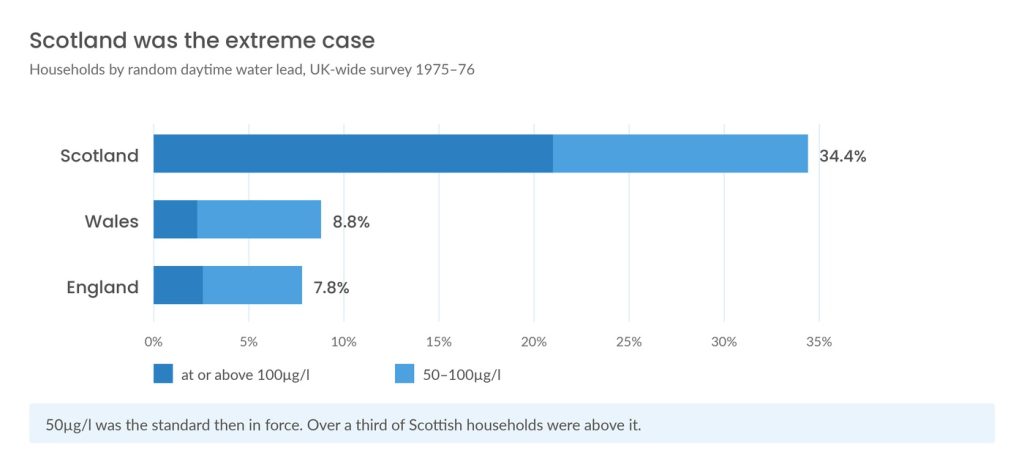
A UK-wide survey in 1975–76 found that 21% of Scottish households had random daytime water lead at or above 100μg/l, against 2.6% in England and 2.3% in Wales. Over a third of Scottish households were above 50μg/l — the standard then in force.[1] These national figures are as reported in CREW / Akoumianaki 2017; the 1977 pamphlet itself has not been consulted, and published summaries differ on the Scottish total at or above 50 µg/l (33% or 34.4%) and on whether the English comparator is 7.8% or 10%. When the European Community screened blood lead across member states between 1979 and 1981, the reference levels were exceeded at Glasgow and Ayr, and the water was blamed.[1] Scotland was not one variant of a common European problem. It was the extreme case, and lead in drinking water was the cause.
Lead plumbing existed throughout Britain. What made Scotland distinctive was the chemistry of many of its supplies. Fifty years later the geography has reversed. Scottish Water has around 47,000 lead communication pipes left.[3] Thames Water expects to end AMP7 with an estimated 1.15 million.[4]
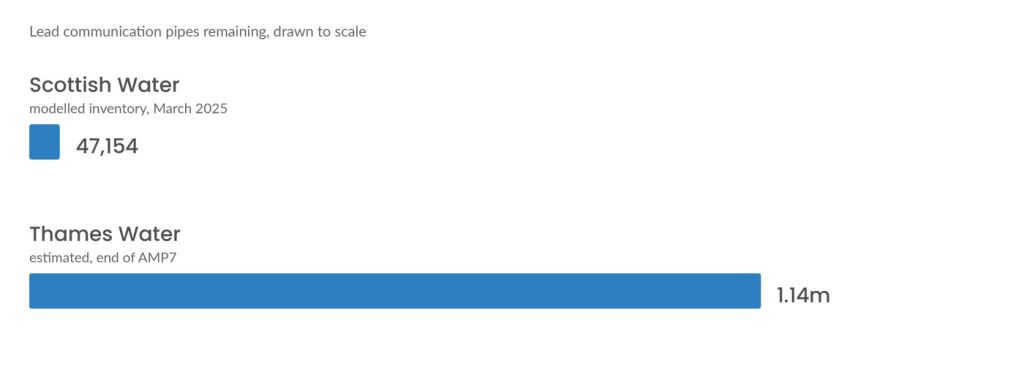
This is not a simple story of Scotland acting while England did nothing. English companies replaced lead communication pipes in substantial numbers. Scotland relied extensively on chemical mitigation and continues to do so. Both systems improved drinking water quality and both succeeded on the terms they set themselves. The difference lies in what happened to the lead pipework while those improvements were delivered — and in what that leaves behind now that the ambition is changing.
When Lead Exposure Through Drinking Water Was a Scottish Problem
In the 1970s the British problem was most visible in Scotland. Much of the country’s public supply came from soft, acidic upland sources with little natural buffering capacity. Where those waters passed through lead communication pipes, domestic plumbing or storage systems, they dissolved lead from the material itself. Untreated source-water pH was reported at about 6.3 in Glasgow in 1976 and as low as 4.5–5.5 in Ayr in 1980–81.[1] Scotland combined two conditions that did not always coincide elsewhere: extensive lead pipework and water capable of attacking it.
The 1975–76 survey also showed where the risk sat. The highest levels were found in houses with lead and copper pipes, 18% of households, and in houses with lead pipes only, 28%.[1] Until 1967 lead pipe was widely used to link cast iron mains to domestic pipework, and lead-lined storage tanks were common in both urban and rural properties.[1]
Glasgow demonstrated the risk first. Water from Loch Katrine was sufficiently plumbosolvent that in 1977 more than half of random daytime samples exceeded 100μg/l lead. Liming raised the pH and reduced aggressiveness; by 1980 approximately 80% of samples contained less than 100μg/l. Maternal blood lead moved in parallel: 22.9% of mothers sampled in 1977 were above 21.9μg/dl, compared with 1.4% in the 1980 survey.[2] Changing the chemistry of the water passing through lead pipes materially changed the amount of lead reaching the tap, and lead in drinking water was associated with measurable human exposure.
Evidence in infants strengthened the case. The Glasgow Duplicate Diet Study of 1979–80 examined wholly bottle-fed three-month-old infants and found a statistically significant relationship between household water lead and blood lead. Later analysis described a clear curvilinear relationship in 85 bottle-fed infants.[2] The question was no longer whether a sample exceeded a regulatory value. Lead released from pipework entered household water, that water was ingested, and rising water lead tracked rising blood lead.
Ayr showed what happened when severe plumbosolvency was deliberately reduced. Untreated water had a reported pH of approximately 4.5–5.5. Population studies formed part of the 1979–81 European Economic Community Blood Lead Surveys, conducted under a directive which set thresholds as a proportion of the population — no more than 2% were to have blood lead above 35μg/dl. Those reference levels were exceeded in Glasgow and Ayr, and the finding was attributed to high lead levels in the public water supply.[1] Investigators raised the pH of the Ayr supply from approximately 5.0 to 8.5 and replaced some lead pipework. Pre-intervention and follow-up data showed a significant relationship between water lead and blood lead. As water lead fell, median blood lead fell from approximately 21μg/dl to 13μg/dl.[1]
The investigation then moved east. The 1983 Edinburgh Lead Study examined primary school children. In central Edinburgh, water lead ranged from 0 to 456μg/l (arithmetic mean 37μg/l, geometric mean 17μg/l). Among 495 children with water data, 21% were supplied by cold water samples above 50μg/l, the standard then in force. Blood lead ranged from 3.3 to 33.6μg/dl (arithmetic mean 10.7μg/dl). Water lead was a significant determinant of blood lead alongside household dust.[2] Later isotopic work reached the same conclusion from another direction: in some individuals with elevated body lead, drinking water accounted for a substantial proportion of intake.[1]
Taken together, the Glasgow, Ayr and Edinburgh evidence established that a lead communication pipe was not simply an obsolete material awaiting renewal. Its public health significance depended on the water passing through it. Under the soft, acidic, poorly buffered conditions found in parts of Scotland, the same material released enough lead to be detectable not only in the water but in the people drinking it.[1]
Scotland Did More Than Treat the Water
The immediate Scottish response was mitigation. Strathclyde Regional Council began lime dosing most Glasgow supplies in 1978.[2] Dosing was intensified as the evidence developed, and plumbosolvency control became an important part of consumer protection elsewhere in Scotland.
Any comparison with England has to begin there. Scotland did not solve its lead problem by choosing replacement instead of mitigation. It used mitigation extensively and continues to. What distinguished the Scottish response was that mitigation developed alongside a second ambition: progressively replacing the lead pipework itself.
That dual approach was explicit by 1990. The Scottish Office described replacement of lead piping as the long-term solution. Water authorities had already been replacing their own lead communication pipes for years, both when they encountered them during other works and when householders renewed the corresponding supply pipe.[5] Mitigation reduced the lead released into the water; replacement took out the material it was released from.
The response also extended beyond the outside stop valve. From 1982, government made substantial financial support available for replacing or bypassing lead plumbing in privately owned homes. An additional £3m was allocated for 1982–83, with £1m for surveys and public information. Between 1982 and 1989 nearly 67,000 private sector grants were awarded. Eligible work initially attracted a 90% grant; when the normal repair grant rate returned to 50% in 1984, lead plumbing retained a preferential 75% rate.[5]
The work funded depended on the type of property. In houses with an individual supply, grant-supported replacement could extend across the customer side lead pipework. In tenement flats, where supplies and ownership were more complex, assistance could instead relate to the lead plumbing within the individual dwelling. The 67,000 grants therefore do not equate to 67,000 identical interventions, but they do represent a substantial programme of publicly supported replacement beyond the water authority’s ownership boundary.
The limits of that approach are visible in Edinburgh. Most old tenement blocks were built with common mains of lead — risers running up the building to the flat bathrooms, the tanks and the original kitchen sink position — and in Edinburgh the storage tanks were commonly lead lined and installed at high level in the bathroom. Two risers were usual: one feeding the tanks, one running direct to the kitchen sinks. The second is the one that matters most for lead at the tap, because there is no tank in the path.
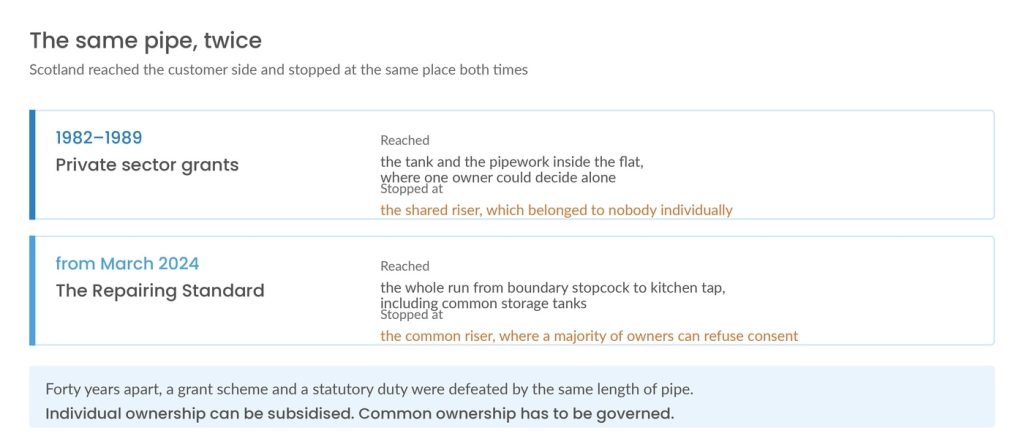
Grant applications were made by individual property owners, and a single application could only reach what that owner controlled: the tank, and the pipework within the flat. Many occupiers were not owners at all, but tenants of the district council or a housing association, where replacement depended on the landlord’s own programme. The riser served the whole stair and belonged to nobody individually. Where tenements were upgraded as part of a common repair scheme the shared pipework could be dealt with. Where they were not, flats could be improved one at a time while the lead feeding them stayed where it was.
That division still governs the position. City of Edinburgh Council’s guidance states that owners are responsible for all of the plumbing in their home and up to the boundary of their property, and that Scottish Water is responsible for all pipes in the street. A shared riser is therefore common property. Replacing one requires an owner to act as co-ordinator, contact every other owner in the block, obtain agreement in principle, and hold a stair meeting to settle the work and the costs. Shared lead pipe replacement is classed as an improvement to a tenement rather than a repair.[22]
By 2003, after the creation of Scottish Water, these routes had been brought together in an explicit regulatory framework. Scottish Executive Information Letter 4/2003 required Scottish Water to investigate and replace lead communication pipes where a regulatory failure implicated them. Where effective plumbosolvency mitigation was impracticable, communication pipes were to be located and replaced systematically. Lead encountered during mains rehabilitation was to be replaced opportunistically. Where a customer replaced their own lead supply pipe and internal plumbing, Scottish Water was required to replace the corresponding communication pipe within six months.[6]
The same policy is equally important for what it did not say. It did not treat replacement as making mitigation redundant. Where mitigation was practicable, Scottish Water was still required to install or optimise it, and dosing could need to continue even after all known lead communication pipes in a zone had gone, because lead might remain on the customer side.[6] Scotland ran both together: mitigation protected consumers while separate mechanisms replaced lead on both sides of the boundary.
Quantifying the outcome requires care. The 1,011,064 lead communication pipes reported for 2002–03 were not a physical census. That figure was an estimate built from incomplete information inherited from predecessor authorities, relying heavily on property age assumptions and incomplete records of earlier replacements. The methodology was subsequently revised as surveys and records improved. The fall in the reported figure in subsequent years therefore combined real replacement with substantial correction of the estimate itself. The difference between the 2002–03 figure and later ones is not a million pipes physically replaced.
Scottish Water’s current figure rests on the same kind of construction, and the company says so. At the end of the 2024–25 reporting year it reported 47,154 lead communication pipes, equivalent to 2.5% of its total communication pipes and a decrease of 1,521 on the previous year. The basis is a statistical survey which estimated lead at approximately 4% of communication pipes in 2010, with the estimate reduced each subsequent year by recorded replacements. The confidence grade is B4. Scottish Water is now working to refine it, using a risk assessment approach to target water quality sampling in areas likely to have lead communication pipes, and running pilot projects for the replacement of lead communication and supply pipes at Tighnabruaich, Kyle of Lochalsh and a DMA in Edinburgh.[3]
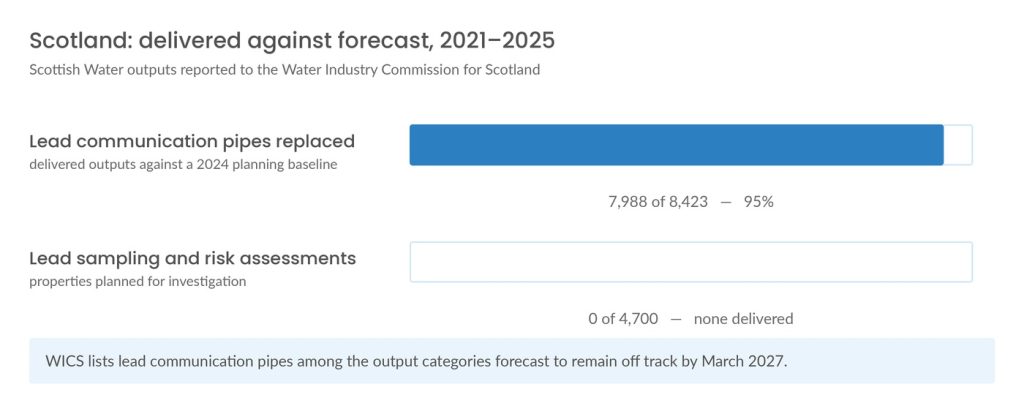
Delivery is better documented than the stock. The Water Industry Commission for Scotland records 7,988 lead communication pipes replaced across 2021–2025 against a baseline of 8,423 — 95% of forecast. Those are delivered outputs rather than modelled changes to an inventory. But the baseline is itself a 2024 planning figure applied back across the period, and WICS lists lead communication pipes among the output categories forecast to remain off track by March 2027.[7] In the same table, Scottish Water forecast lead sampling and risk assessment at 4,700 properties over 2021–2025 and delivered none.[7] Scotland has replaced a great deal of lead. It still does not know with precision where the rest of it is.
Nor does a smaller company side figure mean Scotland has cleared lead from drinking water plumbing. The customer side is materially larger and less well understood. A study commissioned by the Drinking Water Quality Regulator estimated that between 264,532 and 273,751 Scottish homes contained lead piping in 2020, depending on how postcodes with incomplete age data were treated. The authors consider the lower figure more accurate, and give an upper range of 1.23 million at the 95% prediction interval. The model was fitted on 308 street postcodes and applied to more than 70,000.[8] Where a shared riser serves a stair, every flat on it counts as a home with lead piping while there may be one pipe to replace.
The same study is candid about a second problem. In the Scottish House Condition Survey only 49 respondents out of 16,800 reported lead piping, which the authors attribute to brief surveys examining only visible pipes — so householder-reported data underestimates how much lead is present.[8] What can be seen is not what is there.
The Scottish achievement is therefore more specific than the claim that Scotland simply got rid of its lead pipes. It continued dosing while creating multiple routes through which the pipework producing the risk could progressively disappear: planned and risk-based replacement, opportunistic replacement during other works, coordinated replacement when customers renewed their own pipes, and substantial historical financial support for lead plumbing in privately owned homes. The surviving company side stock is now much smaller than the large English company inventories discussed below, but the historical Scottish inventories are not sufficiently comparable to calculate a defensible national percentage replaced. On the customer side, a great deal remains.
England Had a Lead Pipe Problem Too
Scotland’s severe plumbosolvency made the consequences of lead plumbing unusually visible, but the material was never confined to Scotland. England had inherited an enormous quantity of it. Across much of England, water chemistry did not translate the presence of lead pipework into the conspicuous pattern of high tap water concentrations that drove the Scottish investigations. The underlying problem was much larger than the geography of the early exposure evidence suggested.
The best historical national evidence comes from WRc work reported in the mid-1990s. Estimates put the total at almost 8.7 million lead communication pipes and almost 8.9 million lead supply pipes across England and Wales, associated with around 8.9 million homes — approximately 34% of the housing stock.[9] These were estimates of properties associated with lead pipework, not a census of individual pipes. Joint or shared services could not be fully accounted for, and the underlying data were not uniform across companies. What they establish robustly is scale: by the mid-1990s, lead pipework was a normal feature of roughly a third of homes.
Nor was England inactive. Nearly half a million lead communication pipe replacements were recorded between 1991 and 1994 within the WRc reporting framework.[9] Communication pipes continued to be replaced afterwards through reactive work, mains rehabilitation and company programmes. The problem was the denominator. Even replacement measured in hundreds of thousands left millions of properties with lead pipework.
Later estimates reinforce the picture with different definitions. Water UK’s 2018 position paper, drawing on UKWIR work, referred to approximately 9.5 million lead pipes serving homes across the UK, explicitly including both communication and supply pipes. It estimated the cost of relining or replacing what remained across the UK at around £15bn.[10] Those figures cannot be combined with the mid-1990s property estimates, but they show why complete replacement was such a formidable proposition.
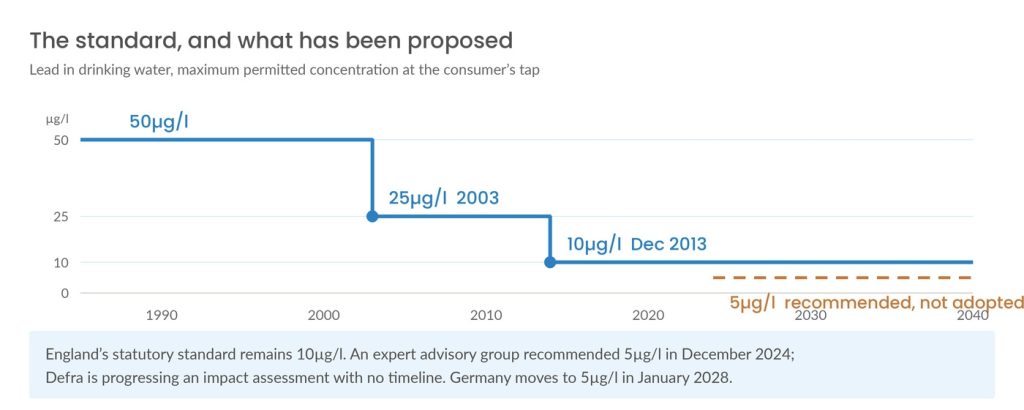
By the 1990s the regulatory context was changing. The previous European standard permitted 50μg/l lead. Directive 98/83/EC set a staged reduction: an interim 25μg/l, then 10μg/l from December 2013.[11][12] The tightening standard created a practical delivery problem across an industry still serving millions of properties through lead containing connections. The Directive did not prescribe how compliance was to be achieved, and it set the point at which compliance is assessed inside the building: for water from a distribution network, the point within premises or an establishment at which it emerges from the taps normally used for human consumption.[19]
What that made plain was that the communication pipe alone was never the unit of work. The costing carried out for government in 1996–97 assumed that where treatment would not achieve compliance, all the lead pipes in a zone would be replaced — communication pipe, supply pipe and internal plumbing — and priced each separately on the basis that the number of properties needing each would be similar.[13] Later work bore that out: partial replacement alone did not improve compliance with the lead standard, elevated levels were observed at the tap after partial replacement, and the largest contributor to failures in standing samples was the pipework and fittings inside the property.[1] Replacing the company’s pipe and leaving the customer’s was understood to be an incomplete exercise from the outset.
Companies could replace lead communication pipes, but complete replacement at scale would be costly, disruptive and complicated by customer ownership beyond the outside stop valve.[12]
England therefore approached the turn of the century with two facts in tension. Millions of properties remained connected through lead communication pipes, lead supply pipes, or both. And the permissible concentration at the tap was being driven sharply downward. Full replacement could take out the source, but replacing millions of company and customer owned pipes within a short regulatory transition would have required an extraordinary capital programme and a solution to the ownership boundary that did not exist.
The practical question was unavoidable: how do you achieve much lower lead concentrations across millions of old connections without replacing them all at once?
Orthophosphate Changed the Equation
The English water industry needed an intervention that could reduce lead concentrations across entire supply areas without first replacing every lead communication pipe. By the turn of the century the preferred approach was clear. Rather than relying principally on replacement, companies would condition the water so it was less likely to dissolve lead from the pipes it passed through. The approach became known as plumbosolvency control, and its most important component in England was orthophosphoric acid dosing.
DWI Information Letters in 2000 and 2001 required companies to assess the plumbosolvency of their supplies and develop treatment strategies capable of meeting the new requirements.[12] Depending on the water, control could involve adjustment of pH, alkalinity or hardness, but orthophosphoric acid emerged as the principal method across much of the industry. The objective was not to take the lead out of the network. It was to change what happened when the water met the lead already in it — reducing the amount released into drinking water sufficiently to protect consumers while the pipework remained in service.
This was understood at the time to be mitigation rather than a solution. The 1997 report to the Department of the Environment said so plainly: the only method that would eliminate lead from drinking water altogether was replacement of all lead containing materials in contact with the water, and treatment by pH adjustment and orthophosphate dosing could reduce dissolved lead but would not eliminate the problem.[13] That was on the record before the dosing programme began. What followed was not a misunderstanding about what mitigation could do. It was a decision to use a measure whose limits were already known.
Dosed into suitable water, orthophosphoric acid reacts with lead at the pipe wall to form a layer of insoluble lead phosphate within the existing scale, which slows further dissolution.[4][12] Effective control requires the dose to be matched to the water and then maintained.[12]
The distinction from replacement is fundamental. Replacement acts on the source of the lead. Orthophosphoric acid acts on what the source releases. A lead pipe remains physically present after dosing begins, but the concentration reaching the tap can fall dramatically because the water has been conditioned before it encounters the pipe. Operationally, this gave companies something replacement could not provide quickly: a means of reducing exposure simultaneously across very large populations supplied through old pipework.
Crucially, it also crossed the ownership boundary. A company could condition the water before it entered the network, and the resulting protection continued as that water passed from a company owned communication pipe into a customer owned lead supply pipe and on into the plumbing. Replacement could not do that. Dosing deferred, chemically and temporarily, a problem that ownership had made intractable.
Dosing also carries a cost of its own. DWI’s own long term planning guidance treats planning for reduced phosphate dosing as a sensible outcome, benefiting the environment through reduction in waste together with efficiencies in reducing what it calls an increasingly costly and diminishing resource.[30] The Environment Agency expects the environmental impact of orthophosphate dosing to become more pressing as other sources of phosphate discharge are addressed.[20]
The scale of adoption is apparent in the company information assembled for DWI’s 2021 long-term lead study. Thames Water reported conditioning for around 90% of its population, Anglian Water 98%, Bristol Water 100%, Northumbrian Water 99.6%, Yorkshire Water 100% and South West Water 80%. Among the six companies providing the detailed datasets used in the modelling, five reported conditioning between 95% and 100% of their populations.[12] This was plainly not marginal. Across large parts of England it had become the normal means by which the risk from surviving lead pipework was controlled.
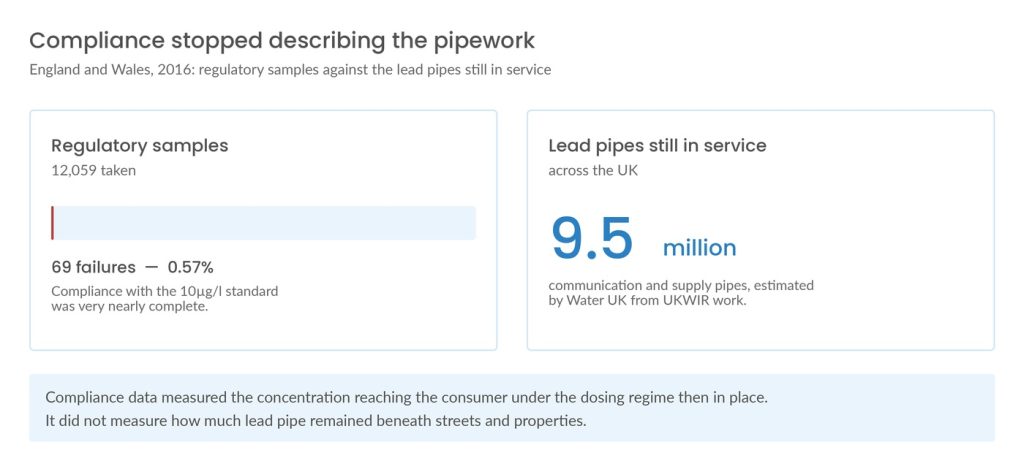
By 2018 Water UK could describe phosphate dosing and pH control as measures in place across water companies for 15 years or more. Together with targeted communication pipe replacement and encouragement for customers to replace supply pipes, conditioning had been successful in largely achieving compliance with the 10μg/l standard. In England and Wales in 2016, only 69 failures were recorded from 12,059 regulatory samples. Water UK nevertheless estimated around 9.5 million lead pipes remained serving UK homes.[10]
Those two observations belong together. Very high compliance had become possible while an enormous quantity of lead pipework remained in service. Compliance data measured the concentration reaching the consumer under the dosing regime then in place. It did not measure how much lead pipe remained beneath streets and properties. As mitigation became more effective, the relationship between those two measures weakened. A network could retain substantial lead while producing few failures, because the water passing through it was being conditioned to suppress release.
DWI’s 2022 guidance describes the resulting asymmetry explicitly. While some companies had been rigorous in replacing their own lead communication pipes, consumers had more often retained their original lead supply pipes. Orthophosphate therefore remained necessary in many areas to maintain compliance with the 10μg/l standard.[30]
Orthophosphoric acid made it possible to achieve very high compliance without first replacing every lead pipe. Once release could be controlled chemically, the immediate requirement to lower concentrations at the tap and the much larger task of replacing the pipes no longer had to proceed at the same speed.
This was the equation that shaped England’s response for more than two decades. By conditioning the water it could reduce the lead released from pipework already in place, and progressively tighten standards while that pipework was replaced over a much longer period. Orthophosphoric acid allowed England to mitigate the risk without first replacing what produced it. It bought decades of effective protection. The lead pipes remained.
What the DWI Risk Model Reveals
By 2021 the success of plumbosolvency control had created a new problem for long-term planning. Compliance was extremely high, but compliance alone could no longer describe the pipework beneath it. If the ambition was to reduce exposure further — initially towards 5μg/l and ultimately towards minimisation — DWI needed a way to distinguish areas where the underlying lead risk was genuinely small from areas where that risk was being successfully mitigated. DWI therefore commissioned WRc to examine the costs and benefits of alternative long-term strategies for England and Wales over the following 60 years.[12]
What follows is research commissioned to inform a decision, not a decision taken. England’s statutory standard remains 10μg/l. The 5μg/l value, the target years and the scenarios for eventual replacement are modelling assumptions in a report written for the regulator. They matter because they shape how DWI and the companies are now planning, and because company business plans have begun to move in the direction they indicate. They are not the law.
The resulting report built a risk-based model at water supply zone level. Zones were grouped into HIGH, MEDIUM and LOW baseline risk categories using historical lead results, property type and age, and the level of plumbosolvency control already applied. A high risk zone was defined as one where there was a relatively high probability that any consumer could ingest lead at a concentration in excess of the standard in force.[12] The model looked behind present compliance and asked what combination of pipework, water quality and mitigation was producing it.
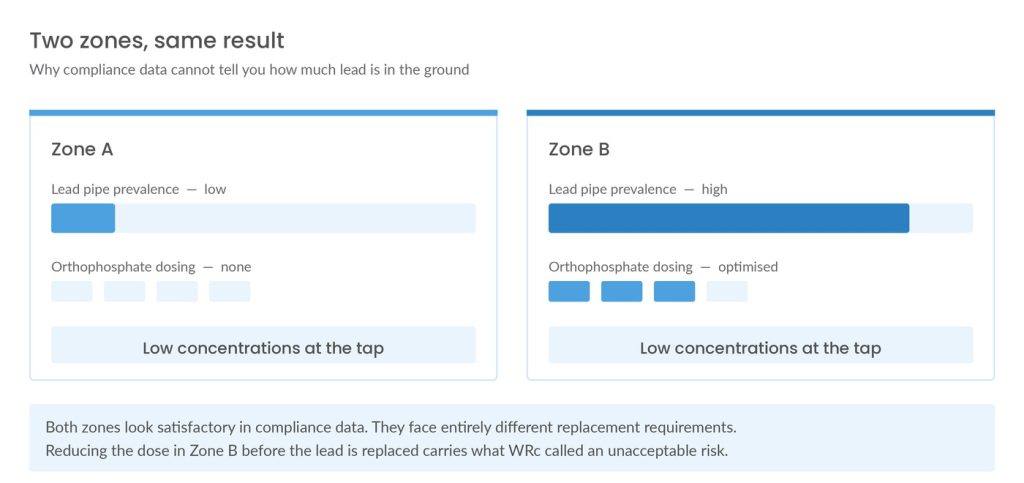
That distinction is crucial because the number of lead pipes and the concentration at the tap are not interchangeable measures. A zone containing little lead may produce low concentrations because there is little lead available to dissolve. Another may contain far more lead pipework yet also produce low concentrations because its water is effectively conditioned. Both look satisfactory in compliance data. They represent very different underlying conditions and very different long-term replacement requirements.
The distinction was not new. The 1997 costing work had run into it and dealt with it by assumption: replacement was not costed for zones that would pass a 10μg/l limit, even where those zones were known to contain lead pipes.[13] Twenty-four years later the same gap between what a zone measures and what it contains had to be modelled rather than assumed away.
WRc’s modelling incorporated lead pipe prevalence, observed Random Daytime results and orthophosphate dosing, divided into four bands. The resulting matrix shows how the apparent risk of a zone changes when prevalence is considered together with the mitigation controlling it. A zone assigned HIGH under the prevalence rules but with no Random Daytime result at or above 3μg/l can move from MEDIUM to LOW once dosing reaches 1mg/l or above.[12] The underlying prevalence has not changed. What has changed is the level of mitigation under which the water reaches the consumer.
The report’s treatment of dose reduction makes that dependence explicit. WRc concluded that trimming the dose before all lead pipes had been replaced in the relevant zones presented an “unacceptable risk” of positive lead samples.[12] Dosing was not withdrawn in order to make replacement necessary. It was maintained while the lead remained, and reduced only after the relevant remediation was complete.
Two implementation options were carried into the economic modelling: replace lead service pipes to the property wall, or replace lead service pipes and any internal plumbing directly connected to the internal water quality compliance point.[12] The second is the wider intervention, and it reaches back through whatever pipework feeds that point rather than stopping at the last length. What WRc did not model was the rest of the potable water plumbing in a property. It set that aside on the grounds that replacing it would carry significant additional direct and social costs with no additional benefit to lead compliance at the water quality compliance point.[12]
The dosing consequences follow the same order. Where only the communication pipe is replaced, dosing frequently remains unchanged. Where remediation extends further — to the property wall, or to the compliance point — progressively greater reductions become possible, including eventual cessation under some scenarios.[12] The DWI-commissioned study states the underlying point directly: replacing the communication pipe only will not necessarily lower water lead concentrations at the point of compliance.[12]
The headline finding was that companies would be required to replace lead service pipes to guarantee compliance with a standard of 5μg/l or lower, with upstream conditioning continuing in the interim. Compliance with regulation mandating the minimisation of lead would be extremely difficult, if not impossible, without remediation up to the compliance point.[14]
The model therefore exposes the central problem facing the next phase of English policy. Low current risk is not evidence of few lead pipes; in some areas it is evidence that mitigation is working. And if reducing that mitigation while the lead remains creates an unacceptable risk of failures, the route to permanently reducing dependence on dosing is not to alter the dose. It is to replace the pipes that make the dose necessary.
From a 10μg/l Standard to a 5μg/l Ambition
For most of the period in which orthophosphoric acid dosing became established, the objective was clear: achieve and maintain compliance with the statutory standard, ultimately 10μg/l at the customer’s tap. Against that objective, plumbosolvency control proved remarkably successful. But the health evidence underpinning lead policy was moving. The question was no longer whether England could maintain compliance at 10μg/l. It was whether the same mitigation-led approach could reliably support substantially lower concentrations while millions of lead pipes remained in service.
It is worth being clear about what 10μg/l represents. The WHO guideline value for lead is 10μg/l, the same as the Directive’s, but it is designated provisional. The reason is that no discernible threshold for lead toxicity has been identified, so the value is not health based. It is based on practical and analytical achievability — on what can be attained in systems with existing lead pipes.[19][20] The number describes what the pipework allows, not what is safe.
The proposal to go lower came from the review that preceded the recast Directive. The 2017 Drinking Water Parameter Cooperation Project, conducted by WHO Europe for the European Commission, recommended retaining 10μg/l as the parametric value while requiring Member States to submit and institute action plans for replacement of existing lead plumbing within five years of adoption, with the objective of meeting a target value of 5μg/l after a suitable period, taking into account the difficulties of achieving lead pipe replacement. It was equally clear about the remedy: most lead in drinking water arises from lead service connections and plumbing in buildings, and replacing them, though very expensive and very disruptive, remains the only long term solution.[19]
Water UK responded to that proposal in 2018. It accepted the public health rationale for reducing the parametric value from 10μg/l to 5μg/l but warned that the delivery consequences would be very different. Achieving 5μg/l would “likely require full lead pipe replacement” rather than further optimisation of existing mitigation. With an estimated 9.5 million lead communication and supply pipes still serving UK homes, Water UK argued the proposed ten year implementation period was insufficient.[10]
The DWI commissioned WRc study published in 2021 put that on a firmer technical footing. Its starting point was that assessments by WHO’s Joint Expert Committee on Food Additives and the European Food Safety Authority had concluded that no lower threshold for adverse effects of lead could be identified.[14] Companies in England and Wales would be required to replace lead service pipes to guarantee compliance with 5μg/l or lower, with upstream conditioning continuing in the interim. Dosing remained an essential protective measure while the pipework remained; replacement was required because mitigation alone could not be relied upon to guarantee the tighter standard.[14]
The Inspectorate adopted that conclusion as its own. Its long term planning guidance of September 2022 cites the report as compelling and significant evidence of the economic implications of exposure to lead through reduced societal intellectual capacity and physiological health, demonstrating by cost-benefit analysis that removing lead from drinking water has a significant overall economic benefit. It states the objective directly: to reduce exposure to lead in drinking water, because there is no safe level of human exposure to lead. The same guidance puts the scale of the task at around eight million properties across the UK — private dwellings and public buildings — still containing some form of lead-based material in the drinking water system.[30]
In December 2024 an expert advisory group convened by the Drinking Water Inspectorate submitted recommendations on drinking water standards to government. On lead, the recommendation was not simply to tighten the standard. It was to develop a cross-government strategy to reduce exposure from lead in drinking water, of which tightening the statutory standard from 10 to 5μg/l is the first of twelve measures.[20]
The justification is explicit: tightening the standard in isolation will not drive the complete replacement of lead in water supply systems, but must be used in tandem with other measures to be effective. Some consumers remain exposed above the current standard because of the legacy of lead plumbing in older properties and the continued use of lead solder and lead in brass fittings. Plumbosolvency control has been an effective public health measure, and despite it some consumers remain exposed to elevated lead in their drinking water.[20]
An important qualification applies to the present English position. The 5μg/l value is not the statutory standard; the prescribed concentration remains 10μg/l. The recommendation went to government in December 2024. Writing to the Environment, Food and Rural Affairs Committee in February 2026, the Chief Inspector of Drinking Water recorded that Defra is progressing an impact assessment but that there is currently no timeline.[21] The move towards replacement is occurring before England has replaced one national statutory number with another.
Thames Water sets out the practical consequence. Since 1998 the company has been dosing orthophosphoric acid at its water treatment works, and 92%+ of those works now have the equipment — which Thames offers as an indication of just how widespread lead pipes are across its operational area. It then cites WRc’s assessment that orthophosphoric acid, as a mitigation method, is reaching its limit of protection, such that any tightening of the 10μg/l standard at the customer’s tap will challenge its effectiveness to achieve compliance. Thames draws the conclusion directly: the alternative to mitigation is taking away the problem you are mitigating — replace all lead pipes.[4]
The direction now emerging reverses the sequence that might seem intuitive. Mitigation is not being abandoned in favour of replacement. Dosing has to continue while replacement is accelerated. Only as the pipework is progressively replaced does the possibility arise of reducing the chemical mitigation that has protected consumers for two decades.
London: The Next Great Lead Pipe Replacement Challenge
The move from long-term mitigation towards replacement becomes particularly significant when it reaches London. The capital combines three characteristics that make it different in scale from most of England: an exceptionally old housing stock, large numbers of legacy lead assets in the regions supplying it, and extensive dependence on orthophosphoric acid dosing to control release from what remains.
Analysis of Valuation Office Agency Council Tax stock data for all 32 London boroughs and the City of London indicates that more than 2.5 million London homes were built before 1970.[15] The concentration is pronounced in some boroughs. Property age is not evidence that an individual building still has a lead supply pipe. The original may have been replaced by a previous owner, during redevelopment, following a leak, or as part of water company work. The VOA data indicates risk; it is not an inventory of lead pipes. Its significance is that London contains millions of properties built while lead was still widely used to connect properties to the treated water network.
That housing stock overlaps three water company regions. Most of Greater London is supplied by Thames Water, while Affinity Water serves parts of north and west London and SES Water supplies areas in the south. Thames Water expects to end AMP7 with an estimated 1.15 million lead communication pipe connections across its operational area — a planning assumption of 1,149,663, modelled from sample failure data rather than counted.[4] Ofwat’s PR19 cost modelling projected around 293,000 lead communication pipes for Affinity Water and around 96,000 for SES Water by 2025 — forecasts made in 2019 rather than reported stock, and both companies’ outturn will differ.[16] None of these are London only counts. All three companies serve substantial populations outside the capital, and the figures cannot be added together and described as the number of lead communication pipes in London. What they establish is that London sits inside supply areas where lead communication pipes remain a material part of the network.
In the dataset assembled for DWI’s 2021 strategy, Thames reported conditioning for approximately 90% of the population it supplied.[12] Extensive dosing had become necessary to control release from the pipework remaining across the Thames system.
London does not reproduce the Scottish exposure conditions of fifty years ago. The general nature of water in Thames Water catchments is relatively non-aggressive, so a lower lead risk.[4] It represents a different form of the same underlying problem. Scotland’s aggressive waters made the presence of lead difficult to conceal from water quality measurements. Across London and much of southern England, increasingly effective mitigation has instead allowed large quantities of lead to coexist with very high compliance. Current concentrations reflect prevalence, water chemistry and mitigation together. They do not provide an inventory of the lead remaining underground.
The route from modelling to obligation ran through the companies. As part of the PR24 process the Inspectorate set out long-term planning guidance to water companies, of which one of eleven expectations was to reduce the risk of lead in drinking water.[20][30] Companies submitted lead strategies with their business plans in March 2023; DWI reviewed them, and accepted strategies were given legal force through undertakings under section 19 of the Water Industry Act 1991 during 2024.[4][17] The scale of what those strategies revealed is worth stating. Most companies set a target of no lead pipe by 2050, but the dates their own submissions implied ran into hundreds of years, with a maximum completion time of 1,355 years.[20]
Thames is clear about its own arithmetic. At the current rate of replacement, around 54,000 lead communication pipes per five year period, it would take until 2135 to reach zero, against the 2050 ambition set by its own Vision 2050.[4] But that is not what Thames proposes. It sets out six programme options and states plainly that a sustained step up in the replacement rate will be needed at some point in future AMPs. A flat rate appears only as a reference case: continued at the present pace, it would leave 934,315 pipes still in the ground in 2050.[4]
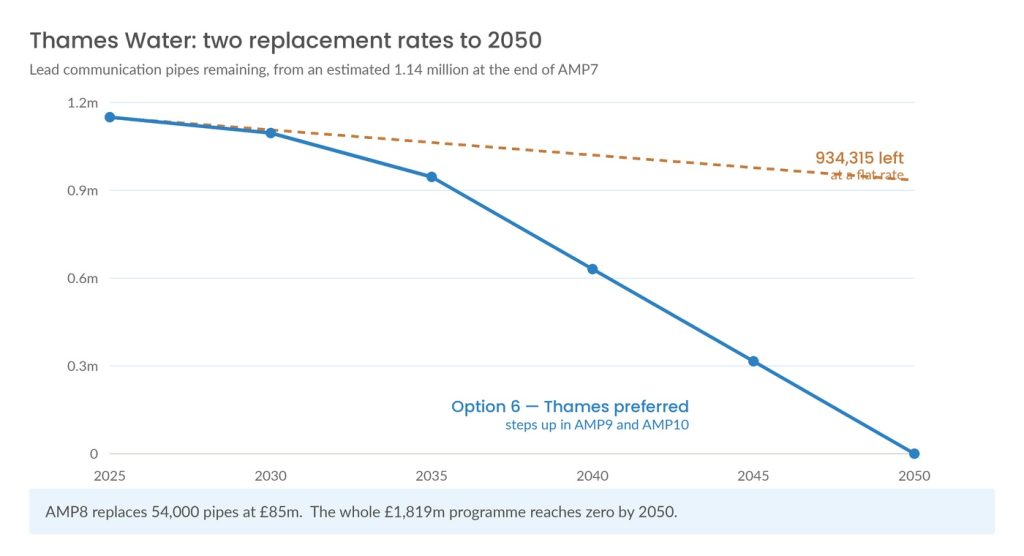
The preferred option is the sixth. Maintain the PR19 approved rate through AMP8, step up in AMP9, step up again in AMP10, then run flat to 2050. That profile replaces 54,000 pipes in this period, 150,000 in the next, and 315,167 in each of the three after that — 1,149,501 in total, at a cost of £1,819m. Every option that reaches zero by 2050 costs the same. What separates them is when the acceleration begins.[4]
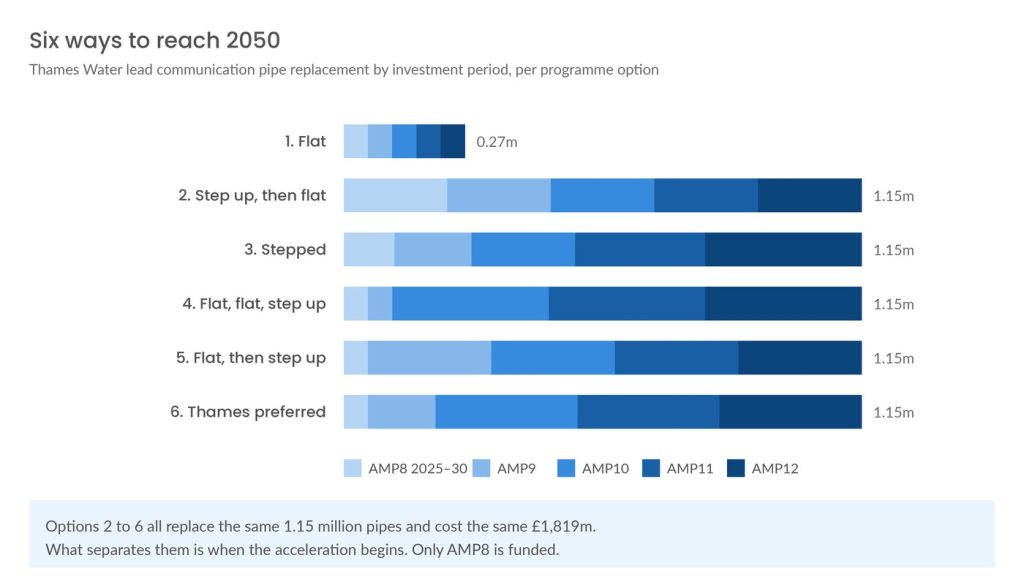
That is the significant fact about AMP8. The programme now being funded is not a plan to clear Thames’s lead. It is the first £85m five year slice of a £1,819m programme, with the major acceleration deferred to the two investment periods after this one.
Thames gives its reasons, and they are the argument of this article stated by the company. Delay allows time for modelling and detection technology to develop. It allows learning from AMP7 and AMP8 trials to be applied. Above all, it allows time to develop national policy on customer side lead pipe replacement. Thames wants an efficient end to end solution for customers, with an understood, agreed and funded mechanism to complete both the communication pipe and the customer side, and says that requires between a one and two AMP delay in stepping up.[4]
The company is equally clear about what the delay costs. It exposes customers to lead in drinking water for longer. It makes the replacement programme larger in future, and may leave the company unable to respond in time to an early lowering of the lead standard. It pushes back the point at which orthophosphoric acid dosing could be disassociated. And in the absence of policy on the customer side it risks return visits to customers who only had their communication pipe replaced the first time — less efficient, and more costly for customers overall.[4]
Those two lists describe a programme waiting on something outside the company’s control. The step up is costed and, Thames believes, deliverable. What is missing is the customer side mechanism it is being held for.
Meanwhile the AMP8 programme is binding. Under an undertaking given in May 2024 under section 19(1)(b) of the Water Industry Act 1991, Thames must continue its proactive lead pipe replacement programme targeting 54,000 lead communication pipe replacements by 31 March 2030, and must proactively replace lead pipework within the company’s ownership if lead is detected at or above 5μg/l within either regulatory or operational samples taken at customers’ taps.[17] England’s statutory standard remains 10μg/l, but the replacement programme is already being driven at a concentration below that failure point.
AMP8 should therefore be understood as the first period of a much larger programme, running at a rate the company itself says must rise. High risk areas cannot move safely towards reduced dosing merely because current compliance is good. The lead has to be replaced first.
Replacing the Communication Pipe Solves Only Half the Problem
Thames Water’s proposed programme is substantial. Its AMP8 plan proposes replacing 54,000 lead communication pipes between 2025 and 2030, with 97% delivered through a targeted proactive programme, using a combination of open cut and moling techniques, replacing pipework up to the customer boundary.[4] Yet in the same case Thames restates what the evidence has held since the 1990s. Lead pipework in contact with drinking water presents an immediate public health risk, and the size of the problem on Thames Water’s and customers’ side is vast. Completing the whole communication pipe programme, Thames writes, “only solves half the problem, as we currently do not replace lead pipes owned by customers, so both the public health and compliance risk would remain.”[4]
What is notable is not the observation but its date. This has been the position since the costing work of the 1990s, and it has been demonstrated repeatedly since. What has not existed, in all that time, is a mechanism to act on it.
The reason lies in the division of a domestic service pipe. The water company is only responsible for the pipe to the outside stop valve, with the customer responsible for pipework and plumbing beyond that. Thames puts the consequence plainly: this makes achieving the public health outcome required complicated, as the responsibility for fixing the problem, including funding, is split.[4] The division is a matter of ownership, but water running to the kitchen tap encounters one continuous service pipe. The regulator is explicit about where the test applies: the point of compliance measurement for lead is at the consumer’s tap, and action is mandatory in response to every analytical result that exceeds the standard.[30]
There is a measurement of how much of the problem sits inside properties, and it arrived by accident. During Covid lockdowns compliance samples were not collected from consumer taps but from points in the network, and the number of lead failures fell notably — which DWI reads as indicating the scale of concern within domestic properties.[20] That points to how much of what the regulatory regime detects originates beyond the boundary.
For London’s older housing stock this matters particularly. A pre-1970 property may have had its communication pipe replaced while retaining the original lead supply pipe. The reverse is also possible. Pipe material has to be understood section by section. A plastic pipe visible where the supply enters a property is not, by itself, evidence that the whole run from main to tap is free of lead.
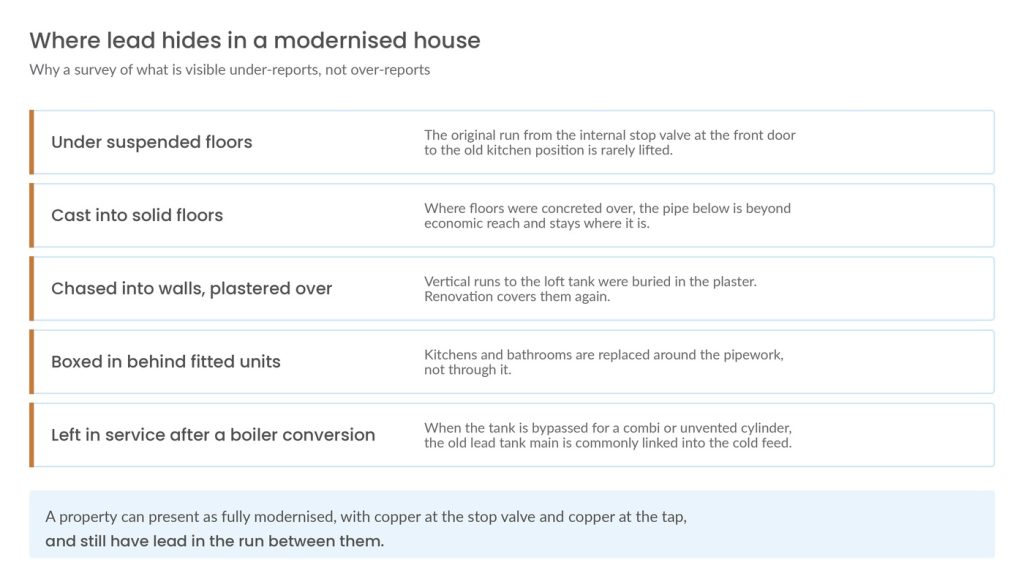
The same applies inside the property, and less visibly. Internal plumbing is rarely replaced in one operation. It is replaced piecemeal, over decades — a bathroom, a kitchen, a boiler — and on each occasion the pipework that can be seen is renewed while what cannot be seen is left. Lead survives beneath suspended floors, cast into solid floors, chased into walls and plastered over, boxed in behind fitted units. A property can present as fully modernised, with copper at the stop valve and copper at the tap, and still have lead in the run between them. A survey of what is visible will under-report, not over-report. Scotland’s own statutory guidance says as much: landlords must check visible pipework to assess whether the supply runs through lead pipes, and the absence of visible lead pipes does not guarantee that the water is not contaminated with lead.[23]
In earlier Victorian terraced housing the layout compounds this. The internal stop valve sits under the floorboards at the front door, and from there the original pipework runs under the floor space to what was the original kitchen position, branching at some point to travel up to the loft and feed the storage tank. Much of the vertical run is embedded behind plasterwork. Where a property has since been converted to a combination boiler or a mains fed unvented cylinder, and the loft turned into bedrooms, the tank is bypassed — and the lead main that fed it is commonly linked into the cold water pipework that came down from the tank to serve the bathroom. The lead is not replaced. It is left in service, concealed, inside a system that presents as modern.
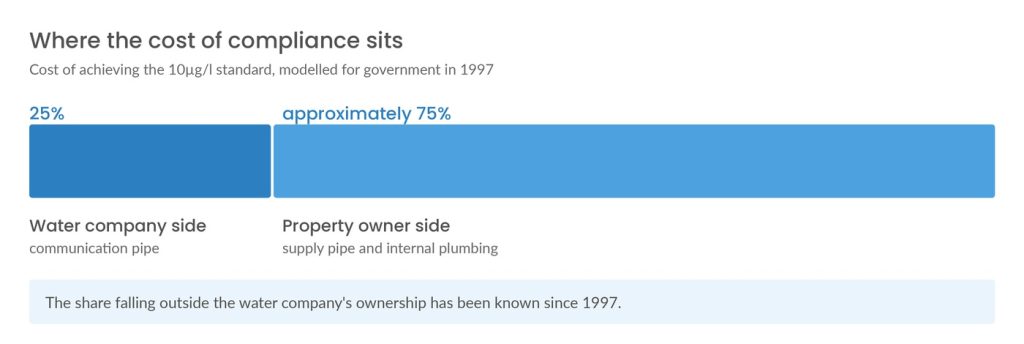
The historical evidence suggests the customer side may be at least as significant as the company side. The mid-1990s WRc estimates identified comparable numbers of properties across England and Wales with lead supply pipes and with lead communication pipes.[9] The costing work carried out for government in 1997 put it in a different form: approximately 75% of the cost of achieving compliance with a 10μg/l standard was associated with replacement of lead pipework that is the responsibility of property owners.[13] No equivalent modern inventory exists. Thames’s own position is that alongside its 1.15 million communication pipe connections there is an unknown number of customer supply pipes, customer plumbing, lead solder and lead fittings also in existence.[4] Nor does replacing the service pipe finish the job: even after full lead service line replacement, lead-tin solders, taps and brass fittings can still release lead, so replacement of internal pipes and taps may also be required.[8]
Nor does the cost of the pipe describe the cost of the work. Every model prices pipe. On the customer side the larger and more variable expense is reaching it and putting the property back afterwards — and that has changed beyond recognition. In Edinburgh in the 1980s the buildings were largely original: lead was chased out of plastered brick and stone, repiped on the same route, tanks swapped for plastic and pipework for copper, with everything but the bathroom suite, the kitchen sink and the hot water cylinder coming out. Today the same job runs behind fitted kitchens, tiled bathrooms, engineered floors and boxing, through routes altered by decades of unrecorded work. The pipe is the cheap part.
Chemical mitigation crosses the ownership boundary automatically. Water is conditioned upstream and remains conditioned as it passes through the company’s communication pipe, across the outside stop valve and through the customer’s supply pipe. This is one reason dosing has protected consumers despite split responsibility. Replacement stops wherever the authority and funding of the organisation carrying it out stop.
The DWI/WRc modelling examined this explicitly. Its replacement scenarios distinguished the communication pipe alone from replacement extending to the property wall and ultimately through to the internal compliance point, taking with it the plumbing that feeds it. Where only the communication pipe was replaced, dosing frequently had to remain unchanged; reductions became possible only as replacement extended further along the service pipe.[12] Taking out one source of lead does not permit mitigation to be withdrawn if significant lead bearing material remains downstream.
Thames’s statement that communication pipe replacement solves only half the problem should be taken literally. Replacing the company’s asset is an important public health intervention, but it does not necessarily leave a lead free service pipe. If the supply pipe remains lead, the water still encounters lead after crossing the outside stop valve. And if the ambition is eventually to replace enough lead for dosing to be safely reduced, that customer owned section cannot remain outside the plan.
The Customer Side Is the Next Policy Challenge
The next phase of lead replacement is as much an institutional challenge as a delivery one. Water companies know how to replace communication pipes. They have asset management systems, investment programmes, regulatory settlements, contractors and established powers to work on their own networks. Supply pipes are different. They are dispersed across millions of individual properties, frequently poorly recorded, privately owned, and beneath land the company does not control.
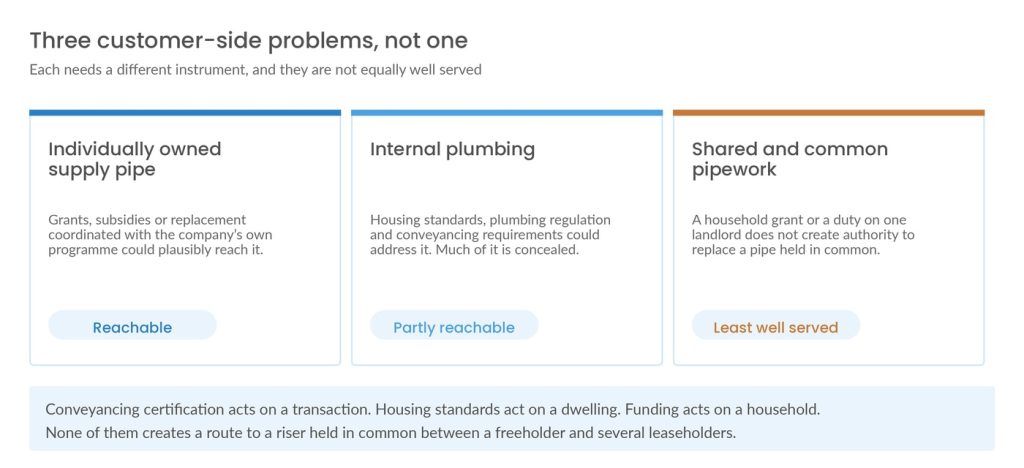
England does not face one customer side problem but three, and they need different instruments. There is the individually owned supply pipe, which grants, subsidies or coordinated replacement could plausibly reach. There is internal plumbing, which housing standards, plumbing regulation and conveyancing requirements could address. And there is shared and common pipework, where a household grant or an obligation imposed on one landlord does not necessarily create authority to replace the whole pipe.
The first difficulty is identification. A company may plan and excavate a communication pipe replacement without knowing whether the adjoining supply pipe is lead, copper or plastic, while the customer may have no idea what lies between the outside stop valve and the internal stop valve.
The second is information and consent. Thames’s own research found that knowledge of lead pipes is low among customers. Many are vaguely aware of the health risks but unsure whether they should be concerned, and because the subject is not widely talked about, they assume the amount of lead in their supply is inconsequential. Many do not know whether they have lead pipes in their own home.[4]
On the ground the confusion runs the other way. Most householders assume the water company is responsible for everything up to the internal stop valve — that the pipe carrying the water belongs to whoever supplies it. Nothing on site corrects that. The stop valve cover in the footpath is often marked with the water company’s name, which suggests ownership rather than the end of it. Many owners first learn of the boundary when the water company notifies them of a leak on their supply pipe, or when they are told the lead in their garden is their responsibility.
A company can decide to renew its own asset. It cannot assume a property owner understands the significance of the adjoining lead supply pipe, is willing to replace it, or can arrange the work within the same programme.
The third difficulty is shared ownership, and it is the one the mechanisms proposed so far reach least effectively. London has the same problem as the Edinburgh tenement, in forms that are harder to see. Terraces are commonly served by shared supply pipes running to the rear of the buildings, frequently with extensions built over them. Converted maisonettes have pipework travelling internally through one flat to reach another. Poorly converted and subdivided buildings have concealed lead risers running up through the structure, boxed in or plastered over, held as common parts between a freeholder and several leaseholders with no clear obligation on any of them to act. Unlike an Edinburgh stair, none of this presents as a shared arrangement at all, and there is no equivalent national lead-replacement mechanism designed specifically to coordinate those common works.
The fourth — and probably decisive — issue is funding. Thames’s customer research suggests support exists: 80% of customers supported the proposal to replace all Thames Water owned lead pipes 2025 to 2050 at £1.68 a year extra on bills, and 86% supported the initiative to replace 67,000 customer owned supply lead pipes between 2025 and 2030.[4] Those figures come from a deep dive with fifty completed responses, and Thames notes that the percentages are based on a relatively small qualitative sample and indicate direction of sentiment only. The final AMP8 plan is more cautious: the Ofwat data lines for external and internal lead supply pipes are both zero, with no specific programme of works proposed on the supply side. Instead Thames proposes an £8.625m customer trial in the target supply areas, to both educate and financially support customers to replace supply pipes to at least the internal stop valve, with recommendations taken into PR29 planning.[4]
The trial is not merely a company proposal. The DWI undertaking requires Thames to design and deliver a series of consumer trials to explore and assess incentives which aim to influence consumer behaviours, to encourage property owners to replace both their external and internal lead pipework, with trial design by 31 December 2025 and delivery by 31 March 2030.[17] England now requires the investigation of a customer side mechanism. It has not yet created one.
That gap matters, and Thames says so itself: it is essential that from AMP9 onwards there is an industry agreed parallel programme of customer side lead pipe replacement, either delivered by water companies or through alternative mechanisms, and that without one the public health risk will persist despite an ambitious communication pipe programme.[4] The same gap was identified at European level. Reviewing the Directive in 2017, WHO Europe observed that in many, if not most, EU jurisdictions buildings are not under the control of the water supplier, and recommended a requirement in the Directive for those responsible for managing water quality in buildings.[19]
In December 2024 the expert advisory group convened by the Drinking Water Inspectorate set out what such a mechanism might consist of. Alongside the lower standard, it proposed lead-free conveyancing certification so that all rented or sold properties meet lead free standards; housing standards which drive lead-free supplies; identifying funding sources to support domestic pipe replacement; mandatory accreditation for plumbers; banning the sale of lead solder; banning lead containing components such as brass fittings, with a phased and risk-based approach to replacing those already installed; plumbing leachate standards in the Water Fittings Regulations; and systematic reduction of risk in public buildings, prioritising schools, nurseries and other establishments children frequent.[20]
One recommendation goes further than the rest. The group proposed assessing the value of water companies owning the supply pipe all the way to the consumer tap, akin to ownership of gas systems, noting that companies currently own the pipework only to the stop cock.[20] That is the ownership boundary itself being put on the table.
Those measures address the first two problems and reach the third least effectively. A conveyancing certificate attaches to a transaction, and a transaction is one flat. Housing standards act on a dwelling. Funding for domestic pipe replacement acts on a household. Accreditation, solder, fittings and leachate standards govern what is installed rather than who may authorise its replacement. None of them creates a route to a riser held in common, and the one recommendation that would — company ownership to the tap — is the only one framed as a question to be assessed rather than a measure proposed. It also carries a physical objection as well as a legal one: a company cannot adopt what it cannot locate, and in a Victorian terrace the pipework beyond the internal stop valve is largely buried.
England has the same coordinated trigger as Scotland, and has had it for years. DWI’s guidance sets the regulatory minimum where there is a risk of exceeding the standard: optimised treatment, public health advice, and replacing the company’s communication pipe by request when the supply pipe is also replaced.[30] What Scotland added was a deadline — six months — and a grant system behind it.
That grant system was not confined to one form of property or one length of pipe. In houses with an individual supply it could support customer side service pipe replacement; in tenement flats it could support replacement of lead plumbing within the individual dwelling. The common principle was that private ownership was treated as a barrier to be managed through policy and funding, not as the point at which public health intervention automatically stopped.[5] But the individual grant reached what the individual owned, and the riser stayed.
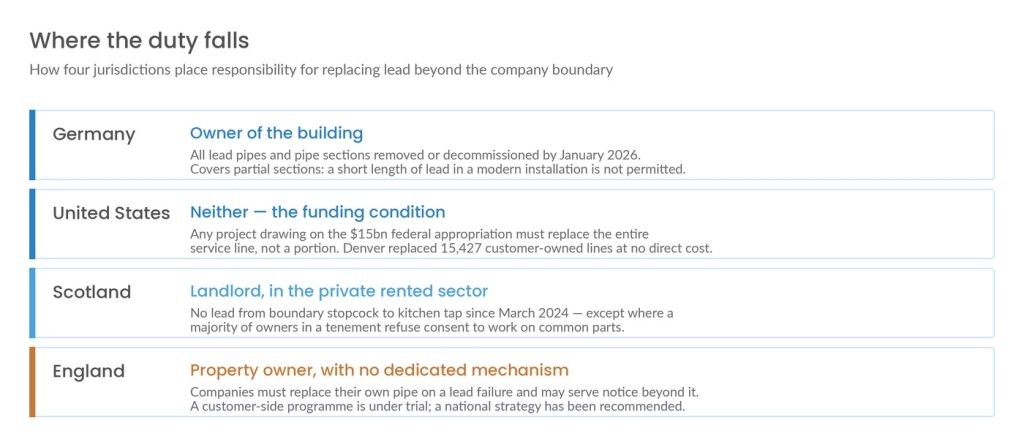
Nor has Scotland stopped, and the same limit has reappeared. Under the Repairing Standard, from 1 March 2024, lead pipes and lead lined storage tanks or fittings should not be present in the drinking water supply of any privately rented property from the boundary stopcock to the kitchen tap — including common storage tanks in tank rooms or roof spaces.[23] That is the whole run, written into a statutory standard, and drafted to reach shared assets.
But the standard already contained an exemption. Since 2019, section 16 of the Housing (Scotland) Act 2006 has treated a landlord as lacking the necessary rights where work to parts owned in common is not consented to by a majority of owners — and a landlord who lacks necessary rights, having taken reasonable steps to acquire them, has not failed the standard.[24] Where the lead is inside the flat it is an individual repair. Where it is traced to the common parts it becomes a mutual repair, and the other owners have to agree.[24] The duty runs to the kitchen tap until it meets the common riser. The same pipe defeated the grants in the 1980s and defeats the Repairing Standard today.
Coordination matters as much as funding. If a company replaces a lead communication pipe in one year and the customer replaces the adjoining supply pipe several years later, the same service pipe has been disturbed twice and for a period part of the lead has remained. Coordinated intervention offers the possibility of replacing both sections in one programme. Thames’s own design begins to recognise this: the targeted programme is intended to support the customer trial in delivering full lead replacement for customers, to at least the internal stop valve.[4]
Partial replacement also carries a technical risk, though not on the service pipe. In UK practice the service pipe is replaced in MDPE, and a lead to plastic joint creates no metallic galvanic couple. The risk arises inside the building where remaining lead is directly connected to copper. Lead acts as the anode and copper as the cathode, and under some conditions the resulting galvanic couple can increase lead release from the remaining lead pipe.[2][18] Piecemeal internal replacement can therefore create a different corrosion condition from the one that existed before the work. The service pipe, rather than the water company asset alone, is therefore the appropriate unit for coordinated external replacement. Internal lead plumbing remains a separate but connected remediation problem.
That leads to a more fundamental question about what England should count as success. The practical unit of a coordinated external replacement programme may be the complete service pipe. The ultimate public health measure is different: whether lead remains in the drinking water path to the compliance tap.
Is the relevant unit, then, a lead communication pipe struck off an asset register, or a property where the drinking water path has been investigated and identified lead removed? The two are not equivalent. The first is administratively straightforward because ownership is clear and the investment can be regulated. The second corresponds much more closely to the public health outcome required, but needs work on both sides of the outside stop valve.
For London the distinction will be especially important. The capital combines an exceptionally large pre-1970 housing stock with a very large number of legacy lead assets and an unknown number of customer owned lead pipes. It also presents every property form at once: terraced houses with individual supplies, shared supplies serving several properties from one connection, converted flats, mansion blocks and leasehold structures. An approach measured only at the outside stop valve could deliver a very large replacement programme while leaving an equally important part of the service pipe unresolved.
Completing the Service Pipe
The history traced through this article leads to a relatively simple conclusion. England does not need to choose between mitigation and replacement. Scotland never made that choice, and the emerging English approach does not require it either. Orthophosphoric acid has provided effective protection while lead pipework remains and will continue to be necessary during a prolonged period of replacement. The question is what that replacement programme is ultimately intended to achieve.
The direction of travel is already clear. The 10μg/l statutory standard remains in force, but the Drinking Water Inspectorate’s long-term work has examined the implications of reducing exposure towards 5μg/l and below. The study it commissioned concluded that lead service pipe replacement would be required to guarantee compliance at 5μg/l or lower, with upstream conditioning maintained during the transition.[14] Water companies are now beginning to translate that direction into physical programmes. Thames Water’s undertaking alone requires 54,000 proactive lead communication pipe replacements by March 2030, alongside replacement where lead is detected at 5μg/l or above.[17]
That acceleration is necessary. But it also exposes the structural weakness that has run through British lead policy for decades. The communication pipe and the supply pipe are separately owned, but they form parts of the same service pipe. Replacing one does not necessarily replace the other. Thames itself acknowledges that replacing its communication pipes would only solve half the problem if customer owned lead remained.[4] The question for England is therefore no longer simply how quickly water companies can replace their own lead. It is what happens when those programmes reach the outside stop valve.
Scotland encountered that problem much earlier. Its historical response was imperfect, and substantial lead remains on the customer side, but government policy did not simply accept private ownership as the point at which intervention had to end. Financial support was provided for the replacement of lead plumbing in privately owned homes, with preferential grant rates reflecting the public health importance of the work.[5] Customer side replacement was linked to supplier side replacement, so replacement of a lead supply pipe could trigger replacement of the corresponding communication pipe within six months.[6] The purpose of those mechanisms was not to erase the distinction between company and customer ownership. It was to prevent that distinction from frustrating the replacement of a recognised source of exposure.
The central difference between Scotland’s historical response and England’s emerging programme is therefore not the ownership boundary itself. The boundary exists on both sides of the border, and so does the request-triggered replacement of the company’s pipe. The difference is what sits behind it. Scotland put money and a deadline there, and continues to legislate: its landlord requirement dates from March 2024. England has so far left the equivalent problem to a patchwork of water company schemes, discretionary support and trials — while the Drinking Water Inspectorate’s advisory group has set out, in detail, what a national strategy would contain.
That distinction becomes increasingly important as regulated investment in company side replacement grows. Communication pipes are identifiable regulated assets. Their replacement can be specified through undertakings, financed through company investment programmes and ultimately recovered through customer bills. The supply pipe adjoining them sits outside that straightforward funding structure. Without a corresponding customer side policy, England risks creating a programme capable of financing the progressive replacement of water company lead while leaving the continuation of the same service pipe beyond the outside stop valve dependent upon the resources and decisions of individual property owners.
That would produce an uncomfortable outcome. The ownership boundary does two things at once: it decides who pays, and it marks where the water company’s obligation stops. Replace the communication pipe and the regulated output has been delivered — the undertaking is satisfied, the asset is off the register, and everything downstream is the property owner’s. The supply pipe, the internal plumbing, the solder and the fittings all sit on their side of the line, in cost and in consequence. That the customer side is where most of the money sits has been known since 1997, when the costing work for government put approximately 75% of the cost of compliance there.[13] Bill payers would have financed the replacement of the water company’s lead while property owners were left with their own. Where they cannot afford to replace it, it stays. The company’s communication pipe would be recorded as replaced. Lead could still remain in the building.
London makes that distinction particularly consequential. More than 2.5 million homes across the capital were built before 1970, while the principal water company regions serving it retain substantial legacy lead assets. Thames alone expects to end AMP7 with an estimated 1.15 million lead communication pipe connections. Accelerating company side replacement on that scale will require sustained investment across multiple AMPs. It would be a major lost opportunity if those interventions repeatedly reached individual properties without creating the means to identify and, where necessary, replace the adjoining lead supply pipe at the same time.
The alternative is not that water companies should simply assume responsibility for every customer owned pipe. It is that England needs a defined policy mechanism for completing the service pipe. Where a communication pipe is scheduled for replacement, the corresponding supply pipe should be identified. Where it is lead, the property owner should be informed and a practical route to coordinated replacement should exist. Financial support will be necessary if ability to pay is not to determine whether lead remains. Higher risk customers should be capable of being prioritised. Completed work should be inspected and recorded so that the output is not merely a company asset replaced but the known material of the service pipe that remains. And as Scotland’s experience shows, the mechanism has to be capable of being tailored to property form — a terraced house with its own supply and a converted flat on a shared service are different engineering and different ownership problems.
Some of the machinery already exists. Section 73 of the Water Industry Act 1991 makes it an offence for an owner or occupier intentionally or negligently to cause or suffer a water fitting for which they are responsible to be so out of order, in need of repair or so constructed that water supplied to the premises is likely to be contaminated before it is used.[25] It does not, on its face, create a general duty to replace inherited legacy lead: liability depends on an owner or occupier intentionally or negligently causing or suffering the relevant condition. But the same section carries a defence, inserted in 1999, where the work was carried out by or under the direction of an approved contractor within the meaning of the Water Supply (Water Fittings) Regulations 1999 and the contractor certified to the person who commissioned the works that the fitting complied with those regulations.[25] Approved contractor status and certification therefore already have a defined statutory role. That is the architecture the advisory group’s proposals for mandatory plumber accreditation and lead-free conveyancing certification would extend, rather than invent.
The Chief Inspector of Drinking Water has since named the lever. Writing to the Environment, Food and Rural Affairs Committee in February 2026, he asked for conveyancing requirements mandating lead pipe replacement, measures to prevent the use of lead solder and fittings in new builds, housing regulations requiring landlords to replace lead, an overhaul of the outdated Fittings Regulations including their governance, and improved oversight of water companies’ enforcement of them — concluding that a national strategy is needed to address lead in plumbing, given the proven health risks and cost–benefit gains, and that amendments to section 75 could make it mandatory rather than discretionary for water companies to require replacement of lead plumbing posing a health risk.[21]
That is an important lever, and the ground is already prepared. DWI guidance tells companies that where a failure is caused by a private domestic system and indicates a significant risk to health, they should seek to have the defect corrected, if necessary using their powers under section 75(2). It goes further on tenure: companies may consider it appropriate to issue section 75(2) notices to landlords of rented properties where the tenant is not empowered to correct the defect themselves — because under section 73 the tenant may otherwise be committing an offence through no fault of their own.[29] The asymmetry is in the verbs. On a lead failure the company must replace any part of the service pipe it owns.[29] Beyond the boundary it may serve a notice — except in public buildings, where DWI already requires companies to exercise their powers and, if necessary, to enforce under section 75.[30] The line the Chief Inspector proposes to move has therefore already been crossed for one category of property. Making section 75 mandatory more widely would close part of the gap, but the standard being enforced still comes from regulations made under section 74 and dating from 1999, and section 73 still answers the question of who is responsible by deferring to whoever else may be liable to maintain the fitting — which, for a riser held in common, is settled by the terms on which the building is held rather than by the Act.
Completing the service pipe is not the same as replacing all the lead. The service pipe ends at the internal stop valve, and the Directive’s point of compliance lies beyond it, at the taps normally used for human consumption.[19] Between the two sits the internal plumbing, replaced piecemeal over decades and concealed where it was never convenient to reach. The service pipe is the unit a coordinated programme could realistically deliver. The compliance point remains the endpoint the regulation and the public health objective are aimed at. Those are not the same thing, and the distinction should be kept.
Other countries have moved, and have placed the duty differently. Germany required remaining lead pipes and lead pipe sections to be replaced or decommissioned by 12 January 2026 — an obligation falling on the owner of the building, and one covering partial sections, so a short length of lead in an otherwise modern installation is no longer permitted. Its lead limit remains 10μg/l until 12 January 2028, when it falls to 5μg/l.[26]
The United States addressed the ownership problem through the funding condition rather than the boundary. At a White House summit in January 2023 the administration launched the Get the Lead Out Partnership, with 123 founding members, and restated its commitment to replacing all lead service lines within a decade. The money is from the Bipartisan Infrastructure Law — nearly $15bn dedicated to lead service lines over five years, of which $1.2bn had already reached 23 states by January 2023. The condition attached to it is the significant part: any project funded from that appropriation must replace the entire line, not just a portion, unless a portion has already been replaced.[27]
Denver Water shows what that produces. Between January 2020 and December 2022 it replaced 15,427 customer owned lead service lines, in lead-free copper, at no direct cost to the customer. It faced both of the difficulties England cites. It did not know how many customer lines it had either — its own estimate runs from 64,000 to 84,000 — so it supplied more than 65,600 free test kits, drilled to verify pipe material, and fed the results into a model that plans the work. And on consent, it made more than 6.72 million customer contacts, reaching over 95% of enrolled households in their primary language, with more than 95% of surveyed customers supporting the goal. Households were given pitchers and filters certified to remove lead until six months after their line was replaced.[28]
Canada and the European Union have both moved towards 5μg/l, the EU value applying from 2036. England and Wales, Scotland and Northern Ireland all remain at 10.[20]
There is already strong technical support for the direction. The recommendations emerging from the UK evidence have called for improved identification and monitoring, continued plumbosolvency control while lead remains, stronger regulatory mechanisms, public and private funding arrangements and ultimately replacement of lead pipes and plumbing. Of particular importance is the recommendation that mechanisms should enable customer owned lead pipes to be replaced at the same time as service connections.[18] That is not simply an administrative convenience. It recognises that partial replacement provides only partial remediation and that the appropriate unit of intervention is the lead bearing service pipe through which drinking water reaches the property.
The measure of success should consequently evolve with the programme. Counting lead communication pipes replaced remains necessary: companies and regulators need measurable outputs against which investment can be assessed. But it should not become the ultimate measure of lead risk reduction. A second output is needed: the number of properties at which the drinking water path has been investigated and identified lead has been removed through to the compliance tap. That would distinguish an asset management programme from one genuinely directed at taking away the source.
There is a broader regulatory reason for making that distinction, and it is one the industry already accepts. Modern drinking water regulation is founded on risk assessment and risk management through Drinking Water Safety Planning — the approach Thames itself describes as identifying and prioritising water quality hazards so that the most appropriate risk mitigation is put in place, and as the discipline that drives its investment strategy.[4] That approach follows hazards through the supply system and identifies the controls necessary to prevent them reaching consumers. Lead is an unusually clear example of why the principle matters. The lead bearing material is the hazard; plumbosolvency control mitigates it; monitoring provides evidence about the effectiveness of that mitigation; and replacement takes the hazard away.
Seen that way, the outside stop valve remains important for determining ownership, responsibility and the funding of physical work. But it cannot define where the hazard ends. Water dosed with orthophosphoric acid does not cease to require protection when it crosses from a company communication pipe into a customer owned supply pipe. Nor does lead downstream become less relevant to the consumer because responsibility for the pipe has changed.
The long-term English approach should therefore bring the emerging replacement programme into line with the risk based logic already embedded in Drinking Water Safety Planning. Effective mitigation should continue for as long as significant lead remains. Company side replacement should accelerate, particularly in the highest priority areas. But communication pipe programmes should increasingly become opportunities to identify and replace the adjoining lead supply pipe, supported by a defined national framework for coordination, prioritisation and financial support.
Fifty years ago, Scotland was forced by its water chemistry to confront the relationship between lead plumbing, drinking water and human exposure earlier than the rest of Britain. Its response evolved from mitigation into something broader: condition the water while the lead remained, replace the pipework progressively, and develop mechanisms intended to reach lead beyond the supplier’s ownership.
England now arrives at the same structural problem by a different route. Orthophosphoric acid has protected consumers extraordinarily effectively while allowing far more lead to remain. As the ambition moves from mitigating that lead towards progressively replacing it, London will be one of the places where the transition is tested at its greatest scale.
The next great lead pipe replacement challenge is therefore not simply to replace London’s lead communication pipes. It is to ensure that the enormous investment now beginning on the company side does not stop at the outside stop valve while the same hazard continues beyond it.
Scotland showed that treatment can cut water lead and blood lead while the pipe stays in the ground. That is why England could bring tap results down without finishing replacement, and why the remaining problem is the lead still in contact with the supply — much of it on the customer side of the stop valve.
References
- Akoumianaki I. Lead in drinking water: public health, mitigation and economic perspectives. Aberdeen: CREW — Scotland’s Centre of Expertise for Waters; 2017. Report No.: CD2016_03.
- Akoumianaki I. Lead in drinking water: public health, mitigation and economic perspectives — Annex. Aberdeen: CREW; 2017. Report No.: CD2016_03.
- Scottish Water. Annual Return 2024/25 to the Water Industry Commission for Scotland, Section H — Asset Inventory: commentary. Line H3.6, Communication Pipes (Lead). Stirling: WICS; November 2025.
- Thames Water. TMS22 Enhancement Case: Long Term Water Quality Strategy — Lead. PR24 business plan submission. Reading: Thames Water Utilities Ltd; 2023. Price base 2022-23.
- HC Deb 23 May 1990, vol 173, cc389–96. Lead in Water, Scotland.
- Scottish Executive Environment and Rural Affairs Department. Information Letter 4/2003: Lead in drinking water. Edinburgh: Scottish Executive; 2003. Requirements restated in Information Letter 5/2006, 5 July 2006.
- Water Industry Commission for Scotland. Scottish Water’s Performance 2024-25. Stirling: WICS; November 2025. Table 2, p. 23.
- Robertson G, Wilson A, Papastathopoulos Y, Graham M, Eades L, Chatzisymeon E, Dent C. Estimating the number of homes in Scotland with internal lead piping. Edinburgh: University of Edinburgh, in partnership with the Drinking Water Quality Regulator for Scotland; 20 November 2020.
- Potter S. Lead in Drinking Water. House of Commons Library Research Paper 97/65. London: House of Commons Library; 21 May 1997.
- Water UK. Recast of the EU Drinking Water Directive: Water UK Position. London: Water UK; 2018.
- Council Directive 98/83/EC of 3 November 1998 on the quality of water intended for human consumption. Off J Eur Communities. 1998;L330:32–54.
- WRc plc. Long-term Strategies to Reduce Lead Exposure from Drinking Water. Report to the Drinking Water Inspectorate, DWI Project 70/2/320. 26 January 2021.
- Miller S, Glennie EB, Crosbie RA, Rayner HE, Jackson PJ. Implications of the Proposed Changes to the Monitoring of Lead in Drinking Water. Final report to the Department of the Environment. Medmenham: WRc plc; May 1997. Report No.: DoE/DWI 4264/2.
- WRc plc. Long-term Strategies to Reduce Lead Exposure from Drinking Water: Executive Summary. Report reference DWI14372.2/16866-0. 26 January 2021.
- Valuation Office Agency. Council Tax: Stock of Properties (CTSOP 4.0), 31 March 2024. London: VOA; 2024.
- Ofwat. PR19 initial assessment of plans: feeder model — enhancement, wholesale water, meeting lead standards (W3006CAW). Birmingham: Ofwat; 2019.
- Drinking Water Inspectorate. Thames Water Utilities Limited — AMP8 Lead Strategy. Undertaking under s.19(1)(b), Water Industry Act 1991. Ref. TMS-2023-00013, version 2. Undertaking given 20 May 2024; acceptance notice 10 February 2026.
- Jarvis P, Fawell J. Lead in drinking water — an ongoing public health concern? Curr Opin Environ Sci Health. 2021;20:100239.
- World Health Organization Regional Office for Europe. Drinking Water Parameter Cooperation Project — Recommendations. Bonn: WHO Regional Office for Europe; 11 September 2017.
- Herschan J, et al. Drinking water quality standards in England and Wales: advisory group recommendations. London: Drinking Water Inspectorate; December 2024. Lead, pp. 44–50.
- Rink M, Chief Inspector of Drinking Water. Letter to Alistair Carmichael MP, Chair, Environment, Food and Rural Affairs Committee. London: Drinking Water Inspectorate; 13 February 2026. Appendix I, items 4 and 11.
- City of Edinburgh Council. Water emergencies: plumbing in your home. Edinburgh Shared Repairs Service. Edinburgh: City of Edinburgh Council; October 2017.
- Scottish Government. Repairing Standard: statutory guidance for private landlords. Edinburgh: Scottish Government; applies from 1 March 2024. Annex D1, paragraphs D.19–D.24.
- Housing (Scotland) Act 2006, s.16(4)–(5); subsection (5) inserted by the Housing (Scotland) Act 2006 (Supplemental Provision) Order 2019 (SSI 2019/62), in force 1 March 2019.
- Water Industry Act 1991, s.73, including s.73(1A) inserted by the Water Supply (Water Fittings) Regulations 1999 (S.I. 1999/1148), reg. 8.
- Umweltbundesamt. Distributing drinking water: lead. Dessau-Roßlau: German Environment Agency. Trinkwasserverordnung, in force 24 June 2023.
- The White House. Fact Sheet: Biden-Harris Administration Announces New Actions and Progress to Protect Communities From Lead Pipes and Paint. Washington DC; 27 January 2023.
- Denver Water. More than 15,000 lead service lines have been replaced. TAP news article by Cathy Proctor. Denver, CO: Denver Water; 6 March 2023.
- Drinking Water Inspectorate. Guidance on the Implementation of the Water Supply (Water Quality) Regulations 2016 (as amended) in England and the Water Supply (Water Quality) Regulations (Wales) 2018, Part 7 — Investigations. Version 3.0, April 2020. Paragraphs 18.8–18.9, 18.12.
- Drinking Water Inspectorate. Long-term planning guidance for drinking water quality. Version 003.7. London: DWI; September 2022. Section 7.4, Lead.
Disclosure
This article is published by London & Surrey Water Services Ltd, a CIPHE member and WaterSafe registered contractor whose business includes lead pipe replacement. The company therefore has a commercial interest in the subject matter. The article is restricted to findings and positions reported in the sources cited, and no claim is made here that is not traceable to those sources. It is not medical advice. Readers concerned about lead exposure should speak to their GP, and readers concerned about lead in their own water supply should contact their water supplier or seek independent laboratory testing.