
The 10 microgramme lead limit is often misunderstood
There is a lot of confusion about the 10 microgrammes per litre lead limit in drinking water.
Many people understandably treat it as a simple safety line: below 10 µg/L is safe; above 10 µg/L is unsafe.
But lead does not work neatly like that.
In England and Wales, 10µg/L remains the current legal compliance standard for lead at consumers’ taps. The Drinking Water Inspectorate lists lead at 10 µg Pb/L at consumers’ taps and explains that µg/L means micrograms per litre, or parts per billion.
However, the 10µg/L value should not be treated as a health-based “safe threshold”. The World Health Organisation states that there is no level of exposure to lead that is known to be without harmful effects, especially for young children and women of childbearing age.
That distinction matters. A regulatory limit is used for compliance, sampling, enforcement and operational decision-making. It does not mean that lead becomes harmless below that number.
For Thames Water customers, the practical question is therefore not only:
“Is my water below 10µg/L?”
The better question is:
“Is there still lead pipework in contact with the drinking water before it reaches my kitchen tap?”
Table of Contents
The three lead numbers Thames Water customers should understand
There are three important numbers in the lead-in drinking water discussion.
| Number | What it means | Why it matters |
|---|---|---|
| 10µg/L | Current legal compliance standard in England and Wales | A result at or above this level is a legal failure at the consumer’s tap |
| 5µg/L | European Union direction of travel, and the regulatory response level in England | Under its statutory undertaking to the Drinking Water Inspectorate, Thames Water must replace company-owned lead pipework where lead is detected at or above this level. Response levels vary between companies |
| As low as reasonably practicable | The long-term public-health objective | Because the old PTWI basis has been withdrawn and no safe threshold has been identified |
The key point is simple:
10µg/L is not a target. It is a legal limit. The long-term aim should be to remove lead pipework from the drinking-water route wherever possible.
Where the 10µg/L lead value originally came from
The 10µg/L lead value was not chosen at random.
It came from an older World Health Organisation and JECFA risk-assessment model based on the Provisional Tolerable Weekly Intake, or PTWI, for lead.
In 1986, JECFA established a PTWI for lead of 25 microgrammes per kilogram of body weight per week for infants and children. This was later reconfirmed and extended to all age groups. The WHO drinking-water background document explains that the second and third editions of the WHO Guidelines derived the drinking-water guideline value of 0.01 mg/L (10 µg/L) by allocating 50% of the PTWI to drinking water for a 5kg bottle-fed infant consuming 0.75 litres of drinking water per day.
That calculation matters because it shows what the old 10µg/L figure originally represented.
| Step | Calculation | Result |
| PTWI for a 5kg infant | 25µg × 5kg | 125µg/week |
| 50% allocated to drinking water | 125µg × 50% | 62.5µg/week |
| Daily drinking-water allocation | 62.5µg ÷ 7 | 8.9µg/day |
| Water consumption assumption | 8.9µg ÷ 0.75L/day | approx. 12µg/L |
The arithmetic produces approximately 12µg/L. WHO expressed the resulting guideline value as 0.01 mg/L, or 10 µg/L.
WHO rounds down to a round figure in mg/L. The background document states the derivation and the result directly: on the assumption of a 50% allocation to drinking water for a 5kg bottle-fed infant consuming 0.75 litres of drinking water per day, the guideline value is 0.01 mg/L. [1]
So the 10µg/L value originally came from a weekly intake allocation model, rounded. It was not a modern declaration that levels below 10µg/L are harmless.
Why the PTWI for lead was withdrawn
The problem is that the scientific basis behind the old PTWI no longer stands.
In 2010, JECFA re-evaluated lead and concluded that the previous PTWI of 25** µg/kg body weight per week** could no longer be considered health-protective. The WHO background document reports that this level was associated with a decrease of at least 3 IQ points in children and an increase in systolic blood pressure of approximately 3 mmHg in adults. Because the dose-response evidence did not identify a threshold for lead’s key effects, JECFA withdrew the PTWI and did not establish a new one.[4]
The WHO/JECFA database reports the same conclusion: the old PTWI was withdrawn because it could no longer be considered health-protective, and no new PTWI could be established because the analyses did not indicate a threshold for the key effects of lead. [3]
That left WHO with a guideline value whose original basis no longer existed. Its response was not to raise the value or withdraw it, but to change what the value means. The 2016 background document states that because lead exposure arises from a range of sources, of which water is frequently a minor one, and because it is extremely difficult to achieve a concentration below 10µg/L through central conditioning such as phosphate dosing, the guideline value is maintained at 10µg/L but designated as provisional on the basis of treatment performance and analytical achievability. [1]
WHO then draws the conclusion explicitly: as this is no longer a health-based guideline value, concentrations should be maintained as low as reasonably practical. [1]
That is the most consequential statement in the whole lead-limit discussion, and it comes from WHO itself. The 10µg/L figure is retained because it reflects what treatment can realistically deliver, not because it marks where harm begins.
That is the critical point:
The 10µg/L drinking-water value was originally linked to a PTWI-based weekly intake allocation. The PTWI has now been withdrawn. That is why 10µg/L should not be presented as a modern health-based safe threshold.
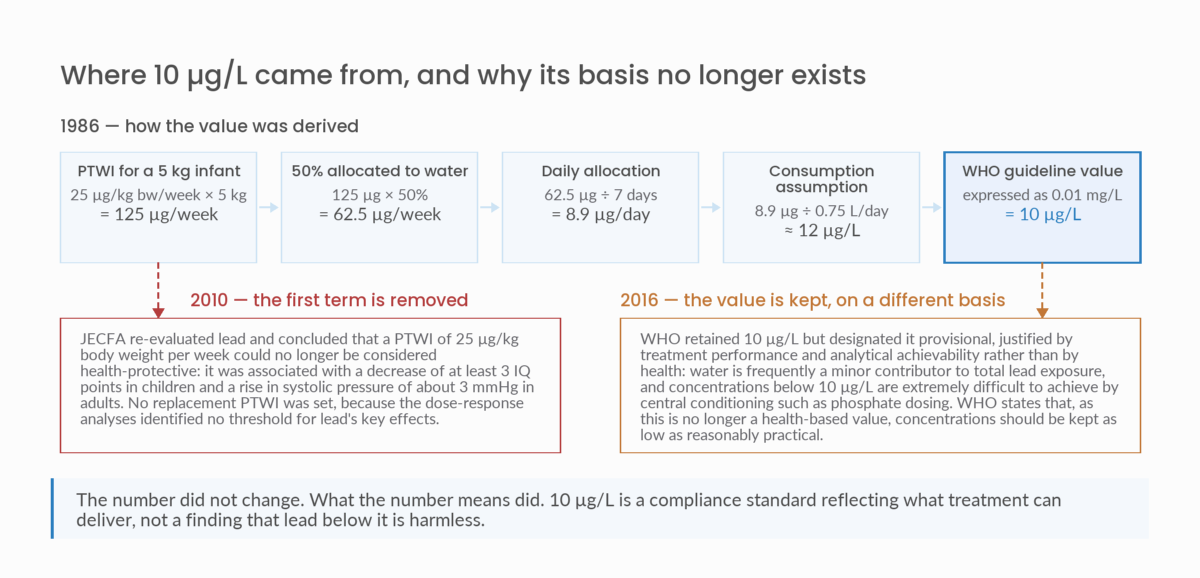
Figure 1. The 1986 derivation allocated half of a provisional tolerable weekly intake to drinking water for a 5 kg bottle-fed infant drinking 0.75 litres a day, producing approximately 12 µg/L, which WHO expressed as 0.01 mg/L. In 2010 the intake figure at the head of that chain was withdrawn and not replaced. The guideline value derived from it was retained on grounds of achievability and marked provisional.
How have lead limits reduced over time
The lead limit in drinking water has been reduced in stages.
This history matters because it shows that regulation has tightened over decades, though not always in a straight line.
The WHO history of guideline development records that the 1958 International Standards for Drinking-water recommended 0.1 mg/L (100 µg/L) for lead. In 1963, this was reduced to 0.05 mg/L, equivalent to 50 µg/L. In 1971, the tentative upper concentration limit was increased back to 0.1 mg/L, partly because lower levels were difficult to achieve in countries where lead pipes were still in use. In 1984, the first edition of the WHO Guidelines returned to a health-based value of 0.05 mg/L, or 50 µg/L. The 1993 WHO Guidelines then proposed 0.01 mg/L (10 µg/L) based on the JECFA PTWI for infants and children.[2]
The practical timeline looks like this:
| Period/source | Lead value | What changed |
| WHO 1958 International Standards | 100µg/L | Early maximum allowable concentration |
| WHO 1963 International Standards | 50µg/L | First major WHO reduction |
| WHO 1971 International Standards | 100µg/L | Tentative increase reflecting practical difficulty where lead pipes were used |
| WHO 1984 Guidelines | 50µg/L | Health-based guideline value |
| WHO 1993 Guidelines | 10µg/L | Derived using the PTWI and drinking-water allocation model |
| England and Wales from 25 December 2003 | 25µg/L | First stage of the transition set by the Water Supply (Water Quality) Regulations 2000, transposing Directive 98/83/EC |
| England and Wales from 25 December 2013 | 10µg/L | Current legal compliance standard at consumers’ taps. Both dates are set in SI 2000/3184, Schedule 1, Table B, item 15 |
| Recast EU Drinking Water Directive 2020/2184 | 5µg/L by 2036 | European Union direction of travel toward a lower lead value |
The important message is not that 10µg/L is the final answer. The important message is that standards have tightened as scientific understanding and regulatory expectations have developed.
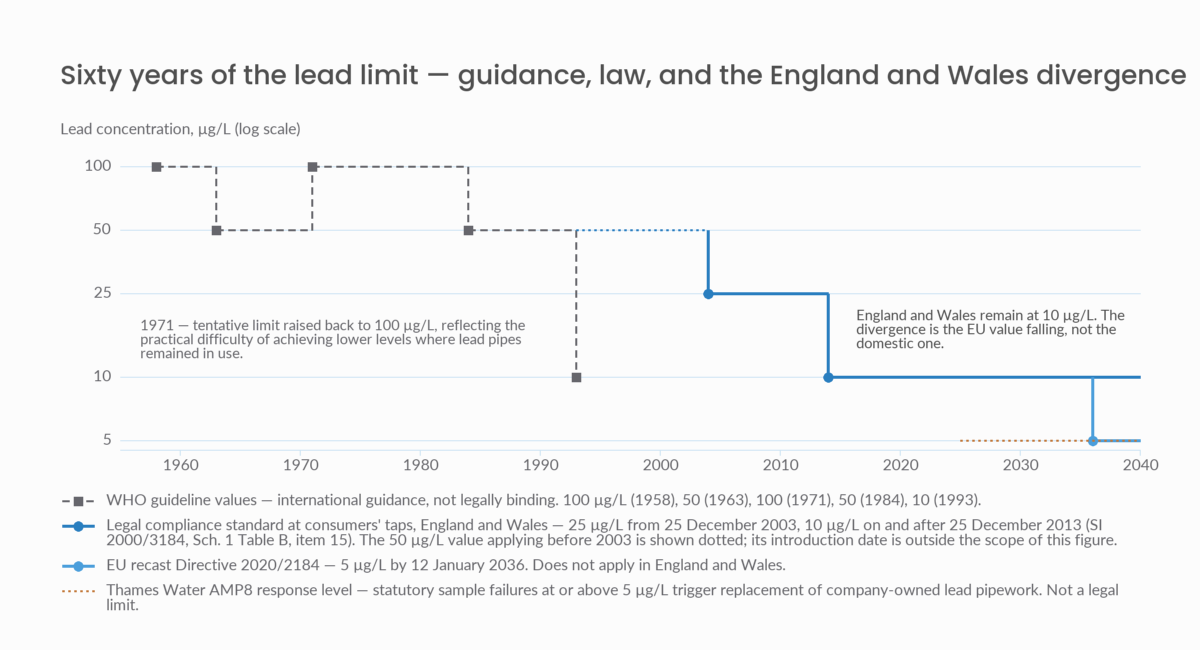
Figure 2. The lead limit has fallen over sixty years, but not smoothly and not through a single instrument. WHO guideline values moved from 100 to 10 µg/L between 1958 and 1993, briefly rising again in 1971. Enforceable limits in England and Wales followed separately, reaching 10 µg/L on 25 December 2013 where they remain. The 5 µg/L figure appears twice with different force: as a future EU parametric value that does not apply here, and as a company response level that carries no legal weight.
The role of the European Union Drinking Water Directive
The European Union Drinking Water Directive has played a major role in turning scientific guidance on lead into enforceable drinking-water standards.
Before the current 10µg/L standard, the lead limit in England and Wales was much higher. The DWI-commissioned WRc report explains that the prescribed concentration value for lead was reduced from 50 µg/L at consumers’ taps to 25 µg/L as a result of EU Directive 98/83/EC. It then moved to 10 µg/L in December 2013, aligning with the WHO drinking-water standard.[7]
Directive 98/83/EC did three important things for lead.
First, it set 10 µg/L as the final lead parameter value. Second, it allowed a transition period during which 25µg/L applied before the final move to 10µg/L. Third, it required that the value apply to water sampled at the tap using a method intended to represent the weekly average value ingested by consumers. [9]
That tap-based compliance point is crucial.
Lead in drinking water is different from many other water-quality issues because it is often not caused by the water leaving the treatment works. It is commonly caused by water passing through lead communication pipes, customer-owned lead supply pipes, internal lead plumbing, lead solder or older fittings.
The European Union Drinking Water Directive, therefore, helped push regulation toward the point that matters most for consumers: the water actually drawn from the tap.
The recast European Union Drinking Water Directive and the move to 5µg/L
The next major step is the recast European Union Drinking Water Directive, formally Directive (EU) 2020/2184.
The recast Directive sets a future lead parametric value of 5µg/L, to be met by 12 January 2036. Until that date, the lead value remains 10µg/L.[10] After that date, the 5µg/L value must be met at least at the point of supply to the domestic distribution system, and the 5µg/L value at the tap applies for the relevant materials-in-contact provisions. [10]
This is not just a numerical change from 10 to 5.
It reflects a wider shift in drinking-water risk management. The older regulatory focus was:
“Keep lead below 10µg/L.”
The emerging regulatory direction is:
“Reduce lead further, focus on domestic distribution systems, and remove lead pipework from the drinking-water route wherever possible.”
The DWI-commissioned WRc report explains that evidence from WHO/JECFA and EFSA — particularly the conclusion that there is no lower threshold for adverse effects of lead on human health — drove the reduction from 10µg/L to 5µg/L in the recast EU Drinking Water Directive.[7]
For Thames Water customers, the recast matters because it shows the direction of travel: lower lead concentrations, stronger focus on pipework close to the tap, and a long-term move away from relying on chemical mitigation alone.
The UK position Post-Brexit
The UK has not automatically adopted the recast European Union Drinking Water Directive as domestic law.
In England and Wales, drinking water regulation continues under UK domestic legislation. The DWI’s position paper on drinking-water quality as the UK exited the European Union explains that drinking-water standards were originally transposed from European Council Directive 98/83/EC, but that leaving the EU did not alter the domestic regulatory framework already in place.[8]
That means the current legal standard in England and Wales remains:
10µg/L for lead at consumers’ taps.
However, the UK position is not simply “10µg/L is fine”.
The DWI-commissioned WRc report considered long-term policy options for England and Wales, including maintaining the current 10µg/L standard, moving to 5µg/L, and ultimately achieving no detectable lead in drinking water. It concluded that water companies would need to replace lead service pipes to guarantee compliance with a lower regulatory standard of 5µg/L or lower, and that minimising lead in drinking water would be extremely difficult without remediation up to the compliance point, normally the kitchen tap.[7]
So the UK position can be summarised like this:
10µg/L remains the current legal compliance standard in England and Wales, but the long-term regulatory direction is lower exposure, lower lead concentrations, and removal of lead pipework from drinking-water systems wherever it remains.
Thames Water’s position: why 5µg/L now matters
For Thames Water customers, 10µg/L is not the only number that matters.
Thames Water’s long-term lead strategy states that lead is detected through samples taken at customers’ taps, that the current lead concentration standard in England and Wales is 10µg/L, and that Thames Water is moving toward monitoring and reacting to a target of less than 5µg/L.
Thames Water’s AMP8 lead control plan also refers to reactive lead communication pipe replacement when statutory sample failures exceed 5µg/L at a customer’s tap. In another section, it describes AMP8 commitment as responding to statutory sample failures ≥5µg/L.
For customers, the practical interpretation is:
| Lead result | Practical meaning |
| Below 5µg/L | Below the level that obliges Thames Water to act, but not a reason to ignore lead pipework if it is present |
| At or above 5µg/L | Requires Thames Water to replace its own lead pipework and to approach you about the rest |
| At or above 10µg/L | A failure against the current legal lead standard and an urgent compliance and replacement issue |
This is why the 10µg/L limit is not the whole story. Thames Water is already required to act at 5µg/L, and the recast EU Directive points to the same value becoming the legal limit elsewhere.
What happens if a sample is at or above 10µg/L?
In England and Wales, 10µg/L is the current legal compliance standard for lead at the consumer’s tap.[5] Thames Water’s long-term lead strategy states that water companies are assessed for compliance when a sample is taken at the customer tap and that, following a lead-standard sample failure, the lead communication pipe must be replaced by the water company.[13]
Thames Water’s public guidance also says that if it finds traces of lead above the standard in a customer’s home, it will inform the customer, notify the local authority environmental health department, explain what it plans to do and share advice on reducing lead levels. [6]
For practical purposes, a sample at or above 10µg/L should be treated as an emergency-priority replacement case. Thames Water’s communication pipe should be investigated and replaced where required, and the customer-owned supply pipe should also be checked urgently.
Where lead in London's drinking water usually comes from
Thames Water states that its water mains are not made of lead and that there is virtually no lead in drinking water leaving its treatment works. The issue is usually older lead pipework serving the property, including lead supply pipes, communication pipes, internal plumbing, solder or fittings.
The Drinking Water Inspectorate gives similar guidance. It explains that before 1970, lead pipework was commonly used to connect properties to the mains water network, and that older properties that have not been modernised may still have lead pipework underground or inside the building.
That means lead is often a property-specific issue.
Two homes on the same street can have very different risk profiles. One property may have already had its supply pipe replaced. Another may still have lead between the water main and the kitchen tap.
The critical question is not just:
“What is the sample result?”
It is:
“Is there still lead pipework in contact with the drinking water?”
Who owns which pipe?
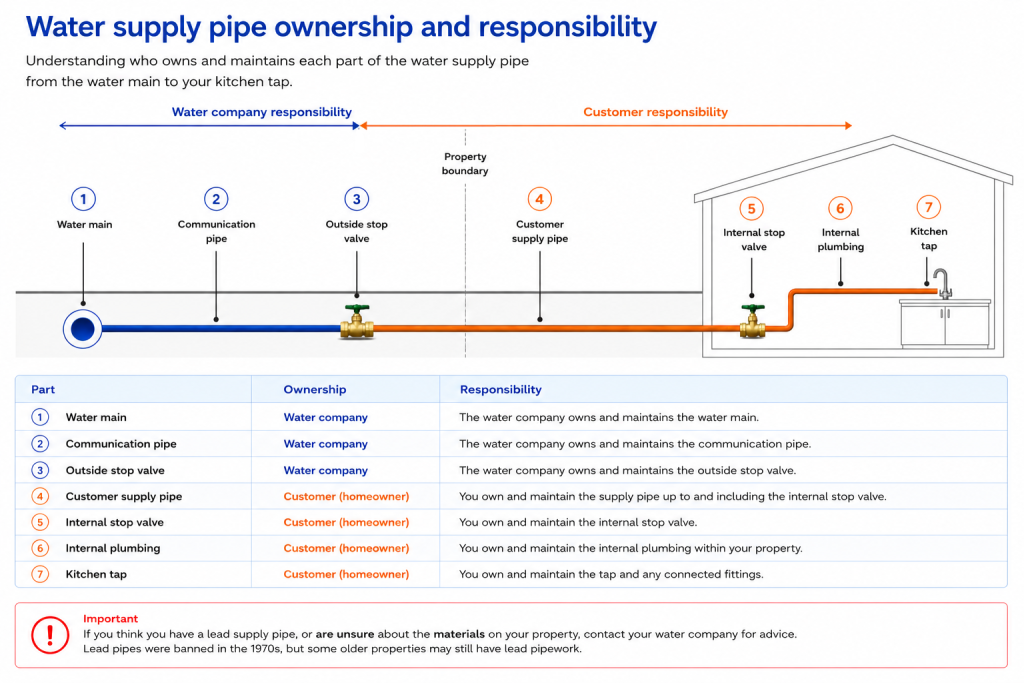
Pipe responsibility is one of the main reasons lead replacement can feel confusing.
Thames Water explains that the customer normally owns the internal pipework and the supply pipe. The supply pipe starts at the outside stop valve and ends at the inside stop valve. Thames Water owns the communication pipe, which starts at the water main and usually runs to the outside stop valve or property boundary.
That split responsibility is crucial.
Thames Water can replace its communication pipe, but that does not automatically remove lead from the customer-owned supply pipe or internal plumbing. If the private supply pipe remains lead, water may still pass through lead before it reaches the kitchen tap.
Thames Water’s Lead Pipe Replacement Scheme
Thames Water operates a Lead Pipe Replacement Scheme for qualifying customers.
Under the scheme, if a customer replaces lead pipework that belongs to them and meets the scheme criteria, Thames Water can replace any lead pipework that belongs to Thames Water. Thames Water’s guidance says customers may apply if, among other criteria, the property was built before 1970, they suspect they have lead supply pipework, they have located the outside stop valve, confirmed their supply arrangement, and are planning to replace the lead supply pipe within the next three months.[12]
Thames Water also explains that if an approved plumber is used, the plumber can issue a certificate for the work carried out. In that case, no open-trench inspection is required, although the certificate still needs to be sent to Thames Water.
There is also a second route.
Thames Water’s public lead guidance says that if a customer is worried about lead but is not in a position to replace their own pipework, Thames Water can collect samples. If those samples show elevated lead levels, Thames Water says it will replace only its communication pipe.
So there are two practical routes for customers:
| Route | What happens |
| Customer-led scheme route | The customer replaces the private lead supply pipe, then Thames Water replaces its lead communication pipe if the scheme criteria are met |
| Elevated-sample route | Thames Water may replace its communication pipe following elevated lead sampling, even if the customer has not yet replaced the private supply pipe |
Both routes matter. But neither removes the need to check the private side if lead remains there.
Why replacing only one side may not solve the whole problem
The long-term public-health objective is to remove lead from contact with drinking water.
The DWI-commissioned WRc report explains that upstream conditioning, such as orthophosphate dosing, reduces lead risk but is unlikely to guarantee compliance with current or future lower standards forever. It states that the long-term solution is to remove contact between lead pipework and drinking water, while recognising the challenge that ownership is split between the water company’s communication pipe and the property owner’s supply pipe.[7]
This is exactly the issue for many Thames Water customers.
If Thames Water replaces the communication pipe but the customer-owned supply pipe remains lead, the water may still pass through lead before reaching the tap.
If the customer replaces the private supply pipe but the communication pipe remains lead, Thames Water may still need to replace its side.
For a proper long-term solution, both sides need to be understood.
How London & Surrey Water Services can help
London & Surrey Water Services helps Thames Water customers deal with the customer-owned side of the problem.
The company specialises in lead pipe replacement, new water connections, customer-side leak detection and supply pipe replacement. Its website states that lead pipe replacement is carried out using limited-dig, low-impact moling equipment by WaterSafe registered contractors in London, and that the company has experience coordinating works with the Thames Water Lead Pipe Replacement Scheme, Developer Services and Customer Side Leakage teams.
For Thames Water customers, London & Surrey Water Services can help by:
- inspecting the incoming supply route;
- identifying whether lead supply pipework is likely to be present;
- advising on the most suitable replacement route;
- replacing the customer-owned lead supply pipe from the boundary or outside stop valve to the internal stop valve;
- using impact moling where suitable to reduce excavation and disruption;
- issuing a certificate of works completed;
- helping coordinate the Thames Water Lead Pipe Replacement Scheme process.
Its lead pipe replacement page also states that the team manages the process from assessment through installation, works closely with the local water company, and issues certification confirming that the new water supply pipe complies with current water supply regulations.
Short-term steps while replacement is arranged
Short-term precautions can reduce exposure, but they do not remove the lead pipe.
Thames Water advises customers with lead pipework to run the cold kitchen tap for two minutes in the morning or after being away for a few days. Thames Water also advises using water from the cold kitchen tap for drinking and food preparation, and states that boiling water does not help remove lead. [11]
The Drinking Water Inspectorate also recommends minimising exposure as far as possible and explains that lead pipes should be replaced as soon as possible where they are present. [6]
Flushing is a short-term measure. Replacement is the long-term solution.
How to check if you may have lead pipes
Thames Water says you are unlikely to have lead pipes if your house was built after 1970 or if all pipework has been replaced since 1970. Older properties may still have lead feeding the property or present in internal plumbing. [11]
You can often start by checking the pipe near the internal stop valve, usually under the kitchen sink, behind kitchen cupboards, in a cupboard under the stairs, or where the water supply first enters the property.
Common signs of lead pipework include:
- dull grey colour;
- rounded or swollen joints;
- soft metal that reveals a shiny silver mark when gently scratched;
- a dull thud when tapped, rather than a clear ringing sound.
If you are unsure, arrange a professional inspection. Do not disturb lead pipework unnecessarily, because disturbing lead pipes can temporarily increase lead levels in drinking water. [6]
Key takeaway
The 10µg/L lead limit is not the whole story.
It originated from an old PTWI-based weekly intake allocation for lead in drinking water. That PTWI has now been withdrawn. WHO retained 10µg/L as a provisional value on the basis of treatment performance and analytical achievability, stating that it is no longer a health-based guideline value. [1] The European Union Drinking Water Directive drove the reduction from 50µg/L to 25µg/L and then 10µg/L, and the recast EU Drinking Water Directive now points toward 5µg/L. In England and Wales, 10µg/L remains the current legal threshold. It is no longer the level at which action is triggered, however. Under statutory undertakings given to the Drinking Water Inspectorate under section 19(1)(b) of the Water Industry Act 1991, Thames Water is required to replace company-owned lead pipework wherever lead is detected at or above 5µg/L in regulatory or operational samples, and to engage the property owner about replacing the rest. [14] The same 5µg/L threshold appears in the undertakings given by Affinity Water, Anglian Water and South East Water, although the trigger wording is not identical between companies: Thames Water and Affinity Water act on detections at or above 5µg/L, while some others are worded as greater than that value. Nor is the threshold universal. Yorkshire Water’s undertaking specifies 7.5µg/L. [15]
For older Thames Water properties, the practical conclusion is clear:
Do not treat 10µg/L as a target. If lead pipework is still present, the long-term solution is replacement.
Ten micrograms per litre is the legal standard at the tap, not a health threshold. A result below it does not mean there is no lead pipe. A result at or above 5 µg/L is the level at which Thames Water is required to act on the pipe it owns. The private side is separate.
Reference list
- World Health Organization. Lead in drinking-water: background document for development of WHO guidelines for drinking-water quality. Geneva: World Health Organization; 2016.
- World Health Organization. History of guideline development: lead. Guidelines for drinking-water quality, 4th ed., chemical fact sheets. Geneva: World Health Organization.
- World Health Organization. Lead poisoning. Fact sheet. Geneva: World Health Organization; 2024.
- Joint FAO/WHO Expert Committee on Food Additives. Lead: evaluation and withdrawal of the provisional tolerable weekly intake. Geneva: World Health Organization.
- Drinking Water Inspectorate. Drinking water standards and regulations. London: Drinking Water Inspectorate.
- Drinking Water Inspectorate. Lead in drinking water. London: Drinking Water Inspectorate.
- Drinking Water Inspectorate, WRc. Long-term strategies to reduce lead exposure from drinking water. Report DWI14372.2. London: Drinking Water Inspectorate; 2021.
- Drinking Water Inspectorate. Drinking water quality in England and Wales as the UK exits from the European Union. London: Drinking Water Inspectorate; 2020.
- Council Directive 98/83/EC on the quality of water intended for human consumption. Lead parametric value and transitional provisions.
- Directive (EU) 2020/2184 on the quality of water intended for human consumption (recast). Lead value of 5 µg/L by 12 January 2036.
- Thames Water. Lead: water quality guidance. Reading: Thames Water.
- Thames Water. Lead pipe replacement scheme. Reading: Thames Water.
- Thames Water. TMS22 enhancement case: long term water quality strategy — lead. Reading: Thames Water; 2023.
- Drinking Water Inspectorate. Thames Water Utilities Limited — AMP8 lead strategy. Undertaking under section 19(1)(b), Water Industry Act 1991. Reference TMS-2023-00013, version 2, accepted 10 February 2026. London: Drinking Water Inspectorate; 2026.
- Drinking Water Inspectorate. AMP8 lead strategy undertakings: company improvement programmes. Section 19(1)(b) undertakings: Affinity Water AFW-2023-00012; Anglian Water ANH-2023-00021; South East Water SEW-2026-00001; Yorkshire Water YKS-2023-00010. London: Drinking Water Inspectorate.
Disclosure
This article is published by London & Surrey Water Services Ltd, a CIPHE member and WaterSafe registered contractor whose business includes lead pipe replacement. The company therefore has a commercial interest in the subject matter. The article is restricted to findings and positions reported in the sources cited, and no claim is made here that is not traceable to those sources. It is not medical advice. Readers concerned about lead exposure should speak to their GP, and readers concerned about lead in their own water supply should contact their water supplier or seek independent laboratory testing.