
London’s Unfinished Lead Pipe Problem
For many Londoners, lead pipes sound like a problem from another era — something associated with Victorian housing, old street connections and plumbing that should have disappeared decades ago. But Thames Water’s own long-term water quality strategy makes clear that lead remains a live drinking-water issue where old pipework is still in contact with the supply. The concern is not usually the water leaving treatment works. Thames Water states that lead detected at customers’ taps comes from internal corrosion of lead pipes, including communication pipes, customer-owned supply pipes and internal plumbing.[5]
That distinction matters. It means the problem is not solved simply by treating water at source. Water may leave the treatment process in good condition, then pick up lead later as it travels through older pipework on the way into a home. Thames Water uses chemical treatment to reduce the amount of lead that can dissolve into drinking water, but its own assessment is clear that mitigation is not the same as removal. The long-term answer is to remove or replace the lead pipes themselves.
The difficulty is that London’s lead pipe problem crosses a boundary between Thames Water’s assets and private property. Thames Water states that the water company is responsible for pipework up to the outside stop valve, while customers are responsible for pipework and plumbing beyond that point.[6] That split makes full replacement harder, because the lead risk may sit partly on Thames Water’s side and partly on the homeowner’s side.
This article explains why lead pipes still matter in London, why Thames Water says replacement is necessary, why chemical treatment cannot be treated as a permanent solution, and why full replacement is so difficult to deliver. It also explains what London homeowners should check, especially in older properties where original supply pipework may still be present.
Table of Contents
The Lead Pipe Risk Still Reaching London Taps
Lead pipes are often talked about as though they belong to the past. In reality, they remain a present-day drinking water issue for London homes where old pipework still carries water between the public mains supply and the tap. Thames Water’s own lead strategy is clear on the source of the problem: lead detected at customer taps does not come from water treatment works. It comes from internal corrosion of lead pipes.
That distinction matters. Water can leave the treatment works in good condition, but still pass through lead pipework before it reaches a kitchen tap. The risk sits in the pipe route itself: the communication pipe, the customer-owned supply pipe, and sometimes the plumbing inside the property. Thames Water states that these pipes and fittings can come into contact with potable drinking water before it is used in the home.
Historically, lead was widely used for the pipes connecting homes to the public mains water supply, as well as for internal plumbing. Although this was banned in 1970, London has not finished dealing with the consequences. Thames Water’s own figures point to a vast remaining problem: around 1.15 million lead communication pipe connections were still estimated to remain on the company side alone as of March 2025[5], before customer-owned supply pipes and internal lead plumbing are even counted. Where this pipework is still carrying water into a property, it is not a theoretical risk — it is lead pipework in contact with drinking water.
This is why the issue cannot be dismissed as a minor historical leftover. Thames Water says samples taken at customer taps can still detect lead in drinking water. The company also acknowledges that customer-owned supply pipes, internal plumbing, lead solder and lead fittings still exist in unknown numbers. In other words, the known company-side problem is only part of the picture.
For London homeowners, the key point is simple: the age and history of the property matter. A modernised home may already have had its supply pipe replaced. Another property on the same street may still have original pipework underground or inside the building. Two houses can look similar from the outside but have very different water supply materials below ground.
That is what makes lead pipes such a difficult public health issue. The risk is not always visible. It is not always obvious from taste, smell or appearance. And it may not be fully resolved just because one section of pipe has been replaced. If lead remains anywhere along the route to the tap, it can still be part of the drinking water pathway.
The practical question for Londoners is therefore not whether lead pipes are an old problem. They are. The practical question is whether old lead pipework is still present at a specific property — and, if it is, how quickly it can be identified and replaced.
The scale of detection is small but about to change. Thames Water takes around 5,000 samples a year at customers’ taps. Between 2018 and 2022, the proportion failing the 10 µg/L standard ranged from 0.04% to 0.17%.[5] That sounds reassuring until you look at what happens when the threshold moves. Thames Water has estimated that monitoring against a target below 5 µg/L would push the failure rate to around 5%, compared with roughly 2% at the 7 µg/L level.[5] The lead has not changed. The line has moved.
Why Lead in Drinking Water Matters
Lead in drinking water matters because this is not simply an old plumbing issue. It is a public health issue. Thames Water states that lead can be detected in drinking water samples taken at customer taps, and that the source is lead pipework rather than water treatment works. Where lead pipework remains in the supply route, it can still affect the water people actually drink.
The greatest concern is exposure in early life. Thames Water identifies young children, infants and unborn babies as the groups most at risk, because lead can affect brain development.[6] That makes the issue especially serious in family homes, childcare settings, nurseries, schools and any property where young children regularly drink tap water.
The health concern is not limited to children. Thames Water also notes that lead may harm kidneys, may contribute to high blood pressure and has been linked to cancer in adults.[6] The current lead standard in England and Wales is 10 micrograms per litre, but Thames Water’s strategy also refers to the World Health Organisation position that there is no level of lead exposure known to be without harmful effects.[5]
This is why the issue should not be softened into a question of taste, appearance or inconvenience. Lead in drinking water is not something homeowners can reliably see, smell or taste. Water can look completely normal and still have passed through lead pipework before reaching the tap. That is one of the reasons lead pipe replacement matters: the risk is hidden until the pipework is checked, sampled or removed.
Testing is useful, but it is not the same as replacement. A water test shows what was present in a particular sample at a particular time. Lead levels can vary depending on how long water has been standing in the pipe, how often the tap is used, the temperature of the water, the season, and the condition of the pipework. In warmer months, the risk of lead entering the water can be higher, particularly where water has been sitting in old pipework for longer periods.
That means a low result from one sample should not be treated as proof that lead pipework is harmless. If the pipe remains in place, the underlying risk remains in place. The real public health objective is not simply to monitor lead, or to keep levels below a threshold on the day of testing. The durable solution is to stop drinking water coming into contact with lead pipework at all.
For London homeowners, the practical message is clear: if a property still has a lead communication pipe, private supply pipe or internal lead plumbing, the issue should not be ignored because the water looks clean or tastes normal. Where lead pipework is present, the safest long-term answer is identification and replacement.
How Lead Gets Into Tap Water
Lead gets into tap water when drinking water passes through pipework or fittings that contain lead. In a London property, the route from the public mains water supply to the kitchen tap can include several separate sections, and the material of each section matters.
A typical supply route looks like this:
Public water main → communication pipe → outside stop valve / property boundary → private supply pipe → internal plumbing → tap
The communication pipe is the section that connects the public main to the property boundary or outside stop valve. In older areas, this may still be lead. After that point, the private supply pipe carries water into the property, and older internal plumbing, lead solder or lead fittings may also be present.
This is why lead can appear at the tap even when only part of the route is affected. A house might have modern taps and visible copper or plastic pipework indoors, but still have an older incoming supply pipe underground. Another property may have had its external pipe replaced but still contain lead somewhere inside the building.
Thames Water identifies three main places where lead can enter the supply route: the communication pipe, the customer-owned supply pipe and internal plumbing.[5] Any of these can come into contact with drinking water before it reaches the tap, which is why the condition of the pipework inside and outside the property matters.
The question is not just whether a property is old, or whether the kitchen has been modernised. The important question is whether any part of the pipework carrying drinking water to the tap still contains lead. If it does, that section can contribute to lead being present in the water consumed in the home
Who Is Responsible For Which Pipe?
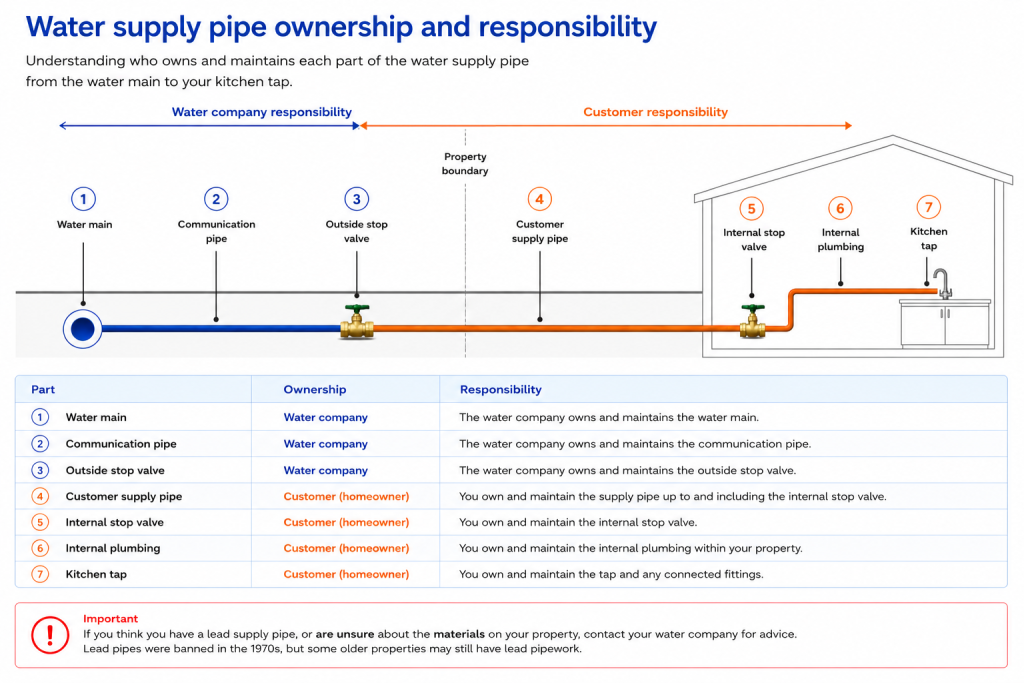
One of the reasons lead pipe replacement is so difficult is that the pipe carrying water into a home is not always owned by one party. The supply route crosses from the public water network into private property, and responsibility changes along the way.
In simple terms, Thames Water is responsible for the public water main and the communication pipe up to the outside stop valve. After that point, the private supply pipe and the internal plumbing are the responsibility of the property owner. Thames Water states that this split makes the public health outcome harder to achieve, because fixing the problem — including paying for the work — is divided between the water company and the customer.[5]
For homeowners, the most important distinction is between the communication pipe and the private supply pipe. The communication pipe is the section on the water-company side. The private supply pipe is the section that carries water from the boundary area into the property. In older London homes, either section may contain lead.
This matters because replacing only one side may not remove the whole risk. If Thames Water replaces a lead communication pipe but the private supply pipe remains lead, drinking water may still pass through lead before it reaches the tap. Equally, if a homeowner replaces their private supply pipe but a lead communication pipe remains on the company side, the risk may not be fully resolved until that section is also addressed.
Thames Water already recognises this as a major challenge. It says its AMP8 work will replace lead communication pipes, but customer-owned supply pipes are a separate issue. Its customer trial is designed to test how education, support and possible financial assistance could help customers remove lead pipework on their side of the boundary.
That is why lead pipe replacement is not simply a matter of waiting for Thames Water to replace everything. Thames Water has a role, but so does the property owner. In many London homes, the section most likely to need action may be underground, under a front garden, beneath a driveway, inside a cellar, or entering the property near the internal stop tap.
The practical question is therefore: where does Thames Water’s responsibility end, and where does the homeowner’s responsibility begin? Until that boundary is understood, homeowners may assume the entire supply pipe is Thames Water’s responsibility when part of it is actually private. That misunderstanding can delay replacement and leave lead pipework in contact with drinking water for longer than necessary.
For London homeowners, the safest approach is to identify the material of the incoming supply pipe and establish which side of the boundary any lead pipework sits on. If lead is present on the private side, it will usually need to be dealt with by the property owner, often with help from an approved plumber. If lead is present on Thames Water’s side, the issue may need to be coordinated with Thames Water so both sides of the supply route are considered together
What Thames Water is legally required to do
The replacement programme described in Thames Water’s investment case is not a voluntary corporate commitment. It is a statutory undertaking given to the Drinking Water Inspectorate under section 19(1)(b) of the Water Industry Act 1991, and the distinction matters for how much weight the published targets carry.
The sequence began on 20 October 2023, when the Inspectorate notified Thames Water that the Secretary of State was considering making an enforcement order against the company under section 18 of the Act. The Inspectorate’s stated basis was that Thames Water was supplying water from multiple assets which may be at risk of exceeding the standards for lead, and was therefore likely to contravene its duty under section 68(1)(a) of the Act and regulation 4(2)(c) of the Water Supply (Water Quality) Regulations 2016.[3,7]
Thames Water gave an undertaking on 20 May 2024 setting out the steps it would take and the dates by which it would take them. The Inspectorate accepted it, and the undertaking was reissued as version 2 on 10 February 2026 under reference TMS-2023-00013.[3]
The commitments it contains include:
- Continuing the proactive lead pipe replacement programme, targeting 54,000 lead communication pipe replacements, by 31 March 2030
- Proactively replacing company-owned lead pipework wherever lead is detected at or above 5µg/L in regulatory or operational samples at customers’ taps, and engaging the property owner to replace their external and internal pipework
- Designing and delivering consumer trials to test incentives that encourage owners to replace their own lead pipework, with trial design complete by 31 December 2025 and delivery by 31 March 2030
- Reviewing and confirming the number of schools and other high-risk buildings in the supply area, and implementing a strategy to reduce lead risk in schools and early years settings, by 31 December 2027
- Continuing to review and optimise orthophosphoric acid dosing as an interim risk mitigation measure
- Producing draft lead reduction plans for AMP9 demonstrating the required ramp-up in replacement rate, by 31 July 2027
Progress reports are due to the Inspectorate annually by 31 January, with enhanced lead monitoring for twelve months after any remedial work and a final report on the efficacy of the strategy by 30 April 2031.[3]
Three things follow from this that are not apparent from the company’s own publications.
The 54,000 figure is a regulatory milestone with a date attached, not an aspiration. So is the AMP9 ramp-up, which the company must set out in draft form more than two years before that period begins.
The 5µg/L response level is a requirement rather than an operational choice. Where a sample reaches that concentration, replacement of the company-owned pipework follows, and the company is obliged to approach the property owner about the rest.
And the Inspectorate itself characterises orthophosphoric acid dosing as interim risk mitigation. That is the regulator’s own language, in a binding instrument, describing chemical treatment as a holding measure rather than a solution.
How Thames Water compares with other companies
Thames Water is not acting alone, and it is not acting voluntarily. The undertaking described above is one of a set given by every water company in England within a few months of each other, and reading them side by side shows both the scale of the intervention and how differently companies have chosen to respond to it.
The Inspectorate issued section 18 enforcement notices on 20 October and 8 November 2023. Most undertakings followed between March and May 2024, with two later ones accepted in 2026, and almost all carry a completion date of 30 April 2031.[2] This was a coordinated national enforcement action on lead in drinking water, and it has attracted almost no public attention.
| Company | Reference | Undertaking given | Response level | Replacement commitment |
|---|---|---|---|---|
| Thames Water | TMS-2023-00013 v2 | 20 May 2024 | 5µg/L | 54,000 communication pipes by Mar 2030 |
| SES Water | SES-2023-00009 | 15 Mar 2024 | 5µg/L company pipe; 10µg/L customer pipe | Trigger-based, no volume target |
| Affinity Water | AFW-2023-00012 | 12 Apr 2024 | 5µg/L | Service pipes at trigger; no volume target |
| South East Water | SEW-2026-00001 | 10 Feb 2026 | 5µg/L | Full pipe survey; phosphate disengagement trial, 4,000 properties |
| Anglian Water | ANH-2023-00021 v3 | 14 Mar 2024 | 5µg/L | Approx. 3,980 by Mar 2030 |
| South West Water | SWB-2023-00013 | 5 Apr 2024 | Not stated in published notice | 20,000–50,000 by Mar 2030 |
| Wessex Water | WSX-2023-00004 | Not stated in published notice | Not stated in published notice | 6,000 by Mar 2030 |
| Southern Water | SRN-2023-00012 v2 | 1 May 2026 | Not stated in published notice | 1,800 by Mar 2030 |
| South Staffordshire Water | SST-2023-00007 | 29 Apr 2024 | 5µg/L | Pilot, approx. 1,200 in a single district metered area by Jun 2028 |
| Yorkshire Water | YKS-2023-00010 | Not stated in published notice | 7.5µg/L | Targeted areas, to property boundary, by Mar 2030 |
| Portsmouth Water | PRT-2023-00009 | 14 Mar 2024 | Not stated in published notice | 60 highest-risk schools and nurseries |
Fields marked as not stated were not present in the published acceptance notice at the time of writing rather than being absent from the undertaking itself.[2]
What the comparison shows
Response levels are not uniform. Most companies act at 5µg/L, but Yorkshire Water’s undertaking specifies 7.5µg/L.[2] SES Water operates a two-tier system: it replaces its own communication pipe above 5µg/L, and above 10µg/L it must also replace, or offer to replace, the customer’s supply pipe. That second tier is unusual and materially stronger than the norm, because it crosses the ownership boundary that defeats most replacement programmes.
Three different models are running at once. Some companies committed to volumes: Thames to 54,000 pipes, South West Water to between 20,000 and 50,000, Wessex to 6,000. Others committed to triggers with no volume target at all, replacing whatever the sampling finds. South East Water is doing something different again, surveying all company and service pipes to establish what is actually there, and running a phosphate disengagement trial across 4,000 properties to test what happens when corrosion control is withdrawn.
Schools are treated three different ways. Thames Water must review and confirm the number of schools and other high-risk buildings in its area and implement a strategy by 31 December 2027. SES Water must replace both its own and the customer’s pipework where lead is detected at schools, nurseries and childminders. Portsmouth Water has a programme covering the 60 highest-risk schools and nurseries in its supply area. Same regulator, same legal instrument, three different levels of obligation depending on which company supplies the school.
And several companies have been told to plan for elimination. A requirement to “produce a plan to achieve lead free drinking water supplies” appears in the SES Water and Dŵr Cymru undertakings, both due by 31 December 2027, and in South East Water’s, which must plan for lead-free supplies by 2050 with the plan submitted by 31 March 2030.[2] That is the Inspectorate requiring companies to work toward removal rather than management, in a binding instrument, well ahead of any change in the legal limit.
For a London or Surrey household, the practical consequence is that the response your water company is obliged to make depends on which company supplies you, and the wording of the trigger varies as well as the number.
Thames Water and Affinity Water are both obliged to act where lead is detected at or above 5µg/L. SES Water and South Staffordshire Water are worded differently, acting on detections greater than 5µg/L, so a result of exactly 5.0 falls outside the trigger as written. Yorkshire Water’s undertaking does not engage until 7.5µg/L.
A result of 5µg/L therefore obliges Thames Water and Affinity Water to replace their pipework. The same result places no obligation on Yorkshire Water at all, and sits on the boundary of the SES Water and South Staffordshire wording. None of this is visible to the customer receiving the result.
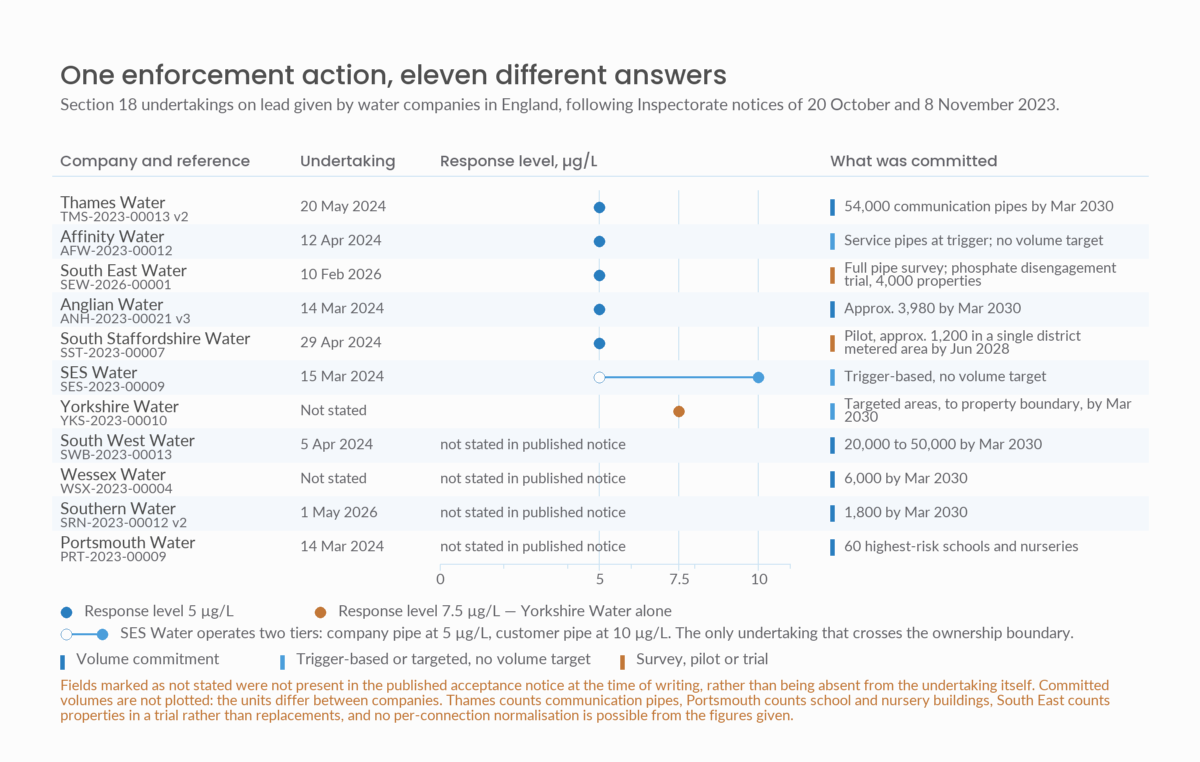
Figure 1. Almost all of these undertakings carry a completion date of 30 April 2031. Three different models are running at once: volume commitments, trigger-based replacement with no target, and survey or pilot work to establish what is there. Response levels are not uniform either. Committed volumes are not plotted because the units differ between companies. This was a coordinated national enforcement action on lead in drinking water.
Thames Water’s Position On Lead Pipe Replacement
Thames Water’s position is that lead pipe replacement must continue because lead pipework in contact with drinking water remains a public health risk. Its AMP8 plan treats lead control as a long-term programme, not a one-off repair issue, with replacement needed on both the water-company side and, eventually, the customer-owned side of the supply route.
The company’s immediate AMP8 proposal is to replace 54,000 lead communication pipes between 2025 and 2030. Most of that work is intended to be proactive and targeted, rather than simply waiting for failed samples or customer complaints. Thames Water says around 97% of those 54,000 replacements will be delivered through a targeted programme using open-cut and moling techniques, with replacement carried out up to the customer boundary.[5]
That is an important shift. A purely reactive approach would mean replacing lead communication pipes only after a water quality failure or when a customer has already replaced their own supply pipe. Thames Water accepts that this would not support the long-term public health outcome. The stated direction is therefore clear: identify likely lead pipework, prioritise higher-risk customers and continue removing lead communication pipes at scale.
But Thames Water also recognises that replacing its own pipework does not solve the whole problem. The private supply pipe and internal plumbing may still contain lead. That is why the AMP8 plan includes a customer trial, costed at £8.625 million, to test how customers can be educated, supported and potentially financially assisted to remove lead supply pipes on their side of the boundary.[5] The aim is to understand how lead pipework can be removed beyond Thames Water’s official responsibility, at least as far as the internal stop valve.
This is where Thames Water’s position becomes especially relevant for London homeowners. The company is not saying that water treatment alone is enough, or that lead pipework can simply be managed forever. Its long-term direction is replacement: removing the lead material from the drinking-water route so the risk is dealt with at source.
The Drinking Water Inspectorate takes the same broad view. Thames Water says the DWI considers the only long-term solution to be removing contact between lead pipework and drinking water, including the replacement or lining of lead supply pipes as well as the replacement of lead communication pipes.[1]
In practical terms, Thames Water’s position can be summed up simply: chemical treatment can reduce risk, sampling can identify failures, and targeted programmes can prioritise the worst areas — but the lasting solution is to remove the lead pipework itself. That is why lead pipe replacement is central to Thames Water’s long-term plan, and why homeowner-side pipework cannot be ignored
Why Chemical and Treatment Is Not Enough
Chemical treatment plays an important role in reducing lead risk, but it is not the same as removing the lead pipe. Thames Water has used orthophosphoric acid dosing since 1998 to reduce lead corrosion in the supply route.[5] The chemical mixes with the water and, when it meets lead pipework, helps form a protective layer inside the pipe. That can reduce lead corrosion, shedding and ingestion — but the lead pipe itself remains in place.
That is the central limitation. Chemical dosing manages the problem; it does not remove the source of the problem. If a communication pipe, private supply pipe or internal pipework is still made of lead, drinking water is still relying on a protective treatment process rather than a lead-free route to the tap.
Thames Water is clear that this type of operational measure is only a short- to medium-term form of mitigation. It can help reduce the amount of lead entering drinking water, but it cannot deliver the long-term public health outcome on its own. The long-term solution is to remove or replace the lead pipework that comes into contact with drinking water.
There is also a practical problem: chemical mitigation is reaching its limit. Thames Water says an assessment by WRc found that orthophosphoric acid is approaching the limit of protection as a mitigation method.[4] If the lead standard is tightened from the current 10 micrograms per litre towards 5 micrograms per litre or lower, chemical dosing alone may struggle to guarantee compliance at the customer’s tap.
The cost and sustainability of chemical dosing also matter. Thames Water says orthophosphoric acid is already expensive, with around £11 million spent each year, and the raw phosphate material used to make it is finite.[5] As costs rise and regulatory expectations tighten, relying indefinitely on chemical dosing becomes less attractive than removing the material that creates the risk in the first place.
This is why replacement matters. A treated lead pipe is still a lead pipe. Chemical dosing can reduce the risk today, but it leaves London dependent on ongoing treatment, monitoring and maintenance. Replacement changes the situation more fundamentally: it removes the lead from the drinking-water route.
For homeowners, the distinction is important. A property may benefit from Thames Water’s wider treatment controls, but that does not mean its own supply pipe is lead-free. If the private supply pipe or internal plumbing still contains lead, the long-term answer is not to assume chemical treatment has solved it. The long-term answer is to identify the lead pipework and replace it
The Scale of London's Lead Pipe Replacement Challenge
The scale of lead pipe replacement in London is difficult to overstate. Thames Water’s PR24 planning estimated that around 1.15 million lead communication pipe connections would remain at the end of AMP7 in March 2025. That figure only covers the company-side communication pipes. It does not include the unknown number of customer-owned supply pipes, internal lead plumbing, lead solder or lead fittings that may still exist on the private side of the boundary.
This means the visible programme is only part of the problem. Replacing Thames Water’s communication pipes is essential, but it does not automatically create a lead-free route all the way to the kitchen tap. If the private supply pipe or internal plumbing remains lead, the public health risk can continue even after company-side work has been completed.
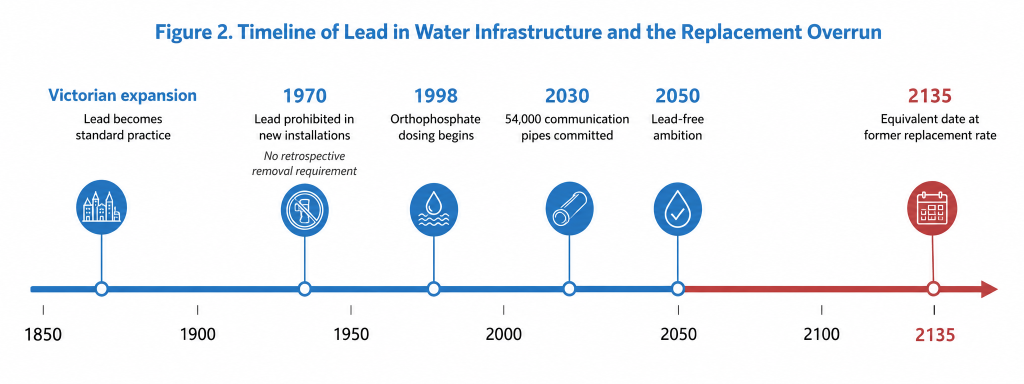
Thames Water’s current AMP8 plan proposes replacing 54,000 lead communication pipes between 2025 and 2030. That is a significant programme, but it also shows the size of the gap. At a replacement rate of around 54,000 pipes per AMP, Thames Water says it would take until approximately 2135 to replace all lead communication pipes[5] — far beyond the 2050 ambition for a lead-free network. That figure is not the plan; it is the reason for the plan. Thames Water’s chosen pathway holds the current rate through AMP8, then steps the programme up in AMP9 and again in AMP10, reaching roughly 315,000 replacements per five-year period and hitting zero by 2050.[5] AMP8 is deliberately the slow part of the curve — the period in which the customer-side problem is meant to be solved before the volume arrives.
The cost is equally large. Thames Water puts the AMP8 lead control programme at around £94.1 million, including communication pipe replacement and a customer-side trial. Its longer-term plan to remove all lead communication pipes by 2050 is estimated at approximately £1.832 billion across AMP8 to AMP12.[5] Crucially, that figure excludes the full post-AMP9 cost of replacing customer-side lead supply pipes, which Thames Water says means the overall cost could easily double.
London also makes the work harder. Replacing buried water pipes is disruptive anywhere, but London adds extra pressure: dense streets, traffic management, restricted working areas, red routes, higher labour costs, access issues, and the need to coordinate works around homes, businesses and public roads. Thames Water specifically identifies increasing streetworks costs, especially in London and on red routes, as one of the cost drivers behind the investment challenge.[5]
There is also the problem of finding the pipes in the first place. Thames Water uses modelling, sampling data and targeting to identify where lead communication pipes are likely to be present, but the picture is incomplete. The customer-owned side is even harder, because the condition and material of private supply pipes often depends on the history of each individual property. Two similar houses on the same street may have completely different pipework depending on past repairs, renovations or replacements.
Scaling up too quickly also creates risks. Thames Water says a major step-up in replacement will be needed to meet the 2050 ambition, but the programme depends on contractor capacity, better mapping, customer-side solutions, new technology and a clearer approach to funding private-side replacement. Without those pieces in place, there is a risk of repeated visits, wasted disruption and inefficient work where only part of the supply route is replaced.
That is why the London replacement challenge is not simply about digging up and replacing old pipes. It is a long-term coordination problem involving Thames Water, regulators, contractors, local authorities, homeowners and approved plumbers. The company-side programme matters, but the full public health benefit depends on solving the harder question: how to remove lead from the whole route into the home, including the private pipework that Thames Water does not currently own.
Why Older London Homes are High Priority
Older London homes are high priority because lead pipework is tied directly to the age of the property and the history of its water supply. Lead was widely used for the pipes connecting properties to the treated water network, as well as for internal plumbing, until it was banned for this purpose in 1970. That means homes built before 1970 deserve particular attention, especially if the incoming supply pipe has never been checked or replaced.
This does not mean every older property has lead pipes. Many homes have had pipework replaced during renovations, extensions, leak repairs or water supply upgrades. But property age is still one of the clearest warning signs. A Victorian terrace, an Edwardian house, an inter-war semi, a converted flat or an older mixed-use building is more likely to have had lead somewhere in the original supply route than a modern property built after lead pipework was banned.
The problem is that water supply pipes are often not upgraded at the same time as visible plumbing. A house may have a new kitchen, modern bathrooms and copper or plastic pipework indoors, while the original incoming supply pipe remains buried under the front path, driveway, basement floor or pavement connection. From the homeowner’s point of view, the property may look fully modernised. From a water supply point of view, part of the route may still be decades old.
Thames Water’s own targeting approach reflects this. Its AMP8 lead replacement plan refers to focusing targeted communication pipe replacement on older housing / building stock and higher-risk customers, including areas with a greater concentration of families with young children.[5] In its recent AMP strategy table, Thames Water also describes the proposed AMP8 approach as targeting higher-risk customers in homes and other properties based on property age and the likelihood of lead pipes being present.
That is an important distinction. The aim is not to create panic about older homes. The aim is to prioritise checks where the chance of finding lead pipework is higher. Property age is not proof, but it is a sensible starting point. If a home was built before 1970 and there is no record of the supply pipe being replaced, the incoming pipe should be treated as unknown until confirmed.
Older flats and conversions can be especially complicated. A converted Victorian or Edwardian building may have shared supply arrangements, altered internal layouts, basement pipe runs or partial replacement work carried out over many years. One section may have been modernised while another remains original. This is why assuming “the plumbing was updated” is not enough. The material of the actual drinking-water supply route needs to be checked.
For homeowners, the priority is simple: older property, unknown supply pipe, no replacement record — check it. The older the building, the more important it becomes to confirm what material carries water from the boundary into the property and onward to the tap. Where lead is found, the long-term answer is replacement, not reassurance based on the age of the kitchen, bathroom or visible pipework.
What Homeowners Should Do Now
For London homeowners, the first step is not to assume that the water supply is lead-free simply because the kitchen, bathroom or visible plumbing has been modernised. The important question is whether the pipe carrying drinking water into the property has ever been checked or replaced.
Start with the age of the property. If the home was built before 1970, lead pipework is more likely to be present, especially if there is no record of the incoming supply pipe being replaced. Official drinking water guidance says homes built before 1970 may have lead pipes, while homes built after 1970 are unlikely to have them.[6]
The next step is to find the internal stop tap, usually where the water first enters the property. In many London homes this may be under the kitchen sink, in a downstairs toilet, in a hallway cupboard, in a cellar, or close to the front of the property. The pipe connected to that stop tap is often the best visible clue to the material of the incoming supply.
Lead pipe is usually dull grey, soft, and may have a swollen joint near the stop tap. If gently scraped with a coin, it can show a shiny silver-coloured surface underneath. This should be done carefully, with disposable gloves, and without creating dust or damaging the pipe. Other materials look different: copper is harder and brownish, iron is dark and very hard, and plastic is often blue, black or grey.
A visual check is useful, but it is not the same as a proper inspection. Some lead pipework is hidden underground, boxed in, buried under floors, or located before the pipe enters the property. A homeowner may only be able to see the final section of pipe, not the whole route from the boundary to the tap.
If lead is suspected, the next step should be confirmation. That may mean asking Thames Water about testing at the kitchen tap, checking whether there are records of previous replacement, or arranging an inspection by a qualified plumber. Official guidance says customers who suspect lead pipes can ask their water company to test the water at the kitchen tap.[6]
Homeowners should also be careful before carrying out building or plumbing work around old pipework. Disturbing lead pipes can temporarily increase lead levels in drinking water. If work has been carried out on lead pipework, official guidance says the tap should be flushed well afterwards.[6]
While waiting for inspection or replacement, short-term precautions can reduce exposure. Water that has been standing in pipework for several hours, such as overnight, should be cleared before being used for drinking or cooking. Running the cold kitchen tap until fresh mains water comes through can help clear standing water from the pipe. But this is only a short-term measure. If lead pipework is present, it should be replaced as soon as possible.
The ownership boundary is important. Thames Water is responsible for the communication pipe on the water-company side, while the private supply pipe and internal plumbing are the property owner’s responsibility. Thames Water recognises that this split makes the public health outcome harder to achieve, because lead can remain on the customer side even after company-side work has been completed.
That means homeowners should not wait passively for a wider replacement programme to solve everything. If the private supply pipe is lead, it is usually the property owner’s problem to resolve. If Thames Water’s communication pipe is also lead, replacement may need to be coordinated so that both sides of the supply route are considered together.
For flats, converted houses and shared supplies, the position can be more complicated. The pipe may pass through communal areas, shared service routes, basements, front gardens or parts of the building controlled by a freeholder or managing agent. In those cases, homeowners and leaseholders may need to involve the landlord, freeholder, managing agent or neighbouring owners before replacement work can be planned.
The practical message is simple: check the age of the property, inspect the incoming pipe where it is visible, do not rely on appearance alone, and get professional confirmation if there is any doubt. If lead is found in the private supply pipe or internal plumbing, the long-term answer is replacement. Short-term flushing and testing can help manage the risk, but they do not remove the source.
How Approved Plumbers Support Lead Pipe Replacement
Approved plumbers are important because much of the lead pipe problem sits on the customer side of the boundary. Thames Water can replace its own communication pipe, but the private supply pipe and internal plumbing are usually the property owner’s responsibility. That is where a qualified plumber becomes essential.
The first job is identification. An approved plumber can inspect the incoming supply pipe, usually near the internal stop tap or where the water first enters the property, and assess whether the visible pipework is likely to be lead, copper, plastic, iron or another material. They can also look for signs that only part of the pipe route has been replaced, which is common in older London homes.
This matters because homeowners often only see the pipework inside the property. The most important section may be hidden underground, under a front path, below a basement floor, beneath a driveway or behind boxed-in finishes. A proper inspection helps establish what is visible, what is unknown, and where further investigation may be needed.
Where lead is confirmed on the private side, an approved plumber can advise on the replacement route. In some properties, this may involve an open trench. In others, moling or another trenchless method may be suitable, reducing the amount of excavation needed. The right method depends on the property layout, access, ground conditions, the position of the existing supply, and where the new pipe needs to enter the building.
Approved plumbers can also help homeowners understand the boundary between private work and Thames Water’s work. If the private supply pipe is lead and the communication pipe may also be lead, the best result usually comes from coordination. Replacing one side while leaving the other untouched can mean the drinking water route is still not fully lead-free.
A compliant private-side lead supply pipe replacement should also be planned with the Thames Water Lead Pipe Replacement Scheme in mind. Thames Water says that if a customer is replacing lead pipework, it can also replace any lead pipework that belongs to Thames Water, provided the customer qualifies and is responsible for the private pipework.[6] The scheme requires the customer to check their supply arrangements, meet the criteria, satisfy Water Regulation requirements, and either provide an accepted approved-plumber certificate or pass a Thames Water reconnection survey. Without a passed survey or certificate from an approved plumber, Thames Water says the customer cannot qualify.
That makes certification important. An approved plumber can issue a certificate for the work they have carried out, avoiding the need for an open-trench inspection by Thames Water, although the certificate still needs to be sent to Thames Water as part of the process. Thames Water also says the new pipework must meet specific Water Regulation requirements, including suitable pipe sizing, correct trench depth, an approved inside stop valve, insulation and ducting at the point of entry, and correct positioning in relation to the outside stop valve.[6]
For flats, conversions and shared supplies, the plumber’s role can be even more important. Older London buildings may have altered layouts from previous conversions, shared supply arrangements or unclear responsibility boundaries. Before replacement work starts, it may be necessary to confirm the supply arrangement, check whether other flats are affected, and establish whether a freeholder, managing agent or neighbouring owner needs to be involved.
The practical value of using an approved plumber is that the work is not treated as a generic plumbing repair. Lead supply pipe replacement affects drinking water quality, property ownership boundaries, excavation, reinstatement, water regulations, certification and Thames Water scheme eligibility. It needs to be planned properly, not patched around.
For London homeowners, the key message is simple: if the private supply pipe is lead, it should be replaced by someone who understands both the plumbing work and the wider Thames Water replacement process. Thames Water’s programme can address company-side pipework where the scheme criteria are met, but private-side replacement is where homeowners usually need direct professional support.
Moling is not a niche technique in this context — it is the default. Thames Water’s own programme expects moling to account for around 80% of its communication pipe replacements, on the grounds that it is the cheaper method.[5] A private-side replacement carried out the same way keeps the two halves of the job consistent, and keeps excavation to the minimum the ground conditions allow.
Conclusion: Lead Pipe Replacement is the Only Durable Solution
London’s lead pipe problem cannot be solved by reassurance, testing or chemical treatment alone. Those measures have a role, but they do not remove the source of the risk. If lead pipework is still carrying drinking water into a home, the underlying problem remains until that pipework is removed, replaced or taken out of contact with the supply.
That is why replacement matters. Thames Water says lead pipework in contact with drinking water presents a public health risk, and its long-term approach is built around removing lead material from the drinking-water route. Its AMP8 plan includes replacing 54,000 lead communication pipes and trialling ways to support customer-side lead supply pipe replacement.
For homeowners, the most important point is that Thames Water cannot usually replace the whole route to the tap on its own. The communication pipe may be Thames Water’s responsibility, but the private supply pipe and internal plumbing are normally the homeowner’s responsibility. If your property still has a lead private supply pipe, it should be replaced — not simply monitored, flushed or left for a future programme.
The good news is that homeowners replacing their private lead supply pipe may be able to use the Thames Water Lead Pipe Replacement Scheme. Thames Water says that if you are replacing lead pipework, it can also replace any lead pipework that belongs to Thames Water, provided you qualify and meet the scheme requirements. The scheme also makes certification important: if an approved plumber carries out the work, they can issue a certificate, and Thames Water says that without an accepted approved-plumber certificate or a passed reconnection survey, you cannot qualify.
That makes choosing the right contractor crucial. A lead supply pipe replacement is not just a plumbing job. It has to be planned around the property boundary, Water Regulation requirements, pipe sizing, trench depth, stop valves, Thames Water scheme rules, certification and, where needed, coordination with Thames Water’s own communication pipe replacement.
London & Surrey Water Services carry out private-side lead supply pipe replacement across London and Surrey. Our plumbers are CIPHE members and WaterSafe registered contractors, which means we can issue the approved-plumber certificate Thames Water requires — removing the need for an open-trench inspection — and coordinate your application through the Lead Pipe Replacement Scheme from survey to sign-off. We work with moling and trenchless installation, and with the practical realities of replacing supply pipes in older London properties: shared supplies, converted buildings, awkward access and unknown pipe runs.
If you suspect your home has a lead supply pipe, the next step is simple: get it checked, confirm the pipe material, and replace it if lead is present. Taking action now can help remove lead from your drinking-water route, support your Thames Water Lead Pipe Replacement Scheme application, and give you proper evidence that the private-side pipework has been upgraded correctly.
Contact London & Surrey Water Services today to arrange a lead pipe inspection or private supply pipe replacement, and make sure your Thames Water Lead Pipe Replacement Scheme application is supported by compliant, certified work.
Thames Water can replace the communication pipe. It cannot, on its own, take lead out of the private supply pipe or the internal run. Treatment reduces how much lead a pipe releases. It does not remove the pipe. Where lead remains on the customer side of the boundary, the source remains.
References
- Drinking Water Inspectorate. Guidance note: long-term planning for the quality of drinking water supplies. London: Drinking Water Inspectorate; 2022.
- Drinking Water Inspectorate. AMP8 lead strategy undertakings: company improvement programmes. Section 19(1)(b) undertakings: Affinity Water AFW-2023-00012; Anglian Water ANH-2023-00021 v3; Portsmouth Water PRT-2023-00009; SES Water SES-2023-00009; South East Water SEW-2026-00001; South Staffordshire Water SST-2023-00007; South West Water SWB-2023-00013; Southern Water SRN-2023-00012 v2; Wessex Water WSX-2023-00004; Yorkshire Water YKS-2023-00010. London: Drinking Water Inspectorate.
- Drinking Water Inspectorate. Thames Water Utilities Limited — AMP8 lead strategy. Undertaking under section 19(1)(b), Water Industry Act 1991. Reference TMS-2023-00013, version 2, accepted 10 February 2026. London: Drinking Water Inspectorate; 2026.
- Hulance J, Kowalski M, Fairhurst R. Long-term strategies to reduce lead exposure from drinking water. Report DWI14372.2. Swindon: WRc, for the Drinking Water Inspectorate; 2021.
- Thames Water. TMS22 enhancement case: long term water quality strategy — lead. PR24 business plan submission. Reading: Thames Water; 2023.
- Thames Water. Lead: water quality guidance; and Lead pipe replacement scheme. Customer guidance. Reading: Thames Water.
- The Water Supply (Water Quality) Regulations 2016, SI 2016/614.
Disclosure
This article is published by London & Surrey Water Services Ltd, a CIPHE member and WaterSafe registered contractor whose business includes lead pipe replacement. The company therefore has a commercial interest in the subject matter. The article is restricted to findings and positions reported in the sources cited, and no claim is made here that is not traceable to those sources. It is not medical advice. Readers concerned about lead exposure should speak to their GP, and readers concerned about lead in their own water supply should contact their water supplier or seek independent laboratory testing.